Ever felt like you're drowning in tech acronyms? "SaaS" gets tossed around in meetings, on landing pages, and in investor pitches, but it often feels like a password you don't know. Let's cut through the noise.
In plain English, Software as a Service (SaaS) is a way to deliver software over the internet. Instead of buying a clunky piece of software and installing it, you pay a subscription to access it through your browser. Think of it as renting a powerful tool instead of owning a complicated machine you have to maintain yourself.
It’s the reason you can use enterprise-grade software without a dedicated IT department.
Key Takeaways
Concept
The Practical Benefit
Subscription Model
Predictable OpEx rather than massive upfront CapEx.
Central Hosting
No local hardware to maintain; access from any browser.
Scalability
Add users or features with a few clicks, not server upgrades.
Maintenance
Provider handles all security, updates, and infrastructure.
What SaaS Actually Means (Without the Corporate Speak)
Let's be honest, the tech world loves its jargon, and "SaaS" is a classic. Founders, product managers, and marketing teams hear it constantly, but its core idea is surprisingly simple.
The best way to get it is with an analogy: think of subscribing to Netflix versus owning a massive collection of DVDs.
With a DVD collection, you had a huge upfront cost, you were responsible for storing all those plastic cases, and you were stuck with that version forever. If an updated director's cut came out, you had to go out and buy a whole new box set. It was a massive pain.
SaaS is the Netflix model for business software. Instead of that one-time purchase and all the headaches that come with it, you get:
Access anywhere, anytime: No more installations or worrying about compatibility. Just log in from any device with an internet connection and you're good to go.
A predictable subscription: You pay a simple monthly or annual fee, which is a lot easier on your company's cash flow than a massive one-time expense.
Constant, seamless updates: The provider handles all the maintenance, security patches, and new features behind the scenes. You always have the latest and greatest version without lifting a finger.
This isn't just a small technical shift—it’s a fundamental change in how modern businesses buy and use technology. It's why the global SaaS market, valued at $273.55 billion in 2023, is expected to grow to over $900 billion by 2032. This isn't just a trend; it's the new standard.
The core idea of SaaS is this: Stop buying software like a product and start using it like a utility. You pay for what you need, when you need it, and let someone else manage all the complex infrastructure.
This model is a massive equalizer. It gives small, scrappy teams access to the same powerful tools that were once reserved for massive corporations with huge IT budgets.
For anyone building a modern digital product, understanding this concept is the first real step. You can see how this plays out in the real world by checking out what a SaaS product looks like in action.
SaaS at a Glance
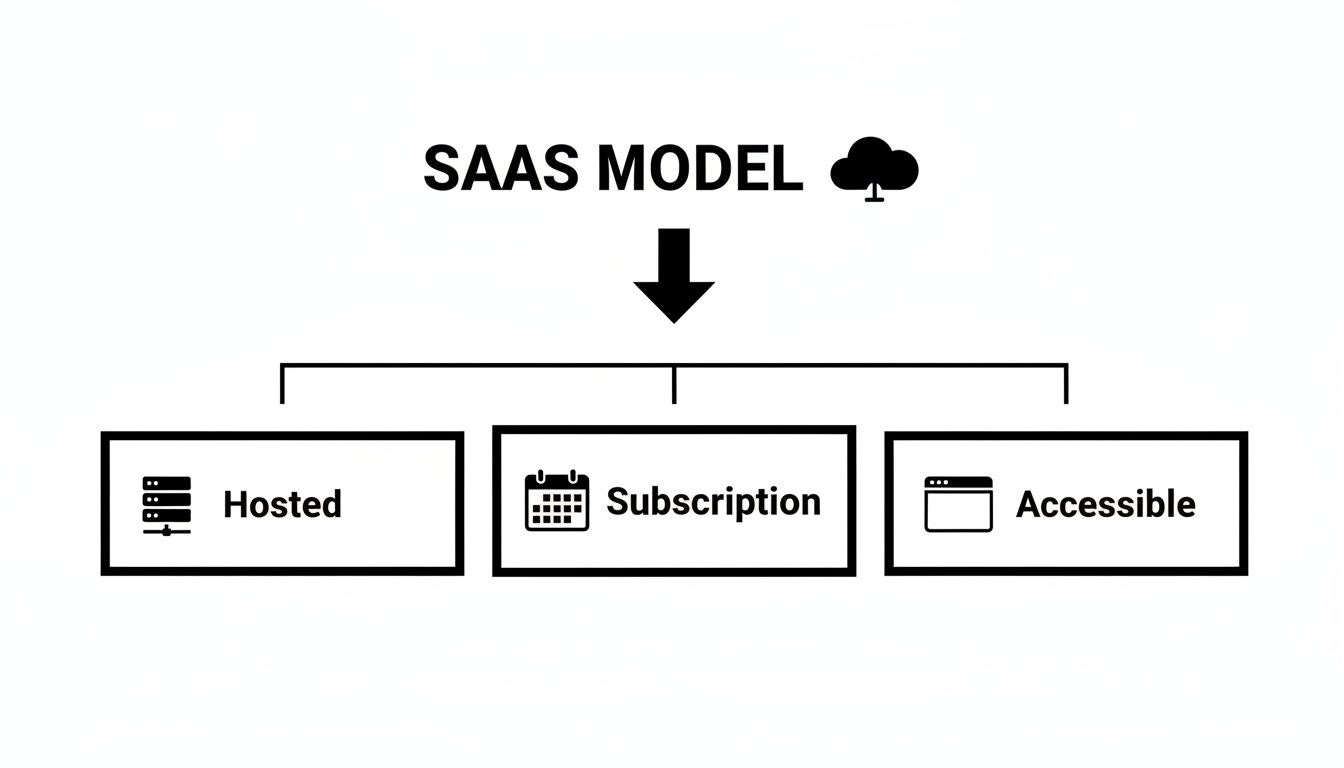
To quickly recap, here’s a simple table breaking down the core principles of the SaaS model. Think of this as your cheat sheet.
Characteristic
What It Means in Practice
Subscription-Based
You pay a recurring fee (monthly/annually) instead of a large one-time cost.
Centrally Hosted
The software lives on the provider's servers, not on your local machine.
Accessed via Internet
All you need is a web browser or a mobile app to log in and use it.
Automatic Updates
The provider handles all maintenance, security, and feature rollouts seamlessly.
Multi-Tenant Architecture
A single instance of the software serves multiple customers (tenants).
How SaaS Works Under the Hood
So, how does this whole "access anywhere" thing actually work? The technology behind SaaS is surprisingly elegant, and once you get it, you see why it's as much about operational efficiency as it is about user convenience.
The magic behind the curtain is a technical architecture called multi-tenancy.
The Apartment Analogy: Think of an apartment building. The building is a single, large structure with shared utilities—the plumbing, electricity, and security system serve everyone. Each resident, or "tenant," has their own private, secure apartment inside that shared structure. They get all the benefits of the building without having to worry about maintaining the foundation or fixing the roof.
SaaS works the same way. A single, powerful instance of the software runs on the provider's servers. Each customer is a "tenant," accessing that same core application, but their data is kept completely separate and secure in their own private space.
The Cloud as the Foundation
This entire apartment building has to sit on a piece of land, and in the tech world, that land is cloud infrastructure. This is where providers like Amazon Web Services (AWS), Google Cloud, or Microsoft Azure come in. They provide the raw computing power, storage, and networking that the SaaS application is built on.
The real beauty of multi-tenancy is in the updates. When the provider decides to upgrade the building’s plumbing, every single tenant benefits instantly and at the same time. No manual updates, no version conflicts—just seamless improvement for everyone.
This centralized approach is a massive advantage. Think about pushing a new feature or a critical security patch. In the old on-premise world, you'd have to update every single customer individually—a logistical nightmare that burns time and money. With a multi-tenant SaaS architecture, you update the core application once, and every user gets the new version the next time they log in.
Why This Matters to You
For founders and product managers, grasping this architecture reveals the model's true power. You're not just selling a piece of software; you're selling a service that is inherently efficient and built to scale from day one.
Effortless Scalability: Adding a new customer is as simple as creating a new "apartment" in your existing building.
Reduced Maintenance Overhead: Your team gets to focus on improving one core application, not troubleshooting hundreds of different installations.
Faster Innovation Cycles: All that newfound efficiency means you can ship updates and respond to market feedback much faster.
The Old Way Versus the New Way of Software
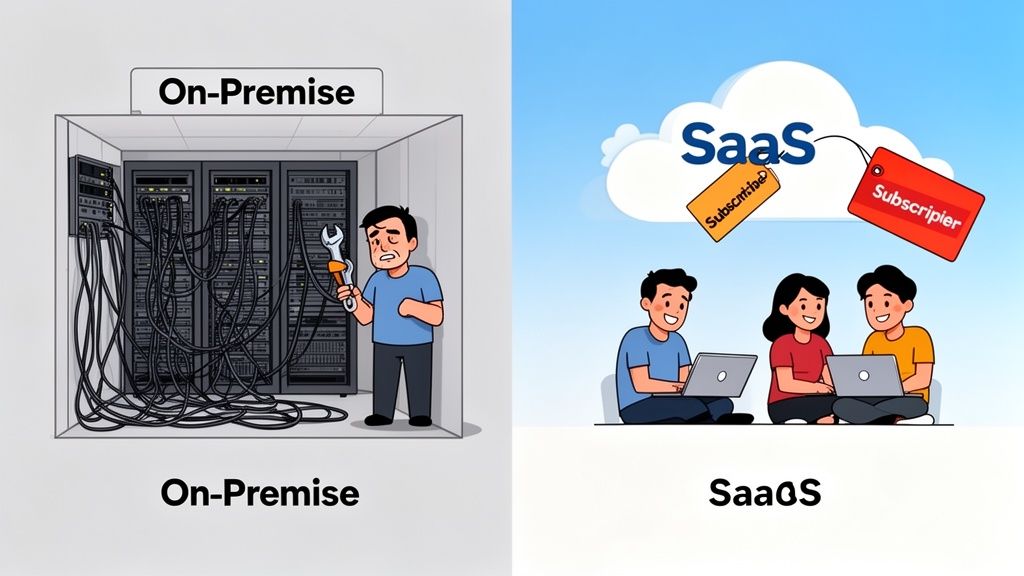
Remember the old days of software? You’d drive to a store, grab a big box off the shelf, and come home with a stack of floppy disks (or later, a CD-ROM) and a manual the size of a phone book. That was the “on-premise” model, and for a long, long time, it was the only game in town.
This old approach felt like a massive commitment because, well, it was. It meant huge upfront license fees, dedicated servers humming away in a dusty closet, and an IT team on speed dial just to keep the lights on.
SaaS flipped this entire model on its head. It wasn't just a technical upgrade; it was a completely different philosophy. It shifted the burden of ownership from you, the user, back to the provider.
SaaS vs On-Premise: A Head-to-Head Comparison
Factor
SaaS (Software as a Service)
On-Premise Software
Cost Structure
Predictable, low monthly or annual fee (OpEx).
Massive one-time license fee (CapEx).
Deployment
Instant via browser login.
Long, complex hardware & software setup.
Maintenance
Zero. Provider handles everything.
Constant. Internal IT team is responsible.
Scalability
Effortless clicks.
Difficult; requires new hardware/licenses.
Accessibility
Anywhere with an internet connection.
Limited to pre-configured local machines.
For founders and marketers, this comparison is a powerful storytelling tool. You can frame your product as the smarter, more efficient way to solve a problem. It’s a compelling narrative that resonates because it directly addresses the deep-seated pain points of the old way. You can see how our framework for AI-powered video creation helps articulate this value clearly and quickly.
Real-World SaaS Examples You Use Daily
The term "SaaS" can feel a little abstract and technical, but chances are you’re already using it every single day. The whole idea clicks when you see it in action.
For Keeping Your Team in Sync
Asana & Trello: These platforms turn project chaos into clean, organized workflows in the cloud.
Slack: The central nervous system for countless teams, connecting to dozens of other SaaS tools seamlessly.
For Unleashing Creativity
SaaS is a force for accessibility, removing the old barriers of high cost and technical complexity.
Figma & Canva: Both moved the entire design world into the browser. Figma lets teams collaborate on app designs in real-time, while Canva empowers non-designers.
For Connecting and Selling
Zoom: The definitive example of communication delivered as a service.
Salesforce: A true pioneer, offering a massive CRM platform entirely through the cloud. Salesforce connects sales, service, and marketing tools.
The Real Trade-Offs of the SaaS Model
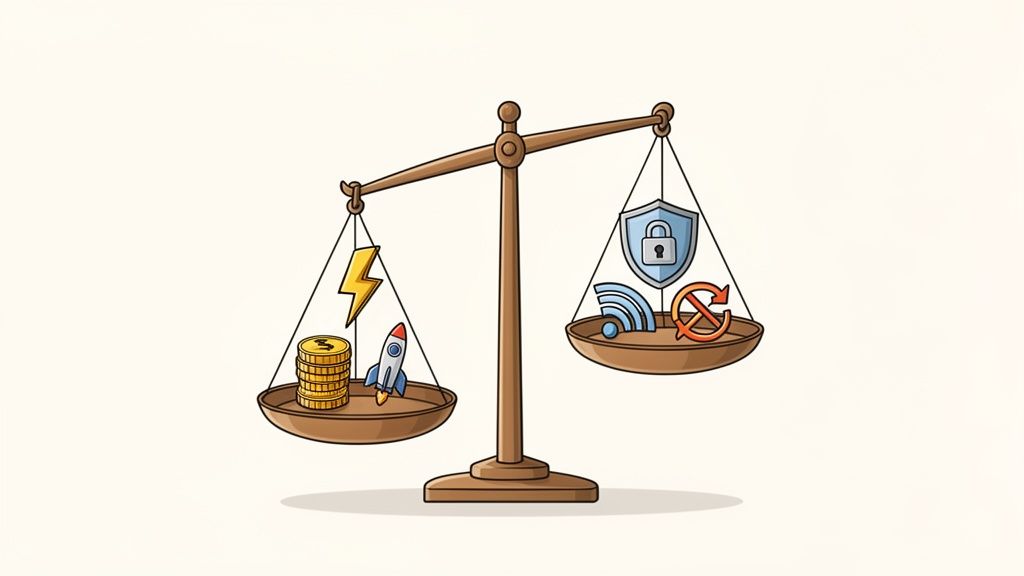
Let's be honest—no business model is a silver bullet. When you go with SaaS, you're swapping total control for speed and convenience.
The Upside: Incredible Scalability and Predictability
Predictable Recurring Revenue: Stable, forecastable revenue streams for financial planning.
Lower Entry Cost: Small, manageable subscriptions demolish barriers to entry.
Faster Deployment: Instant access for customers and automatic updates for everyone.
The Downside: The Real-World Challenges
The biggest challenge by far is the relentless fight against customer churn.
The subscription model is a double-edged sword. It gives you predictable revenue, but it also forces you to re-earn your customer's business every single billing cycle.
Reliance on Connectivity: No internet means no product access.
Data Security: You are the custodian of your customers' data, demanding massive investment in trust and compliance. Many SaaS companies rely on sharp guides for making training videos to onboard users and fight churn.
Explaining Your SaaS Value Without the Fluff
Knowing what SaaS means is one thing. Explaining the value of your own SaaS product? That’s a completely different beast.
The default move is usually a messy, unscripted screen recording (the "DIY Trap") or hiring a big-name agency (the "Agency Drain"). But there’s a better way: structured clarity.
Stop Listing, Start Solving
Nobody buys features. They buy solutions to their most painful problems. Your job is to connect your software directly to the outcome your customer desperately wants.
The goal is to communicate value, not complexity. Clarity beats high-production fluff every single time.
A Few Common Questions About SaaS
What Is the Difference Between SaaS, PaaS, and IaaS?
Let's use a pizza analogy to make everything clearer:
IaaS (Infrastructure): Renting a professional kitchen. You have the oven, but you bring the ingredients and make the pizza from scratch.
PaaS (Platform): Take-and-bake pizza. The dough and sauce are prepared; you just add toppings and bake it.
SaaS (Software): A fully cooked pizza delivered right to your door. Ready to use immediately.
Is SaaS Secure for Sensitive Business Data?
Absolutely. Reputable providers invest huge amounts into security (SOC 2, GDPR). However, security is a shared responsibility—your business must still enforce strong password policies and 2FA.
How Do SaaS Companies Make Money?
Tiered Pricing: Basic, Pro, and Enterprise plans.
Per-User Pricing: Costs scale with team size.
Usage-Based: Tied to data storage, API calls, or contacts.
Explaining your SaaS product’s value clearly is the first step toward winning customers. Forgeclips provides a framework-based approach to create structured, high-performing demo videos that convert—without the cost and delays of traditional agencies. See how it works at https://forgeclips.com.