What exactly is a SaaS explainer video?
It's your product's elevator pitch, refined for clarity and impact. An explainer is a short video, typically 60-90 seconds, that explains what your software does, who it’s for, and the value it delivers. It's not a feature walkthrough; it's a focused story designed to turn a confused visitor into an interested prospect, fast.
Why Your SaaS Needs an Explainer Video
Explaining complex software with text and screenshots is an uphill battle. Prospects rarely have the patience to read long feature lists or connect abstract benefits to their real-world problems.
Your product could be a game-changer, but if a potential customer lands on your site and can't grasp its value in under two minutes, they're gone. This is the exact problem a great SaaS explainer video solves.
Think of an explainer video as your most efficient salesperson. It works 24/7 on your homepage, in ad campaigns, and in sales emails, delivering a perfect, consistent pitch every time. It doesn't just list what your product has; it frames those features within a story of a problem and its solution, making your value instantly clear.
The Business Impact of Clarity
A well-crafted video is a strategic tool that moves the needle on key growth metrics. For SaaS founders, the path from curiosity to conversion is paved with understanding.
A clear explainer video drives real results by:
- Increasing conversion rates. It bridges the gap between a visitor’s pain point and your software’s solution, making a trial signup or demo request a logical next step.
- Building trust. Professional communication signals a well-thought-out product. It shows you understand your customer's challenges.
- Reducing bounce rates. An engaging video holds attention far longer than a wall of text, giving you more time to prove your value.
- Improving sales efficiency. It arms your sales team with a consistent asset that educates prospects before a call, leading to more productive conversations.
The data backs this up. A staggering 96% of people report watching an explainer video to learn more about a product. Even better, 85% have been convinced to make a purchase after watching a brand's video, solidifying its role as a critical step before conversion.
These videos are effective, which is why they have become the second most common type of marketing video created worldwide. If you want to dive deeper, Wyzowl’s research offers more video marketing statistics and insights.
Ultimately, a strong explainer video transforms your abstract software into a tangible solution. It's the fastest way to guide a potential user from "What does this do?" to "I need this." Seeing examples of high-performing SaaS explainer videos can show you what this looks like in practice.
The Blueprint for a High-Converting Explainer Video
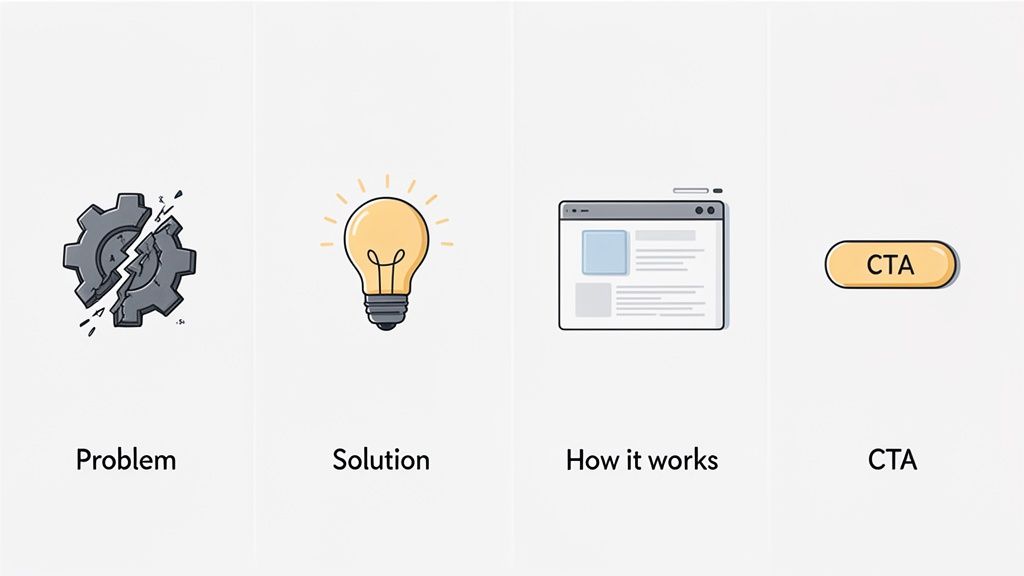
A great SaaS explainer video isn’t just a montage of features. It’s a strategic narrative where every scene builds on the last to tell a persuasive story. The videos that drive sign-ups almost always follow a proven four-part structure designed for busy B2B buyers.

Getting this sequence right is what separates a video that just gets views from one that gets you customers.
1. Start with the Customer's Problem
Before you mention your product, you have to earn your viewer's attention. The fastest way is to start with a pain point they know well. Describe the frustrating, inefficient, or costly problem your ideal customer faces daily.
This approach shows you understand their reality. When a prospect sees their struggle reflected on screen, they lean in. That immediate connection makes them want to hear what you have to say next.
Skip this, and you're just another product pitch they'll ignore. Nail the problem, and you’ve captured their attention.
2. Introduce Your SaaS as the Solution
Once you've set the stage, it's time to introduce your SaaS as the clear, obvious answer to the pain you just outlined.
This is the pivot point. Resist the urge to list features. Instead, frame your product as the specific fix for the problem. Land a single, powerful value proposition that sums up how your tool resolves their conflict.
For example, instead of a dry line like, "Our product has automated reporting," try a benefit-driven statement: "Stop wasting hours building reports and get instant insights." This small shift connects a feature to the outcome, making the value tangible.
3. Show Exactly How It Works
This is where you move from promise to proof. After positioning your solution, you need to show how it delivers. This isn't a full tutorial; it's just enough to make them believe.
Zero in on the "aha!" moment. Showcase 2-3 core actions in your UI that directly solve the problem from the intro. The goal is to make your software feel intuitive and real. This visual evidence builds trust and helps the viewer mentally picture themselves using your tool with ease.
This part of your video can often be expanded into a more detailed product demo video for leads further down the funnel. But for an explainer, keep it tight and focused on the core value.
4. End with a Clear Call to Action
You’ve done the hard work. Now, tell them exactly what to do next. A video without a clear Call to Action (CTA) is a missed opportunity. Don’t assume they’ll figure it out.
Your CTA should be direct, simple, and tied to your business goal. Common SaaS CTAs include:
- Start Your Free Trial
- Book a Demo Today
- Sign Up for Free
Wrap up your video by hitting that main benefit one last time, then present the CTA. Make it impossible to miss, both in the voiceover and with on-screen text. This clarity removes friction and makes it simple for an interested viewer to take the next step.
Common Approaches (Without Judgment)
Once you have a solid script, you face a strategic choice with real tradeoffs in time, money, and quality. You have three traditional paths to choose from. Each can be the right move depending on your company's stage, budget, and timeline.
Agencies
Hiring a video production agency is the classic, high-end option. You pay for a team to handle everything: script polishing, storyboards, animation, and voice-over. They bring strategic know-how and a crew of specialists.
This path makes sense for well-funded companies that need a polished, custom video for a major campaign. The biggest benefit is the professional quality and strategic guidance you receive.
However, that quality comes at a price. A good animated explainer from a reputable agency usually starts in the $5,000 to $15,000 range and can go much higher. The timeline is also significant, typically 4 to 8 weeks from start to finish.
Freelancers
A more flexible and budget-friendly path is to assemble a team of freelancers. You might hire a scriptwriter, a motion designer, and a voice-over artist, managing them yourself. This gives you direct creative control and can produce great results.
Going with freelancers works well if you have a clear vision and someone on your team who can act as the producer. The catch is that you are responsible for coordinating everything-juggling timelines, giving feedback, and ensuring all the pieces fit together. That management overhead is a real hidden cost.
DIY / Template Tools
At the other end of the spectrum are do-it-yourself video tools like Canva or template-based platforms. These options are fast and inexpensive, letting you create a video in a few hours for a small subscription fee.
This route is good for quick social media clips or internal videos where speed is the main priority. For a core marketing asset like a SaaS explainer video, however, DIY tools often miss the mark. They lack the built-in narrative structure needed to persuade and convert. The final video can look generic and fail to build trust.
Cost & Time Reality Check
Every founder wrestles with two finite resources: time and capital. A custom SaaS explainer video is a real investment. The weeks or months spent in a traditional production cycle come with a huge opportunity cost.
That's time you're not spending on distribution, testing your message, or learning what your audience wants. For a startup, that delay can be the difference between finding traction and stalling out. The invoice is only half the story; the real cost includes the hours your team pours into managing the project.
This decision tree helps frame the primary production paths most SaaS teams choose from.

The choice isn't just about what you can afford. It's a strategic decision balancing quality against your need for speed and control.
How Forgeclips Solves This
This is why a different approach is necessary for many founders. The goal should be to get 90-95% of a custom result for a fraction of the cost and time, freeing up resources for what really matters: distribution.
The economics of video production have shifted. Traditional custom animated explainers often run between $5,000 and $15,000, with high-end projects hitting $25,000–$75,000+. Today, AI-supported studios and hybrid systems bring professional SaaS explainers into a much more realistic price range of $500 to $5,000 per video. For a deeper dive, you can explore the new economics of AI-assisted video production.
A service like Forgeclips was built to solve this problem. We combine proven, conversion-focused video frameworks with rapid, AI-assisted production and a final human polish. This hybrid model delivers a professional SaaS explainer video in days, not months. This gives founders a polished, conversion-focused video without painful tradeoffs.
Example / Use Case
Imagine you run an early-stage SaaS that automates inventory management for e-commerce stores. An agency quotes you $8,000 and a 6-week timeline. A freelancer team costs $3,000 but requires 10-15 hours of your time for project management over three weeks.
Instead, you could use a streamlined service that offers a pre-built framework for product explainers. You provide your script and branding, and in less than a week, you receive a professional video for under $1,000.
The $7,000 and five weeks you saved can now be invested directly into LinkedIn and YouTube ad campaigns. You start getting real-world feedback on your messaging immediately, not two months later. This is the practical advantage of prioritizing distribution over prolonged production cycles.
Distribution-First Mindset
A brilliant video that no one sees has an ROI of zero. The conversation around video needs to shift from just creation to measurable impact.
The real advantage of an efficient production process is unlocking the budget and time for a robust distribution strategy, which is where growth happens. When production is fast and cost-effective, you can reallocate saved resources into getting your message in front of the right people.

Where Your SaaS Explainer Video Should Work
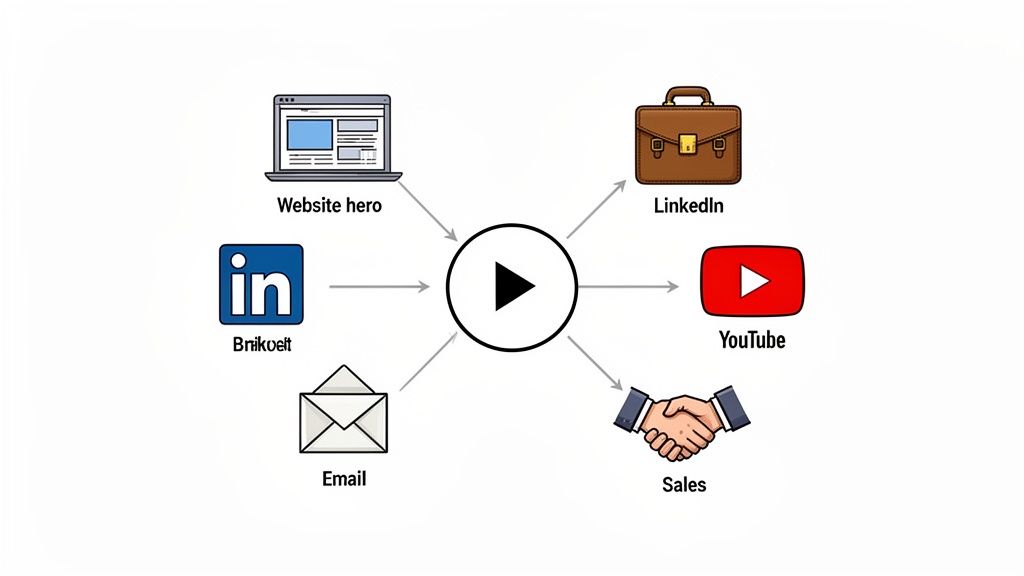
A single, well-made SaaS explainer video is incredibly versatile. It’s a tireless salesperson that can work for you across multiple channels, 24/7. Your goal is to get it in front of prospects at every relevant touchpoint.
Essential places for your video include:
- Your website hero section. This is your most valuable online real estate. An explainer video here immediately answers, “What does this do?” and is proven to boost engagement.
- Paid ad campaigns. A strong explainer is perfect creative for platforms like LinkedIn and YouTube. It grabs attention and communicates value quickly, making it a powerful tool for driving qualified traffic. You can find examples of how to structure video ads for YouTube campaigns to see this in action.
- Organic social content. Share your video on platforms like LinkedIn and Twitter to educate followers and drive them to your site. A concise video almost always performs better than text-only posts.
- Sales outreach and onboarding. Arm your sales team with the video to use in email sequences. It warms up cold leads and ensures prospects understand your product before a demo call.
Production speed enables testing, measurement, and optimization across multiple channels. This iterative loop is the real engine of growth, not a single “perfect” video.
Soft Call to Action
We've covered a clear, founder-focused path forward. A great SaaS explainer video creates clarity and builds trust. The production choice you make has strategic consequences, and a distribution-first mindset delivers ROI.
The right approach comes down to your company's stage and goals. You're not trying to make a perfect video; you're trying to find the most efficient tool for the job. The one that gets your message into the market quickly so you can start learning.
Find Your Most Efficient Path
Whether you choose an agency, a team of freelancers, or a modern hybrid service, the mission is the same: translate your product's value into a story that clicks with your audience.
For early and growth-stage founders, platforms like Forgeclips offer a practical alternative. You get the clarity and quality of a custom project without the traditional costs and painful delays. This approach frees up your time and budget to focus on distribution-the part that actually drives growth. We invite you to explore how a performance-focused video can fit into your strategy.
Your Top Questions, Answered
When diving into video for the first time, a few questions always come up. Here are straight, practical answers for founders figuring out their video strategy.
What’s the Perfect Length for a SaaS Explainer Video?
For top-of-funnel videos like your homepage hero or a social media ad, aim for 60-90 seconds. That’s the sweet spot. It’s enough time to grab attention, show the core value, and push them toward a call to action before they click away.
For middle-of-funnel content, like an in-depth feature demo, you can go longer, around 2-3 minutes. At this stage, your audience is already interested and looking for more detail. Match the video's length to the viewer's level of interest.
What Metrics Actually Matter?
The point of a SaaS explainer video is to drive action, so its success should be tied to growth.
Here are the KPIs to watch:
- Conversion Rate: Are people signing up, requesting demos, or starting trials from the page where your video lives? This tells you if it’s working.
- Audience Retention: How much of the video are people watching? Platforms like Wistia or YouTube provide this data, showing you where your message is hitting or falling flat.
- Play Rate: What percentage of visitors are hitting the play button? A low play rate might mean your thumbnail is weak or the video is placed too far down the page.
These three numbers give you a clear picture of whether your video is connecting with viewers and pushing them to the next step. A video's success is measured by its power to turn a curious visitor into a qualified lead or a paying customer.
How Often Should I Update My Explainer Video?
You need a new explainer video when your core value proposition, target customer, or UI changes significantly. Review it once a year to ensure it still tells the right story.
If you pivot, push a major update, or refresh your branding, a new video is non-negotiable. An outdated video erodes trust. This is where production speed makes all the difference. When you can iterate quickly, your marketing stays in sync with your product without huge costs or long waits.
Ready to create a professional SaaS explainer video that clarifies your product and converts visitors? Forgeclips uses proven frameworks and AI-assisted production to get you a high-quality video in days, not months.