You got a quote for that product video. One was a total gut-punch. The other seemed way too good to be true. Now you’re stuck, wondering why getting a simple, clear video for your software feels like a trip to a shady auto mechanic.
The truth is, a professionally produced video can range from $5,000 to $25,000, with bigger projects easily soaring past that. The real question isn't what it costs, but what you're actually paying for.
Why Is Getting a Straight Answer on Video Costs So Hard?
You've built a killer SaaS product. You know a sharp demo video would make your landing page sing. So you start asking around for quotes, and the numbers are all over the map. What gives?
The confusion comes from a broken, outdated model. Traditional agencies are built on layers of management, endless meetings, and bloated overhead. They’re great at selling you on "cinematic quality" when all you really need is clarity. They talk about "brand storytelling" when you just need to show users how to solve a problem.
The Real Numbers from the Agency World
Let's not dance around it. An old-school agency project often takes months and costs a fortune. These firms love billing at $100–$149 per hour.
For a standard 2-3 minute SaaS explainer, that could mean anywhere from $1,500 to over $8,000. Need actors or complex motion graphics? That number can jump to $20,000 or more in a heartbeat. It’s a pricing structure from a different era, designed for big brands with bottomless marketing budgets, not a SaaS founder or product manager who needed to prove ROI yesterday.
The problem isn't your budget; it's the agency business model. It prioritizes billable hours over efficient, clear communication. You end up paying for their slow process, not for the value you receive.
Setting a Realistic Baseline for SaaS Videos
So, what should you actually plan to spend? It depends on what you actually need.
A video’s job is to communicate value and drive action—not win an art award. For most SaaS companies, that means focusing on three things:
Clarity: Does the video clearly explain the problem and how your software fixes it?
Speed: Can you get it done in weeks, not half a year?
Performance: Will it actually help you get more sign-ups or slash support tickets?
By zeroing in on these goals, you can sidestep the "high-production fluff" that inflates costs. Instead of getting bogged down in creative debates, you can focus on building an asset that works.
To make this tangible, let's compare what you might pay. Traditional agencies still command high prices for custom work, but leaner hybrid models (like what we do at Forgeclips) offer a more direct path to high-quality video without the five-figure price tag.
Video Type
Traditional Agency Cost Range
Lean/Hybrid Model Cost Range
Typical Timeline
SaaS Explainer (2D)
$7,000 – $25,000+
$1,500 – $5,000
2-4 Weeks
Product Demo (UI-focused)
$5,000 – $15,000
$500 – $2,500
1-2 Weeks
Live-Action Testimonial
$8,000 – $20,000+
$3,000 – $7,000
4-8 Weeks
Social Media Ad (15-30s)
$2,500 – $10,000
$300 – $1,500
3-7 Days
As you can see, the right approach can make a huge difference. By choosing a workflow built for speed and clarity, you’re not just saving money—you’re getting a valuable marketing asset into the world faster.
Avoiding the Agency Drain and the DIY Trap
Why does getting a simple product video feel so broken? For most SaaS founders and product managers, you’re stuck between two equally frustrating paths. Each one promises a solution but winds up creating its own unique set of headaches that cost you time, money, and momentum.
The problem isn’t your budget or your video skills. It’s the outdated processes that define both approaches. Let’s be honest about the two bad options you’re likely facing.
The Agency Drain: A Slow, Expensive Process
First is the “Agency Drain.” You hire a traditional production company, drawn in by their slick portfolio and promises of cinematic magic. The kickoff meeting feels great. But it quickly devolves into endless check-ins, creative debates over scripts, and a bloated feedback loop that stretches for weeks—or even months.
They talk a big game about brand storytelling, but they often miss the point. They’re experts in making things look good, not necessarily in communicating how your software solves a specific, painful problem for a user.
You end up with:
Massive Bills: Costs can easily spiral into the $10,000-$25,000 range for a single video, full of line items for things you never knew you needed.
Wasted Time: The average agency project can drag on for months, delaying your launch or marketing campaign.
Misaligned Focus: The final video might be beautiful, but if it doesn’t clearly explain your value proposition in a way that converts, it’s a failed investment.
The agency model is built on billable hours, not efficiency. You pay for their process, their overhead, and their creative detours, which rarely align with a founder’s need for speed and ROI. It’s a system designed for a different era of marketing.
The DIY Trap: A Quick Path to Nowhere
On the other side is the “DIY Trap.” To cut video production costs, you decide to tackle it yourself. You subscribe to a few online tools, buy a generic template, or maybe even fire up some complex editing software you saw on YouTube. "How hard can it be?" you think.
You quickly find out.
You spend hours wrestling with confusing timelines, fighting buggy software, and trying to force a one-size-fits-all template to fit your unique product. You might explore some of the best AI video creation tools, but they often lack the polish and strategic direction needed for a compelling demo.
Weeks later, you have a video that looks… okay. But it feels cheap. The pacing is off, the message is muddy, and it fails to build the trust and credibility your SaaS product desperately needs. You saved money, but you wasted your most valuable asset: your time. The opportunity cost of spending weeks on a subpar video is immense.
Both paths lead to frustration. The Agency Drain is too slow and expensive. The DIY Trap is too inefficient and often produces a result that hurts your brand more than it helps. This leaves a massive gap for a third option—one that prioritizes structure and clarity over fluff or guesswork.
Where Your Money Actually Goes in Video Production
That five-figure quote you got for a video isn't just a number pulled from thin air. It represents a long list of services, talented people, and complex processes, each with its own line item. Understanding where that money is going is the first step toward controlling your video costs and avoiding wasteful spending.
Breaking down a production invoice can feel like trying to translate a foreign language. You’ll see terms like "pre-production," "B-roll," and "post-production" thrown around, but what do they actually mean for your budget? Let's demystify it.
The Three Phases of Production Costs
Every video project, whether it's a massive brand film or a simple SaaS demo, moves through three distinct phases. Agencies love to bill for each one separately, often padding them with their own overhead.
Pre-Production (20-25% of Budget): This is all the planning. It covers everything from brainstorming the core idea and writing the script to storyboarding, location scouting, and casting. For SaaS videos, this is the critical stage where your message is either nailed down or completely lost.
Production (50-60% of Budget): This is the actual filming or creation phase—lights, camera, action. The costs here include the film crew, cameras, lighting, sound gear, actors, and any location fees. It's almost always the most expensive part of the process.
Post-Production (20-25% of Budget): This is where all the raw pieces come together. Editing, sound design, adding motion graphics, color grading, and delivering the final files all happen here. This phase is notorious for hidden costs, especially when it comes to revisions.
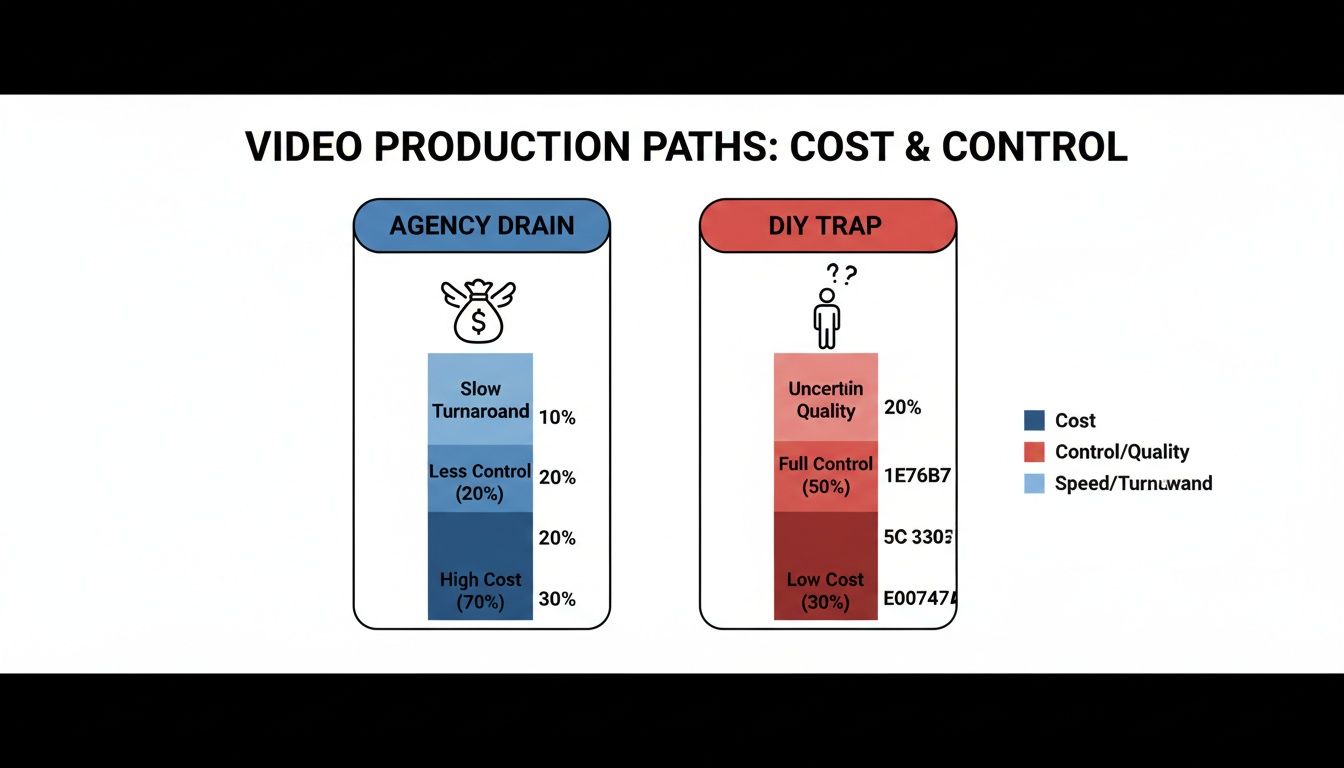
The infographic below shows how different paths—the expensive "Agency Drain" versus the frustrating "DIY Trap"—lead to wildly different outcomes for your money and your time.
This visual really gets to the heart of the frustration. The traditional agency model burns cash on overhead and coordination, while going it alone burns your most valuable resource—your time—with no guarantee of a good result.
Unpacking the Individual Cost Drivers
So, beyond those three big phases, what specific things really drive up the price?
Looking at the numbers, you'll see a lot of variation. A full-day shoot can run you anywhere from $750 to $5,000. Hiring talent adds another $150 to $2,500 per day, per person. Even something that seems simple, like a music track, can set you back $350 to $2,000. You can see how fast the expenses add up.
To give you a clearer picture, here’s how the budget for a typical SaaS explainer video often breaks down.
Video Production Cost Driver Analysis
Production Element
Percentage of Total Budget (Estimate)
Cost Impact
Concept & Scriptwriting
10-15%
High (Foundation of the video)
Storyboarding/Animatics
5-10%
Medium (Reduces costly errors later)
Crew & Equipment (Live-Action)
30-40%
Very High (The biggest single expense)
Talent/Actors
10-20%
High (Face of the video)
Animation/Motion Graphics
25-35%
Very High (Labor-intensive)
Editing & Color Grading
15-20%
High (Shapes the final story)
Voiceover & Sound Design
5-10%
Medium (Crucial for polish)
Music & Asset Licensing
2-5%
Low-Medium (Can spike if using pop music)
This table shows that the creative and human elements—scripting, talent, and animation or crew time—are where most of your money goes. Getting these right is key, but so is finding an efficient way to manage them. For an even more granular look at the editing phase, this essential budgeting guide on video editing costs is a fantastic resource.
The real cost of video isn't just the sum of its parts. It's the inefficiency of the process. Every unnecessary meeting, creative detour, and revision round adds to the bill without adding to the video's effectiveness.
The Hidden Fees Agencies Rarely Mention
That initial quote you get is often just the beginning. A number of "hidden" fees can pop up and inflate your video production costs if you aren't watching closely. Knowing what to look for helps you negotiate a better deal from the start.
Common Hidden Costs to Watch For:
Excessive Revision Rounds: Most agency contracts only include one or two rounds of feedback. Anything more is billed at a steep hourly rate. This is probably the single biggest cause of budget overruns.
Music and Asset Licensing: A great soundtrack isn't free. Licensing a popular song can cost a fortune, and even "royalty-free" music libraries have subscription fees and tricky usage restrictions.
Multiple Formats and Deliverables: You’ll need different versions of your video for your website (16:9), Instagram (1:1), and TikTok (9:16). Agencies often charge extra to reformat and render each version.
Project Management Fees: Buried in the invoice is often a 15-20% fee just for the "privilege" of having a project manager. This is a cost that a more streamlined, modern process can significantly reduce or eliminate entirely.
When you understand where the money is supposed to go, you shift from being a passive client to an informed partner. You can spot where your budget is creating real value versus where it’s just being wasted on fluff. If you want to go even deeper on this topic, you can also read our practical guide on understanding video marketing costs for SaaS founders.
Why a Framework Beats a Blank Canvas
Trying to make a product video from scratch is a lot like trying to build a house without blueprints. You end up wasting time debating layouts, moving walls, and second-guessing every choice. All the while, your video production costs are quietly climbing.
The best SaaS videos aren't accidents. They’re built on a solid structure—a proven storytelling formula designed to walk the viewer through a very specific journey. This isn’t about being restrictive; it’s about being effective. A great framework makes sure you hit the critical story beats that actually get users to act.
A framework isn't a rigid template. It’s a repeatable system that forces clarity and focuses every dollar on what really matters to your audience: solving their problem. It’s the difference between improvising on stage and executing a well-rehearsed play.
The Anatomy of a High-Performing Video Framework
Think of a framework as the skeleton of your video. The skin and clothes might change, but the bones underneath remain the same because they’re based on how people are persuaded. It's a reliable map that gets you from point A to point B without getting lost along the way.
A strong SaaS video framework always moves through these four key stages:
The Hook: Grab attention immediately. Start with a specific, relatable frustration your audience feels every single day. Forget the fancy logo intro—get straight to the pain.
The Problem: Dig into that struggle. Show you understand their world and the real consequences of the problem they’re up against. This is where you build empathy and trust.
The Solution: Introduce your product as the clear, obvious answer. Here, you connect their pain directly to your features, showing how your software offers relief and a better way forward.
The Call to Action: Tell them exactly what to do next. Whether it's "Start a trial," "Book a demo," or "Download the guide," a clear next step is non-negotiable.
This formula works because it mirrors the way people make decisions. It puts the viewer's needs first and guides them logically to a conclusion, instead of just throwing a bunch of features at them and hoping something sticks.
How Structure Slashes Your Video Production Costs
Using a framework does more than just make your story better—it directly attacks the biggest sources of budget bloat in video production. By forcing you to be clear from the very beginning, it creates a powerful ripple effect across the entire project.
For SaaS founders, this means getting to a converting video much faster. You're not reinventing the wheel for every new feature launch. You have a system that works, letting you produce high-quality videos quickly and predictably. Your ROI will thank you.
For product managers, it creates a scalable way to communicate value. Instead of giving the same live demo over and over, you have a polished, on-demand asset that explains a feature perfectly every single time. This frees up your team to focus on building, not just explaining.
Ultimately, structure gets rid of the guesswork. It cuts down revision cycles by getting everyone aligned on the core message from day one. A framework is one of the most powerful tools you have for lowering your video production costs because it ensures every dollar is spent on what actually moves the needle for your users.
Smart Ways to Lower Video Production Costs
Cutting your video budget doesn’t have to mean settling for poor quality. The goal isn't to be cheap; it's to be smart. It’s about moving beyond the obvious advice and focusing on practical, actionable strategies that squeeze more value from every dollar you spend on lowering video production costs.
This all starts with a shift in mindset: invest in clarity, not complexity. For a SaaS demo, a simple, well-executed screen recording with a professional voice-over is often far more effective than a convoluted live-action shoot.
Let's dive into the tactics that actually work.
Embrace Strategic Simplicity
The most impactful cost-saving measure is deciding what not to do. Before you even think about getting quotes for a live-action video with actors, ask yourself a hard question: could a clean 2D animation or a polished screen recording tell the story better? For SaaS products, the answer is almost always yes.
The most expensive video is one that fails to communicate its core message. Smart cost-cutting means focusing your budget on elements that enhance clarity—like a sharp script and a clear voice-over—rather than on "high-production fluff."
The days of building every single video element from scratch are long gone. Modern production workflows are filled with opportunities to slash expenses without ever sacrificing the final quality. Technology and subscription services are your best friends here.
Subscription Stock Assets: Stop paying per asset for music, stock footage, or graphic templates. Subscribing to services like Artlist or Envato Elements can dramatically lower your costs.
AI-Assisted Production: New tools are fundamentally changing the game. AI can now handle tedious tasks like rough cuts, color correction, and transcription, cutting editing time significantly.
Hybrid Production Models: This is the Forgeclips philosophy in action. You combine the sheer speed of AI for initial drafts with the creative polish of a human editor for the final product. The result? You get studio-grade quality in a fraction of the time and at a fraction of the cost.
To really embrace these strategies, look for clever options everywhere. For instance, exploring the potential of using highly accurate and affordable services for your transcription needs can make a huge difference. Digging into AI transcription services for speed and savings can be a game-changer for efficiently generating captions and subtitles, directly impacting your budget.
Think Globally and Define Your Scope
Your production partner and your project plan are two of the biggest levers you can pull to manage costs. Making smart choices here is what prevents your budget from spiraling out of control.
Hourly rates for video production can swing wildly by location, from $100–$149/hour in the US and Canada to under $25/hour in the Philippines. This opens up major savings for teams open to working with global talent, especially since the adoption of cloud editing has surged by 40% since 2021, making remote collaboration completely seamless.
Finally, the most powerful tool for controlling costs is a tightly defined project scope. Before you even start, lock down these details:
The Core Message: What is the one thing you want the viewer to know or do?
The Target Audience: Who are you talking to, and what do they actually care about?
The Deliverables: Exactly which video formats do you need (e.g., 16:9, 1:1, 9:16)?
The Revision Process: Agree on a specific number of feedback rounds before production begins.
This level of upfront planning is your best defense against "scope creep"—that slow trickle of "just one more change" requests that can completely sink a budget. By defining your needs with this level of clarity, you ensure every dollar you invest is delivering real, measurable value.
The Forgeclips Approach: A Smarter Middle Path
So, you’re stuck. The “Agency Drain” has you burning cash on endless meetings, while the “DIY Trap” is stealing your weeks for a video that just looks… cheap. What’s the alternative when both roads lead to frustration?
The answer isn't about working harder or spending more. It's about working smarter. This is where a structured, framework-driven system offers a real way forward. It’s the middle path that gives you agency-level quality at DIY speed, all built on a simple philosophy: clarity over creative fluff.
We built Forgeclips on this exact principle. We looked at the real problems driving up video production costs—messy processes, endless revision cycles, and a total lack of focus on what actually gets people to convert—and we engineered a better way.
Combining Structure with Speed
Instead of starting from a blank page, we use proven video frameworks designed specifically for SaaS marketing. Whether you need a product demo, a feature explainer, or a landing page video, the structure is already optimized to walk viewers from problem to solution. This instantly gets rid of the costly creative guesswork that bogs down agency projects.
Our approach is a hybrid model that pulls the best from both worlds:
AI-Assisted Processes: We use smart tech to do the heavy lifting, like drafting initial scripts, gathering assets, and generating voiceovers. This is how we cut production time from months down to days.
Human-Led Expertise: Every single video is then handed off to professional editors. They’re the ones who refine the pacing, perfect the sound design, and make sure the final product has the strategic polish needed to build trust and drive action.
This combination is what lets us deliver studio-grade videos for a fraction of the typical agency cost. You're no longer paying for bloated overhead or inefficient workflows.
It’s not just a tool; it's a streamlined production pipeline. Forgeclips is designed for founders and product teams who need to move fast, communicate clearly, and see a real return on their investment.
The Logical Solution to High Costs and Slow Turnarounds
By starting with a framework-first philosophy, we directly attack the two biggest pain points in video production. High costs are kept in check because the process is incredibly efficient. Slow turnarounds vanish because the system is built for speed from the ground up. You get a high-performing video asset, ready to go live in as little as 48 hours.
For SaaS founders, this means you can finally create the videos you need for launches, feature updates, and marketing campaigns without draining your runway.
For product managers, it means you can quickly get clear, scalable assets to explain features, improve your onboarding, and reduce the strain on your support team.
This is the smarter middle path—one that respects your time, your budget, and your urgent need for results. It’s a logical move away from the broken models of the past, delivering the clarity and ROI you’ve been searching for.
The Real Answers to Your Video Production Cost Questions
Let's get straight to it. You've got questions about video production costs, and you deserve real answers—not the usual agency runaround. We pulled together the most common questions we hear from SaaS founders and marketers who are tired of vague estimates and just want to know what a project will actually cost.
This isn't about buzzwords. It's about giving you the numbers and the context you need to budget with confidence.
How Much Should a 2-Minute SaaS Explainer Video Cost?
A 2-minute SaaS explainer video can land anywhere between $1,500 for a lean, framework-based video and $15,000+ when you go the traditional agency route. The final price tag hinges on things like custom animation, the voice talent you hire, and how deep the scripting process goes.
The biggest factor, though, is often the process itself. Agencies bake in fees for project management, endless creative meetings, and their own overhead. A hybrid approach that uses a proven framework usually hits the sweet spot, coming in around $2,000-$5,000 for a high-quality video without the agency bloat.
What Is the Biggest Hidden Cost in Video Production?
Revisions. Hands down, the single biggest hidden cost is the endless feedback loop. Most agencies will quote you for one or two rounds of changes, but anything beyond that gets billed at a steep hourly rate.
A project with fuzzy goals or a messy creative process can easily see its budget swell by 20-40% from back-and-forth feedback alone. This is where a framework-based approach saves you a fortune by forcing clarity and alignment right from the start.
When you begin with a structure everyone agrees on, you cut down the need for those costly revisions later on.
Is Live-Action Cheaper Than Animation for a Product Demo?
Not always. While a simple screen recording with a voiceover is incredibly cheap, a professional live-action shoot is almost always more expensive than a well-done 2D animation.
Think about what a live-action video requires:
Hiring actors and a film crew.
Renting equipment like cameras, lights, and mics.
Scouting and securing locations to film.
For most SaaS products, animation gives you more clarity and control over the story at a much more predictable price. You can show your UI and abstract ideas with a precision that live-action just can't match, making it a smarter investment for clear communication.
Can AI Tools Replace a Human Video Editor?
Not entirely, but they’re becoming incredibly good at cutting costs and speeding things up. AI is perfect for handling the tedious, time-sucking tasks that drive up editing hours—think creating initial rough cuts, transcribing audio for subtitles, or generating basic b-roll.
But you still need a human editor for the final polish. They bring the storytelling instinct, pacing, sound design, and creative judgment that makes a video feel professional and connect with an audience. The best (and most cost-effective) approach combines both: AI for speed, human expertise for quality.
Ready to skip the agency headaches and DIY frustration? Forgeclips offers a smarter middle path. We use proven frameworks and a hybrid AI-human process to deliver high-performing SaaS videos in days, not months, at a price that makes sense. Start creating videos that actually convert.