For SaaS founders, product video production should be a simple, repeatable process. Instead, it often becomes a bottleneck that prevents you from showing your product’s value when it matters most.
The issue isn’t a lack of talent. Traditional video workflows were not built for the speed and iteration a growing startup needs. That mismatch creates a cycle of high costs and slow turnarounds for videos that do not quite land.
Key takeaways
Startups struggle with video because traditional workflows are slow and built for one-off projects.
Define a KPI first. “We need a product video” is not a goal.
Agencies, freelancers, and DIY all have real trade-offs in speed, quality, and founder time.
A simple script framework beats feature-dumps: Problem, Solution, How It Works.
Distribution multiplies ROI: repurpose one core video into multiple formats and channels.
As a founder, you know video is essential. It shows people how your product solves their problem, not just tells them. Yet producing a simple demo or explainer often comes with friction that does not match the lean way you build your product.
The core issue is the production model. It’s usually built for large one-off projects with big budgets and long timelines, not for a startup that needs to ship, test, and learn every week.
The communication gap
One of the biggest hurdles is getting an outside team up to speed. You live in the product. Translating the nuance, the “aha” moments, and the pain points into someone else’s workflow can become its own job.
This typically creates a few frustrations:
Endless revisions: The first draft misses key details, starting a long feedback loop.
Polish over clarity: The video looks great but fails to land the message.
Loss of authenticity: It feels generic instead of sounding like the people who built the solution.
The time and cost dilemma
Even when the output is strong, the math can be painful. A high-quality agency video can easily exceed five figures. A skilled freelancer can still cost several thousand for a single polished demo.
You might get one great explainer video, but what about next month’s feature launch? The real cost is not just the invoice. It is the opportunity cost. Every week spent in production is a week you are not using the video to drive sign-ups or run campaigns.
This is why product video production often feels disconnected from the startup mindset: move fast and iterate.
Connecting your video goals to business growth
Before thinking about production, define what success looks like. “We need a product video” is not a goal. A goal is tied to a business problem you need to solve.
The purpose of a video is to move a metric. Are you trying to reduce support tickets, increase trial sign-ups, or lower cost-per-acquisition? Each problem requires a different message, structure, and format.
From vague ideas to tangible metrics
Without a clear objective, you end up with a generic video that looks fine but accomplishes nothing. Instead, think in specific use cases.
Homepage: A 60 to 90-second explainer to improve visitor-to-trial conversion.
Paid ads: Short 15 to 30-second snippets built to stop the scroll and drive clicks.
Onboarding: A quick “first win” tutorial to reduce friction and support tickets.
A video without a metric is art. A video with a metric is a marketing asset. Mapping each video to a KPI is the strategic foundation that makes every production decision easier.
Common approaches to production (without judgment)
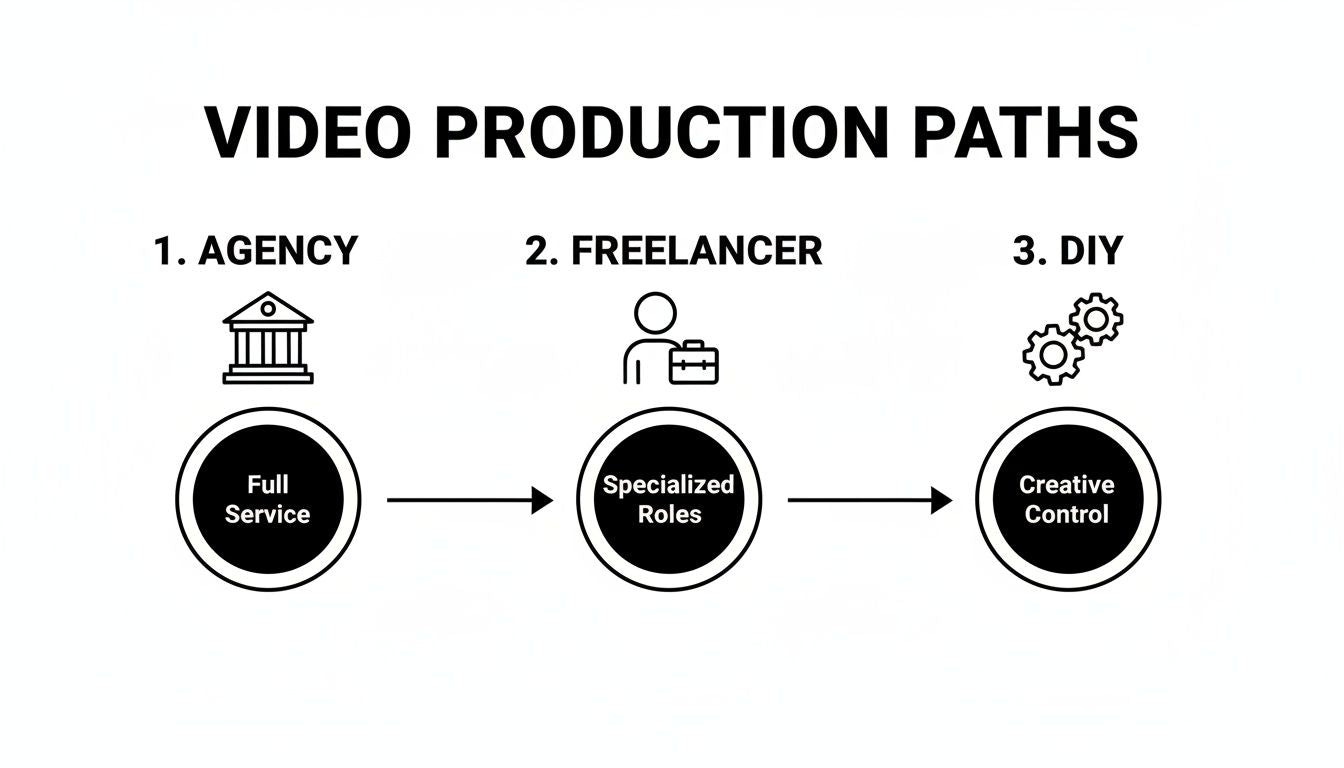
When it’s time to make a product video, founders typically choose one of three options: an agency, a freelancer team, or DIY tools. None are inherently right or wrong. The best fit depends on your budget, timeline, and how much founder time you can spend managing production.
Agencies
Agencies handle the full process: strategy, storyboarding, production, editing, and delivery. This can be great for flagship campaigns, but it often comes with the highest cost and the slowest timelines.
Freelancers
Freelancers can be more flexible and affordable. You can hand-pick specialists and get excellent results. The trade-off is coordination. Managing multiple people, timelines, and feedback can become its own full-time role.
DIY and template tools
DIY tools offer the lowest direct cost and fastest turnaround, useful for quick support tutorials and internal updates. The limitation is quality and strategy. Without a production background, it is easy to create something that looks unprofessional or misses the value.
A good first step is understanding different types of SaaS videos so you can match format to goal.
Cost and time reality check
For an early-stage company, the cost of a single high-end video can take a large share of the marketing budget. Even when you can pay for it, iteration becomes hard.
The real cost is opportunity cost. Every week in production is a week you are not running campaigns. Every hour you spend managing production is an hour not spent on product or sales. Speed and iteration are startup advantages, and slow production fights that.
How Forgeclips solves this
This is where a solution like Forgeclips fits in. It provides a structured system designed to deliver high-quality videos with speed and consistency, helping founders get professional results for a fraction of traditional costs.
The goal is simple: give you back time and budget. Instead of getting stuck in production, you can focus on distribution and testing, while still communicating your product’s value clearly.
Example use case: a B2B SaaS launch
Imagine you are launching a new analytics feature. Your goal is adoption among existing users and new sign-ups from teams that need that capability. A traditional process might take 6 to 8 weeks and cost thousands, which can kill launch momentum.
With a streamlined system, you could produce a polished 90-second feature video in under a week. The video explains the problem, shows the dashboard solution, and highlights the outcome: clear, actionable insights.
This is not about replacing agencies. It is a practical alternative for teams that need to move quickly and start generating results in days, not months.
A practical production workflow for founders
A repeatable workflow is what gets videos made. You do not need a Hollywood process. You need an intentional, efficient system that produces a high-quality video without pulling you out of the business.
Building your script with structure
For SaaS, one of the most reliable frameworks is Problem, Solution, How It Works. It is simple, logical, and benefit-driven.
Problem: Name the pain point and make it relatable.
Solution: Introduce your product as the clear answer.
How it works: Show only the key “aha” moments, not every button.
If you only get one thing right, make it audio. People tolerate imperfect visuals, but they will click away from distracting sound.
For visuals, keep the UI capture clean: high resolution, no notifications, no messy desktop, no extra tabs. Your product is the hero.
A common mistake is trying to show everything. A great product video is ruthlessly edited to show only what proves the value proposition.
Assembling the final product
Editing is where you sync voiceover to visuals, add subtle highlights, and keep pacing tight. A structured system helps you get a polished result without advanced software learning curves or heavy management overhead.
Adopting a distribution-first mindset
A polished product video is worthless if your ideal customer never sees it. Many founders obsess over production quality, upload the video to the homepage, and hope for the best.
The real benefit of efficient production is freeing budget and time for distribution. When you think distribution first, the game changes.
Maximizing reach through repurposing
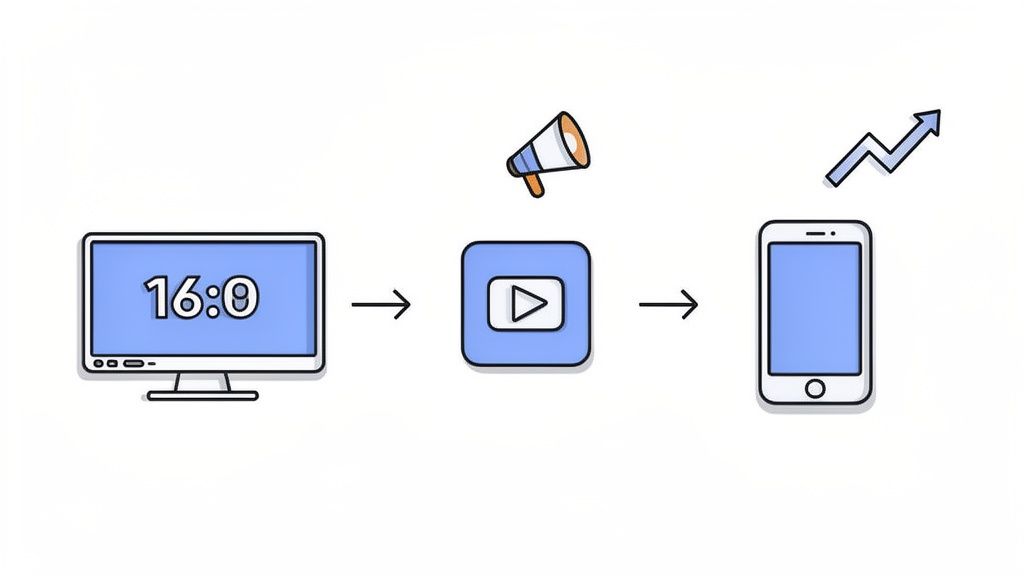
Create one core asset and adapt it for different platforms:
16:9: Website, YouTube, blog posts.
1:1: LinkedIn and Instagram feeds.
9:16: Stories, TikTok, Shorts, and vertical ads.
This multi-format approach is not extra work. It ensures the message lands in the format each platform rewards. See product marketing video examples for real formats tied to real goals.
A simple distribution checklist for founders
Website and product placement
Homepage hero placement
Feature pages with short clips
Onboarding flows for first-win actions
Social and content
LinkedIn post with square cut and a conversation-starting caption
YouTube upload with keyword-rich title and description
Email with a thumbnail and play button linking to the video
Paid advertising
Vertical cut for targeted social campaigns
Retargeting to visitors who did not sign up
A few common questions about product videos
How long should a SaaS product video be?
Match length to the job. For a homepage or landing page, aim for 60 to 90 seconds. For a feature deep-dive, 2 to 3 minutes can work. For social ads, land the point in under 30 seconds.
What is the single most important part of a product video?
A clear script and clean audio. People forgive average visuals, but they will not tolerate unclear messaging or distracting sound. Tight, benefit-focused writing matters.
What is a realistic budget for my first video?
It depends on the path:
Freelancer: Often $1,000 to $5,000+ depending on scope and quality.
Agency: Often starts around $10,000 and goes up quickly.
DIY: Lowest cash cost, highest time cost.
A practical middle ground is a hybrid approach that delivers professional polish without agency pricing.
Next steps
At Forgeclips, we built a structured system that delivers studio-quality product videos fast, so you can focus on getting your message out there.
Want a repeatable video pipeline instead of a one-off project?
See how our video frameworks help you move fast and communicate clearly.