You've got an idea. Maybe it's scribbled on a napkin, maybe it's a recurring thought that just won't go away. It feels like a sure thing. But here's the uncomfortable truth: passion doesn't build a business. Before you write a single line of code or spend a dollar on a logo, you have to prove that someone desperately needs what you're imagining.
To start a business, you must first validate that a real, painful problem exists, then build the smallest possible solution (an MVP) to solve it. From there, you establish a lean legal and financial foundation and execute a focused plan to attract your first users.
Validate Your Idea Before You Build Anything
The startup graveyard is filled with beautifully engineered products nobody wanted. The most common founder mistake isn't a bad product; it's a perfectly good product for a problem that didn't exist. They jump straight into building, burning cash and time, only to launch to the sound of crickets. The antidote is disciplined validation—a series of small, low-cost experiments to test your assumptions before you're too invested.
Talk To Humans First
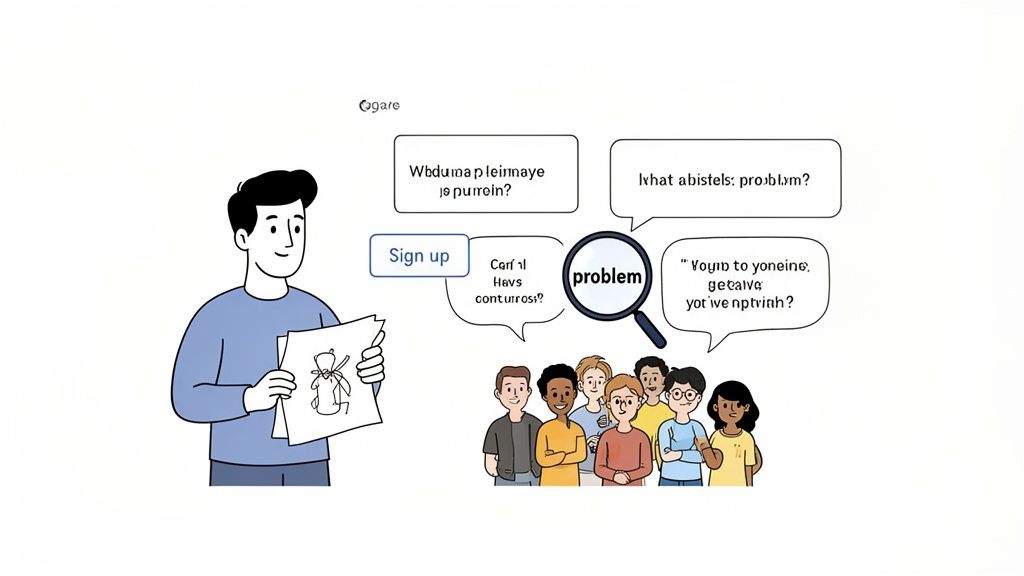
Your first move isn't a landing page. It's not a prototype. It's talking to real people. The goal of these "problem interviews" isn't to pitch your solution. It's to shut up and listen. You need to get potential customers talking about their current frustrations, their clunky workarounds, and their real-world pain points. You’re hunting for answers to a few key questions:
Is the problem real and frequent? You're looking for a "hair-on-fire" problem, not a minor inconvenience.
Are people already trying to solve it? If they're using ugly spreadsheets or duct-taping multiple tools together, that’s a fantastic sign. It's proof of demand.
What’s the perceived value of a solution? Would they actually pay to make this problem disappear?
This direct feedback is gold. It helps you refine your value proposition and ensures you're building for a real audience, not just yourself. This is how you discover the nuance needed to build a SaaS product that solves a specific user problem.
From Conversations To Data
Once you’ve confirmed the problem exists through conversations, it's time to quantify interest. One of the most effective tools is a simple landing page with a clear value proposition and an email sign-up form. That's it. You're testing whether your message resonates enough for someone to give you their email—a small but meaningful form of currency. Here’s a quick-reference guide to your early-stage reality checks.
Lean Idea Validation Toolkit
Method
Objective
Tools Needed
Problem Interviews
Understand the pain point deeply from the user's perspective.
A list of 10-15 potential customers, a conversation guide.
"Smoke Test" Landing Page
Measure interest by capturing emails for a product that doesn't exist yet.
Quickly gauge sentiment and problem awareness in a target community.
LinkedIn, Twitter/X, or relevant Facebook/Reddit groups.
Concierge MVP
Manually deliver the "solution" to a handful of early users to test the process.
Email, spreadsheets, and your own time.
These methods aren't about getting a perfect "yes" or "no." They're about learning quickly and cheaply, so you can iterate on your idea before you've committed serious resources.
The goal is to find undeniable proof that the problem is painful enough to warrant a paid solution. Forget polite encouragement from friends; you need commitment, even if it's just an email address.
Make no mistake, the competition is fierce. Globally, there are over 150 million startups, with a staggering 50 million new ones launching every year. This flood of new businesses makes validating your idea more urgent than ever. You have to stand out. Learn more about the current startup landscape and its challenges. This isn't about being first; it's about being right.
Build a Minimum Viable Product That Actually Works
The term “MVP” gets a bad rap. For too many, it’s an excuse to ship buggy, half-finished products. A true Minimum Viable Product isn’t about being minimum—it's about being viable. It’s the simplest version of your product that solves one core problem for one specific group of people. That’s it. Its only job is to create a tight feedback loop that tells you where to go next.
This isn't about building a scaled-down version of your grand vision with ten features that are 20% done. It’s about building one core feature that is 100% complete and delivers real, immediate value. Nail this, and you build momentum.
Ruthlessly Prioritize Your Features
Right now, your head is swimming with feature ideas. It’s time to get ruthless. Your MVP should be laser-focused on the single most important thing that solves the pain point you just validated. A simple framework to cut through the noise is the MoSCoW method. It forces you to sort every potential feature into four clear buckets:
Must-Have: Non-negotiable. Without these, the product is fundamentally broken. This is your value proposition.
Should-Have: Important features that add a ton of value but aren't critical for the first release.
Could-Have: "Nice-to-haves." Desirable, but with a smaller impact on the core experience.
Won't-Have (This Time): Features explicitly out of scope for this version. Calling them out prevents scope creep.
Your MVP is built only from the "Must-Have" list. Everything else can wait. This discipline separates a focused, useful product from a bloated, confusing one.
Choose Your Weapon: No-Code vs. Code
Once you’ve defined that core feature, you hit a fork in the road: how will you build this thing? For most early-stage startups, it comes down to two paths: no-code tools or a lean, custom codebase. There's no universally "right" answer here, just the right answer for you.
No-code platforms like Bubble, Webflow, or Adalo are built for speed. You can get a functional prototype into users' hands in weeks, sometimes days. This is an incredibly powerful way to test assumptions cheaply and quickly. The trade-off? If your idea depends on complex logic or a totally unique user experience, you might hit a wall.
On the other hand, writing your own code gives you ultimate flexibility and a path to scale. If you have a technical co-founder or a vision for a product with custom functionality, this is the better long-term bet. Just know it comes at the cost of a slower initial build and higher upfront investment.
The purpose of an MVP is to maximize learning while minimizing risk. It's a scientific instrument, not just a product. Its job is to answer the question: "Will people actually use this to solve their problem?"
Once your MVP is live, you need to show its value instantly. This is where launch assets come in. Knowing how to make a product video that clearly demonstrates your core feature solving a user's problem can make or break early traction. Your MVP doesn’t just need to work; it needs to be understood in seconds.
Establish Your Startup's Legal and Financial Foundation
Let's talk about the part of your startup journey that feels like eating your vegetables. It's not glamorous, but getting your legal and financial house in order from day one is what separates a real business from a side project that could implode at any moment.
Ignoring this "boring" stuff is a common, and often catastrophic, mistake. It leads to founder disputes, messy tax situations, and sometimes, the complete loss of a great idea. This isn't about becoming a lawyer; it's about building guardrails so you can focus on your product and customers.
Choosing Your Business Structure
One of the first real decisions you'll make is how to legally structure your company. For most SaaS and digital product founders, the choice boils down to two main options: the LLC or the C Corp.
Limited Liability Company (LLC): Think of this as the flexible, straightforward option. It's often ideal for bootstrapped startups or those not immediately seeking venture capital. Profits and losses pass through to the owners' personal tax returns, which simplifies things considerably.
C Corporation (C Corp): This is the gold standard for startups planning to raise venture capital. VCs almost universally require a C Corp structure because it allows for the easy issuance of different classes of stock. It's more complex and costly to maintain, but it’s built for scale and external investment.
If you’re self-funding, an LLC is usually the fastest and simplest way to get started. If you have your sights set on raising a seed round in the next 12-18 months, forming a C Corp from the beginning can save you significant legal pain later.
The Founders' Agreement: A Non-Negotiable Document
This might be the most important document you create. Before you even have a product, you need a founders' agreement. This is a contract between you and your co-founders that outlines the uncomfortable "what ifs."
It should clearly define:
Equity Splits: How ownership is divided. This needs to be decided based on contribution, not just an easy 50/50 split.
Roles and Responsibilities: Who is the CEO? Who is the CTO? What are the key decision-making powers for each role?
Vesting Schedules: Equity should be earned over time, typically over four years with a one-year "cliff." This protects the company if a founder leaves early.
Departure Scenarios: What happens if a founder wants to leave, or worse, needs to be removed?
Having these tough conversations now prevents business-ending arguments later. Don’t skip this step.
A handshake agreement feels great until there's real money—or real conflict—on the table. Putting it in writing isn't about a lack of trust; it's about professional respect for each other and the business you're building together.
Setting Up Your Financial Guardrails
Getting your finances straight from day one is non-negotiable. Co-mingling personal and business funds is a recipe for disaster. It creates a nightmare for accounting and can even put your personal assets at risk. Your initial financial setup can be surprisingly simple:
Open a Dedicated Business Bank Account: As soon as you've registered your business, this is your next stop. All company revenue goes in, and all business expenses come out.
Get a Business Credit Card: This helps build business credit and makes tracking expenses much cleaner than using a personal card.
Track Everything: You don’t need fancy software at first. A simple spreadsheet is enough to track every dollar spent. Log every subscription, every software purchase, and every contractor payment.
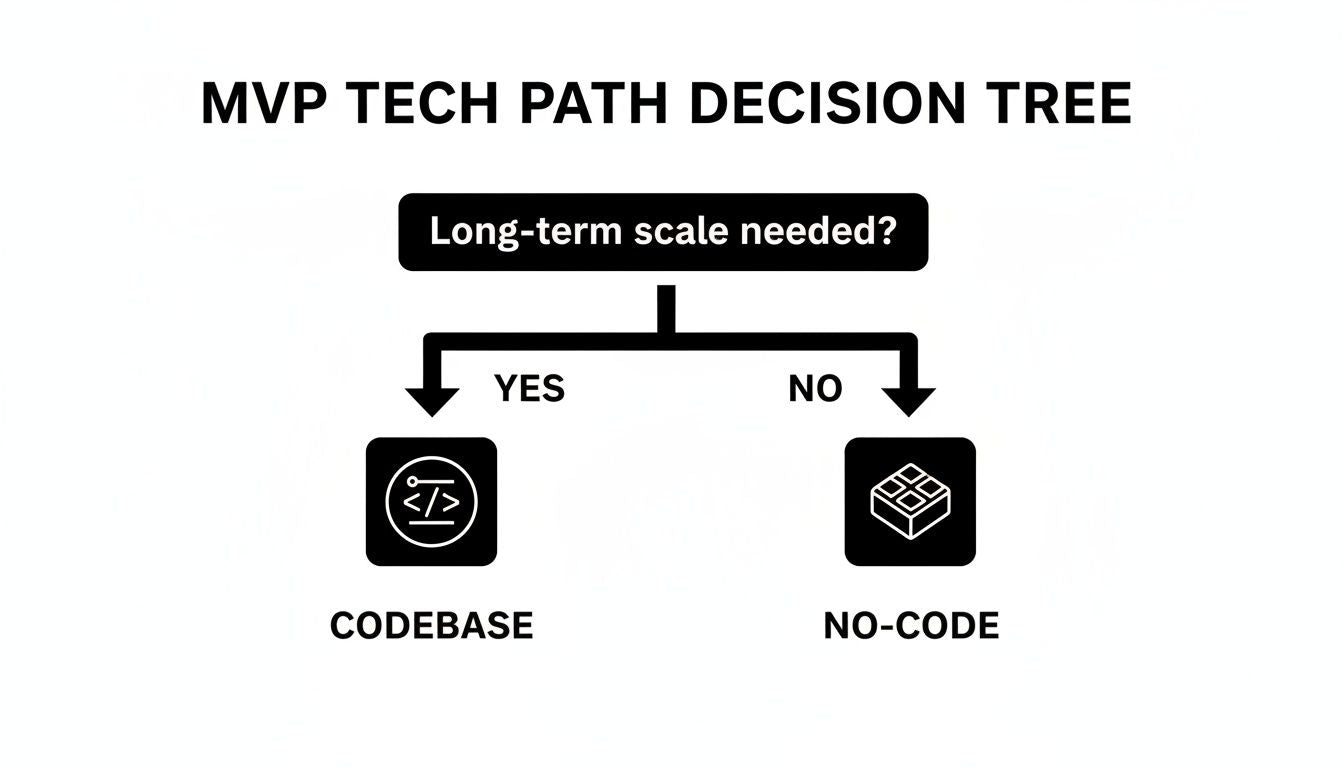
The following flowchart can help you visualize how even early decisions, like choosing a tech path, have long-term implications.
This decision tree illustrates a critical early choice—whether to use no-code tools for speed or a custom codebase for scale—which directly impacts your initial capital needs. For founders considering raising funds, understanding the nuances of a business loan for a startup company is an essential next step after establishing a solid financial foundation. A clean financial record and a clear legal structure are prerequisites for any serious funding conversation.
Develop a Go-To-Market Strategy That Delivers Users
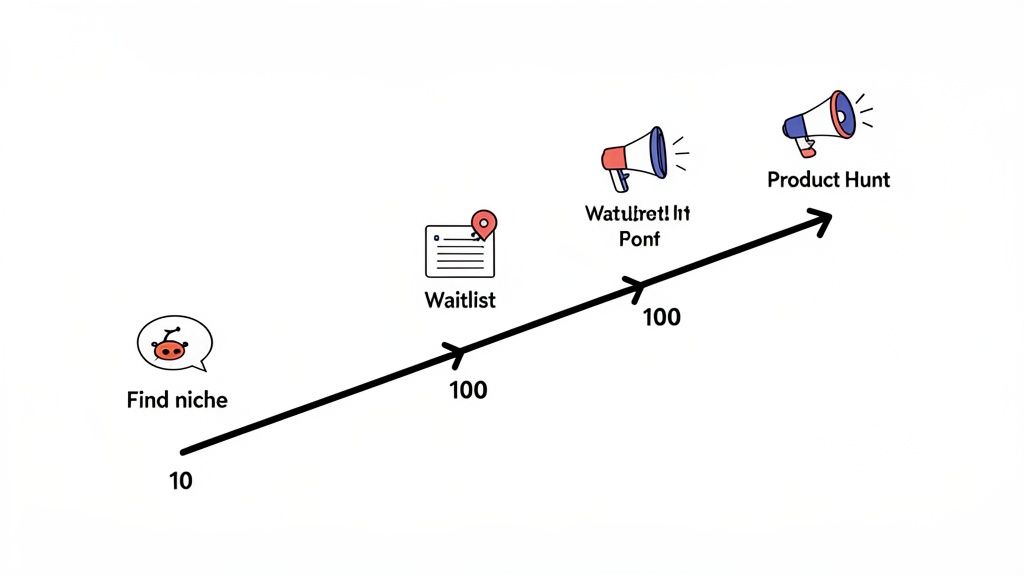
A great product with no plan to reach its first users isn't a business—it's just a well-engineered hobby. Your Go-To-Market (GTM) strategy is the roadmap that takes you from zero users to your first 10, then your first 100, and beyond. Forget casting a wide net. Your first users won't come from a Super Bowl ad; they'll come from the specific digital corners where they already hang out.
Find Your People in Their Natural Habitats
Your ideal customers are already gathered somewhere online, complaining about the very problem you’re solving. Your job is to find them, listen, and then gently introduce your solution. This isn’t about spamming links; it's about becoming a genuinely helpful member of a community. Think small and specific:
Niche Subreddits: Look for communities like r/saas for general industry talk, but also get hyper-specific. Building a tool for writers? Check out r/writing or r/selfpublish.
Private Slack and Discord Groups: These are goldmines of high-intent conversations. Find industry-specific communities where people ask for tool recommendations daily.
Specialized Forums: Platforms like Indie Hackers or Hacker News are obvious choices for tech products. Don't overlook older, industry-specific forums with dedicated user bases.
The goal is to add value first. Answer questions, share expertise, and only mention your product when it’s truly relevant. This builds trust and positions you as a problem-solver, not just another seller.
Build an Early Access Waitlist That Converts
Before you launch, build anticipation. An early access waitlist is your single best tool for this. It’s not just about collecting emails; it’s about creating a core group of early adopters who feel invested in your success. But a simple "coming soon" page won't cut it. You need to give people a compelling reason to sign up and stay engaged.
Your waitlist isn't a passive holding pen. It's your first community. Treat it as such by offering exclusive content, early product peeks, and direct access to you. Make them feel like insiders.
For example, you could offer a lifetime discount for the first 100 sign-ups or provide a valuable, free resource that helps solve a piece of their problem right now. Once they're on the list, don't go silent. Send regular, informal updates on your progress. This builds a relationship so that when you finally launch, you have an eager audience ready to go.
Use Launch Platforms for Concentrated Bursts of Attention
When you’re ready for a public debut, platforms like Product Hunt or AppSumo can deliver a massive, concentrated burst of attention. A successful launch on these sites isn't just about getting upvotes; it's about driving a significant wave of initial users who can provide invaluable feedback and social proof.
A strong Product Hunt launch requires preparation. You need to build relationships in the community beforehand, prepare your launch assets, and be ready to engage with every single comment on launch day. This is where a killer demo video becomes non-negotiable. Clear, concise product marketing videos are essential to explain your value proposition in under a minute. You can see great examples of product marketing videos that convert to get an idea of what works. This single effort helps you punch far above your weight.
Understand What Investors Actually Want to See
Even if you’re bootstrapping, it’s crucial to understand what the funding world is looking for. Investor sentiment is a strong indicator of market health and the metrics that truly matter. Today, investors aren't funding ideas; they are funding traction.
The good news? The market is active. Globally, investors injected $425 billion into over 24,000 private companies last year, a robust 30% jump from the year prior. Early-stage funding is particularly strong, hitting $37 billion in Q4 alone. You can dig into these venture funding trends on Crunchbase News.
This data shows money is available, but it’s flowing to startups that can demonstrate three key things:
A Validated Problem: Hard proof that you’re solving a real, painful need.
A Working MVP with Traction: Evidence that people are using your product.
A Clear Vision for Growth: A credible plan for how you will acquire more users.
Your GTM strategy directly addresses all three of these points. It proves the problem, gets you your first users, and lays the foundation for future growth.
Create Launch Assets That Actually Convert
Your landing page is your hardest-working employee. It works 24/7 and has one job: make a visitor understand your product's value in ten seconds or less. If it fails, that visitor bounces. Gone forever. This is where countless founders get stuck, trapped between two equally terrible options for creating their most important sales asset—the product video.
The Founder's Dilemma in Video Production
On one side, you have the "DIY Trap." This is the world of clunky screen recordings and awkward narration. It might feel fast and cheap, but it often makes your beautifully polished product look amateurish and confusing.
On the other side is the "Agency Drain." This is the path of hiring a traditional video agency, which means high costs, weeks of meetings, and a timeline that drags on for months. For a startup needing to move fast, it's just too slow and expensive.
This forces an impossible choice: sacrifice quality for speed, or sacrifice speed and budget for quality? The real answer is to reject both paths.
A Framework-Based Approach To Video
You don't have time to improvise where it matters most. A structured, framework-based approach to your launch assets—especially video—is the only way to win. It replaces creative guesswork with a proven formula designed for absolute clarity and conversion. A high-impact product demo doesn't need high-production fluff. It just needs to answer three questions instantly:
What is it? Show the product and the problem it exists to solve.
How does it work? Demonstrate the core feature in action, connecting it directly to the user's biggest pain point.
What do I do next? Give them a clear, unmissable call to action.
This philosophy of structure is what separates an asset that looks nice from one that actually works.
Choosing the Right Path for Your Startup
The middle path—combining professional structure with startup speed—is your unfair advantage. It’s about finding a system that lets you create studio-quality assets built for performance and delivered in days, not months. Every founder faces tough trade-offs when trying to create a compelling product video. Here’s a look at the most common scenarios.
The Founder's Dilemma in Video Production
Approach
Typical Cost
Time to Delivery
Primary Downside
DIY Trap
Your time + software
A few hours
Lacks professional polish and strategic clarity.
Agency Drain
$5,000 - $25,000+
4-12 weeks
Slow, expensive, and often misaligned with startup speed.
Framework System
Predictable & affordable
Days
Requires you to trust a proven structure over custom creative.
A great product explained poorly is a failed product.
Your launch video isn't just a marketing asset; it's the bridge between a user's problem and your solution. Make that bridge as short and sturdy as possible.
This is the entire premise behind Forgeclips. We built a system that rejects the founder's dilemma, offering a framework-based approach that delivers structured, high-converting videos with the speed a startup demands. It’s not just about making videos; it’s about making your value proposition impossible to ignore. It’s the logical middle path for any founder who needs to move fast without compromising on quality.
Startup FAQs: Your Questions, Answered
Once the initial spark of an idea hits, the questions start flooding in. It's a universal part of the founder's journey. Here are some direct, no-nonsense answers to the hurdles that trip up most founders.
How Much Money Do I Need To Start a Business?
The honest answer is: it depends entirely on your business model and your definition of "start." A software-as-a-service (SaaS) business can get off the ground for under $1,000. Seriously. By piecing together no-code tools, using free software trials, and pouring in your own time (sweat equity), you can get surprisingly far. Your first real costs will be the basics: a domain name, web hosting, and a tiny marketing budget.
If your idea involves physical inventory, custom hardware, or hiring a team from day one, you'll need more upfront capital. The key is to think lean. Ask yourself: what's the absolute bare minimum I need to spend to get a working product in front of one paying customer?
The goal isn't to have a massive war chest before you start. It's to prove your business model with as little capital as possible. Validate the idea first, then look for funding to scale what you know already works.
The amount of cash you need is directly tied to your Minimum Viable Product (MVP). A disciplined MVP keeps your burn rate low by forcing you to focus only on the core feature.
What Legal Structure Is Best for a Startup?
For most tech founders, this boils down to two options: a Limited Liability Company (LLC) or a C Corporation (C Corp). The right choice almost always comes down to your funding plans.
LLC (Limited Liability Company): This is usually the best starting point for bootstrapped or self-funded startups. It's simpler to set up, offers more management flexibility, and has "pass-through" taxation, which means profits are taxed on your personal returns.
C Corporation (C Corp): This is the gold standard for any startup planning to raise money from venture capitalists. VCs almost exclusively invest in C Corps because this structure lets you issue different classes of stock for investors, employees, and founders. It’s more complicated to maintain, but it’s built for outside investment.
Think of it this way: an LLC is designed for operational simplicity. A C Corp is designed for investment readiness. If pitching VCs isn't on your roadmap for the next 18-24 months, an LLC is probably the smarter choice.
Do I Need a Formal Business Plan?
The days of needing a 50-page, leather-bound business plan before writing a single line of code are long gone. For a modern digital startup, that kind of document is a monumental waste of time. It's obsolete the moment you get your first piece of real customer feedback.
What you actually need is a Lean Canvas or a simple pitch deck. These are quick, one-page documents that force you to be brutally concise about the most critical parts of your business. A Lean Canvas hits the essentials:
Problem: What are the top 1-3 problems your customer is desperate to solve?
Solution: How does your product solve them?
Key Metrics: Which numbers actually define success for you (e.g., weekly active users, conversion rate)?
Unique Value Proposition: A single, clear sentence explaining why you’re different.
Customer Segments: Who, specifically, is your target audience?
This isn't a static document. It's a living tool you'll update constantly as you learn from your first users. It gives you all the strategic direction you need without the rigid fiction of an old-school business plan.
How Do I Find My First Customers?
Getting your first 10 customers is a completely different game than getting your first 1,000. Forget scalable marketing channels for now. In the beginning, your job is to do things that don't scale. Your first users will come from manual, direct outreach.
Go where the pain is. Hunt down niche online communities—think Reddit, Slack groups, Discord servers, or industry-specific forums—where people are actively complaining about the exact problem you solve.
Listen before you sell. Don't just show up and drop a link. That’s spam. Participate in discussions, offer genuinely helpful advice, and only mention your product when it's a natural solution.
Tap your network (carefully). Reach out to friends, former colleagues, and LinkedIn connections who fit your ideal customer profile. But don't ask for a sale. Ask for feedback. People are much more willing to give you their opinion than their money.
The goal right now is learning, not just revenue. These first few customers are your most valuable source of truth. They will tell you what’s working, what’s broken, and what you need to build next.
When Is the Right Time To Quit My Day Job?
Deciding to go "all in" is deeply personal. It depends on your finances, your risk tolerance, and the traction your business is showing. There’s no magic formula, but there are clear signals that can help you make the call.
A solid rule of thumb is to wait until your startup is generating enough revenue to cover your basic personal living expenses. Some call this "ramen profitability." Hitting this milestone proves you have a viable business and takes off the immense financial pressure that can suffocate an early-stage company.
The other key signal is momentum. Are you consistently getting new users? Are your key metrics growing month-over-month? If your day job has become the single biggest bottleneck to your startup's growth, it's time to seriously consider making the leap.
Ready to make your product's value proposition impossible to ignore? Forgeclips replaces the slow, expensive agency process with a structured, framework-based approach to creating high-converting software demos and promo videos. Get studio-quality assets delivered in days, not months.