The best product videos don’t just list features; they tell a story that solves a customer's problem. You have to hook the viewer in the first 8-10 seconds, show them exactly how your product makes their life better, and give them a clear next step. Get that right, and you turn passive viewers into active users.
Your Product Video is The Sales Pitch You Keep Getting Wrong
You spend weeks, maybe months, building a killer new feature. You polish the landing page copy until it’s perfect. You hit "launch," and... crickets. The sign-up needle doesn't budge.
You know the product is good, but explaining its value with static screenshots and paragraphs of text is like trying to describe a concert with a single photograph. It just doesn’t connect.
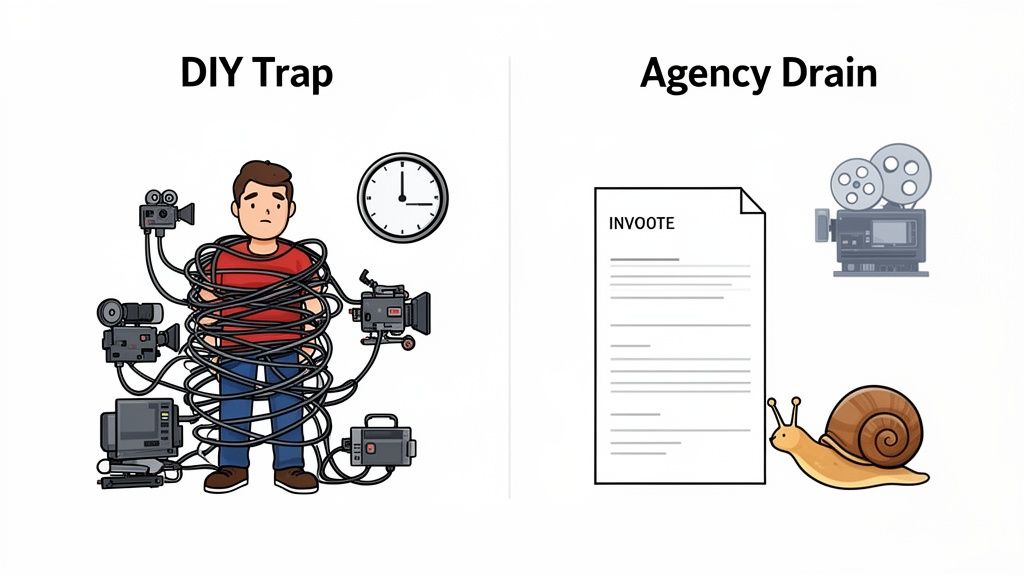
This is a familiar frustration for most SaaS founders and product managers. The options for creating a product video feel totally broken, forcing you down one of two equally painful paths. It's a choice between the DIY Trap and the Agency Drain.
The Broken Choice in Video Production
On one side, you have the DIY Trap. You figure you’ll save some money and tackle it yourself. But pretty soon, you're losing entire days wrestling with clunky editing software, trying to get your screen recordings to look clean, and realizing your voice-over sounds… well, like you recorded it in a closet. The final video often looks amateurish, which can do more damage to your brand’s credibility than having no video at all.
Then there’s the Agency Drain. You reach out to a professional agency, hoping for a beautiful, polished video. What you get back is a sky-high quote, a confusing production timeline that stretches on for weeks, and endless feedback loops where they never quite seem to grasp what your software actually does. You end up spending a fortune on a video that looks nice but completely misses the point.
This dilemma becomes a major bottleneck for growth. For founders, it means stalled conversions and a launch that fizzles out. For product teams, it’s a constant stream of support tickets from users who never read the docs.
The real problem isn't your budget or your video skills. It’s the flawed process you've been sold—one that forces a choice between slow and expensive or fast and ineffective.
It's time to admit that both of these paths lead to the same dead end: a video that fails at its only job, which is to clearly and compellingly communicate your product's value.
Throughout this guide, we'll unpack a much smarter, more structured approach. You can see a few product marketing video examples that follow this philosophy. It's not about becoming a video expert; it’s about adopting a better framework that actually works.
Why 'Just Hitting Record' Leads to Failure
Let's be blunt: most product videos don't work.
They fail because they wander aimlessly, lacking a clear structure to guide the viewer from confusion to clarity. The temptation to "just hit record" is strong—it feels fast and easy. But this usually leads to one of two equally bad outcomes.
You either end up with high-production fluff that says nothing, or a rambling screen recording that confuses more than it clarifies. This forces you into a false choice between two broken paths.
The Two Broken Paths of Product Video Creation
Most teams get stuck between two equally frustrating options for creating product videos. One is a chaotic, time-consuming mess, and the other is a slow, expensive grind. Both lead to mediocre results.
Pain Point
The DIY Trap
The Agency Drain
Cost
Low initial cost, but massive hidden costs in your time and lost conversions.
High upfront costs ($10k-$30k+) for a single video.
Speed
Feels fast at first, but bogs down in endless edits and retakes.
Painfully slow, with timelines stretching 6-8 weeks.
Quality
Often looks amateur, damaging brand credibility.
Technically polished, but often misses the product's core value.
Control
Full control, but you're responsible for every single detail.
Minimal control; your product's nuance gets lost in translation.
Neither path gives you what you actually need: speed, clarity, and a repeatable system that gets results.
The DIY Trap: The Hidden Costs of 'Doing It Yourself'
Going the DIY route seems like the smart, scrappy choice at first. How hard can it be? You buy some screen recording software, find a royalty-free music track, and carve out a weekend to get it done. The initial cost is low, but the hidden expenses quickly add up.
Your time—your most valuable asset—vanishes into a black hole of editing tutorials and retakes. You might spend 20 hours wrestling with software only to produce a video that looks disjointed. The audio is tinny, the pacing is off, and the message gets lost in a series of unfocused clicks.
The result is a final product that can actively damage your brand's credibility. For a SaaS founder trying to win that first crucial batch of users, an amateur video suggests an amateur product. The money you "saved" is lost ten times over in missed conversions.
The Agency Drain: Slow, Expensive, and Disconnected
Fleeing the DIY trap, many founders run straight into the arms of a traditional agency. They promise professional quality, and their portfolios look impressive. But the process is often a slow, expensive grind.
You get a hefty quote that makes your eyes water, followed by a production timeline that stretches for six to eight weeks. Communication gets filtered through account managers, and crucial details about your product's nuance are lost in translation. The agency is great at making things look pretty, but they don't understand your software's core value proposition.
This misalignment is costly. You spend weeks in feedback loops trying to explain why they highlighted a minor setting instead of the killer feature that solves the user's biggest problem. For a Product Manager, this means a delayed feature launch and another month of answering the same support tickets. You end up with an expensive video that's technically well-made but strategically useless.
The core issue with both paths is the lack of a repeatable system. One relies on improvisation, the other on outsourcing understanding. Neither is built for the speed and clarity modern software companies need.
This frustration is pushing companies to find a better way. The trend toward in-house production is undeniable, with 91% of businesses using video as a key marketing tool. While 59% create videos entirely in-house, a strategic 32% are now using a hybrid model—mixing internal efforts with specialized services to maintain control and quality. You can dive deeper into the video marketing statistics from Wyzowl to see how teams are adapting.
This middle path is where efficient SaaS video creation lives. It avoids the chaos of DIY and the bloat of agencies by focusing on structure first. Before you ever hit record, you need a solid plan—a blueprint that defines the story you're telling. A great first step is to explore a storyboard template for video creation to see how planning transforms the process.
This framework-based approach isn't just a different tactic; it's a fundamental shift in how you think about creating product videos. It’s about building a system that delivers clarity, speed, and results every single time.
Ditch the Improv: Why Your Videos Need a Framework
So, you want to make a better product video? The answer isn't a bigger budget or some fancy new editing software. It’s a framework.
Having a repeatable, logical structure is the one thing that separates a product video that actually converts from one that gets skipped after eight seconds. Think of it as an API for storytelling—a reliable structure that works every time. It frees you up to focus on what matters: your product’s unique value, not the container it comes in.
This is how you get a serious, almost unfair, advantage. You don't need to be a creative genius to make a great video. You just need a better process.
Structure Beats Improvisation, Every Time
Trying to improvise your way through a video is a recipe for a rambling, unfocused mess. It's the number one reason most DIY videos fail to connect. The viewer is left trying to piece together what your product does and, more importantly, why they should even care.
A framework flips that entire dynamic. It forces you to make the hard decisions upfront, ensuring every single second of your video serves a purpose. It’s a system designed to build clarity, not just show off features. This structured approach consistently communicates value, reduces the mental load on your viewer, and guides them toward a specific action.
A great product video isn’t art; it’s an argument. It makes a clear, persuasive case for why your solution is the best choice for the viewer’s problem. A framework is the logical outline for that argument.
By committing to a structure, you stop guessing and start building a repeatable system. This is how you create videos that deliver real ROI, whether you’re a founder hunting for sign-ups or a product manager trying to cut down on support tickets.
The Four Pillars of a High-Performing Video
A killer video framework isn't complicated. It’s built on four simple pillars that work together to take a viewer from mildly curious to fully convinced. Once you get this blueprint down, your results will change dramatically.
The Problem-Focused Hook: Forget your logo. Forget your company name. Start by immediately hitting on a pain point the viewer knows all too well. Articulate their frustration so clearly that they nod and think, "Yes, that's exactly my problem." Do that, and you've earned their attention for the next 60 seconds.
The Clear Value Proposition: Now that you have their attention, deliver your core promise. In one or two sharp sentences, explain how your product solves the problem you just introduced. This isn't about the how yet; it's about the valuable outcome they'll get.
The Guided Feature Walkthrough: Okay, now you can show them how it works. But this isn't a random tour of your UI. It's a focused demonstration showing the exact steps a user takes to get from their problem to your promised outcome. You're connecting their pain directly to your solution, feature by feature.
The Compelling Call to Action (CTA): End with a single, unmissable next step. What do you want the viewer to do right now? Whether it's "Start a free trial," "Book a demo," or "Sign up for early access," make the ask direct and frictionless.
This four-part structure just works. It mirrors the way people actually make decisions—moving from problem awareness to solution discovery and, finally, to action.
Why This Framework Gives You an Edge
Adopting this structured approach changes the entire game. It completely eliminates the blank-page paralysis that kills most video projects and replaces it with a clear, actionable roadmap.
For SaaS founders and indie hackers, the advantage is speed and ROI. A framework lets you create high-quality videos quickly and consistently, turning a marketing bottleneck into a conversion machine. You stop wasting time on videos that don't perform and start building a library of assets that actually drive growth.
For product managers and dev teams, the benefit is clarity and scalability. A structured video becomes a powerful tool for user onboarding, feature announcements, and internal alignment. You can explain complex workflows with perfect consistency, reducing repetitive support questions and making sure everyone—from users to stakeholders—gets the value of what you've built.
Ultimately, a framework makes effective video creation accessible. It’s a system that lets you punch way above your weight, creating product videos that are more focused, persuasive, and effective than those produced with ten times the budget.
Building Your Video From a Proven Framework
Alright, let's get tactical. Enough theory about why frameworks are better—let’s walk through how to actually use one to build a video that performs, from the first planning session to the final export. Improvisation is out. A deliberate workflow is in.
This isn't about becoming a professional videographer. It's about having a repeatable process that saves you from the classic pitfalls of DIY video, like unfocused messaging and those endless, soul-crushing re-edits we all dread.
Start with the One Big Idea
Before you even think about hitting record, you need a crystal-clear answer to one question: What is the one thing you need the viewer to understand by the end of this video?
It’s tempting to cram every cool feature into a 90-second demo, but that just creates noise. A great product video is ruthlessly focused. It picks one high-value problem and demonstrates a clear, satisfying solution.
To find your "one big idea," think about these triggers:
The "Aha!" Moment: What action or feature makes users truly get your product's value for the first time?
The Biggest Pain Point: Which customer frustration does your product absolutely demolish?
The Key Differentiator: What can your software do that the competition can't? Focus on that.
Once you have this core message, everything else—the script, the visuals, the call to action—snaps into place around it. This singular focus is the foundation of a video that actually converts.
Write for the Ear, Not the Eye
Your script is the blueprint for your entire video. A common mistake is writing it like a blog post, packed with long, complex sentences. That’s a fast track to a confusing voice-over that people will immediately tune out.
The rule is simple: write for the ear, not the eye. Use short, conversational sentences that are easy to follow. Read every line out loud. If you stumble over a phrase or run out of breath, that sentence is too long. Chop it up.
A good rule of thumb is to aim for a pacing of around 150 words per minute. This feels natural and gives the viewer time to process what they’re seeing and hearing. We've got a detailed guide on how to make a script that works for product videos that you might find helpful. When in doubt, remember that clarity always beats cleverness.
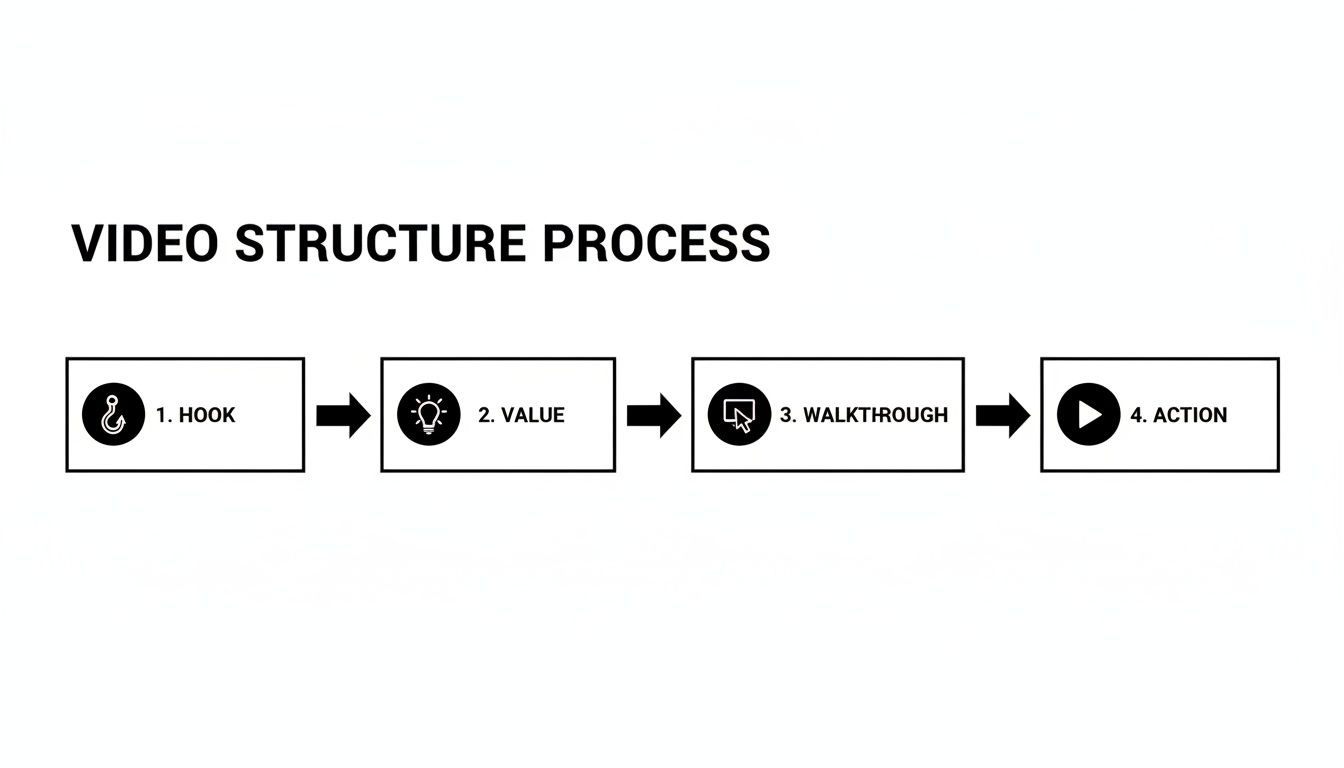
This simple flowchart shows the four core beats of a high-performing video.
This logical sequence—from capturing attention to driving a specific outcome—is the backbone of any video that successfully moves viewers to action.
Capture Clean Visuals and UI
With your script locked in, it's time to capture the visuals. The goal here isn't cinematic perfection; it's absolute clarity. Your user interface (UI) is the star of the show, so present it cleanly.
The viewer should never have to guess where you're clicking or what's happening on screen. Your job is to guide their eye with precision.
Before you hit record, prep your screen:
Use a clean user account: No one wants to see distracting test data or your personal information.
Set an appropriate resolution: Record in a standard 16:9 aspect ratio, like 1920x1080, for maximum flexibility later.
Hide distractions: Close unnecessary tabs, turn off notifications, and hide your bookmarks bar.
During the recording, move your cursor deliberately. Don't shake it around wildly. Every movement should have a purpose, guiding the viewer’s eye from one step to the next.
Polish in the Edit
Editing is where the structure truly comes to life. This is where you add the polish that separates a professional demo from a raw screen recording. The most impactful edits are often the simplest.
Focus on these key elements:
Pacing: Cut out any dead air or slow loading times. Your video needs to feel brisk and respectful of the viewer's time.
Zooms and Pans: Use smooth zooms to draw attention to specific UI elements you're discussing. This is crucial for guiding focus.
Text Callouts: Add simple text overlays to reinforce key benefits or clarify complex steps. A few well-placed labels can make a huge difference.
Remember, the goal is to enhance understanding, not to show off flashy effects.
For SaaS, video length is also critical. The data shows short-form is king: 63% of consumers prefer short videos to learn about services, and 71% of marketers find that clips between 30 seconds and 2 minutes perform best.
Plan for Multiple Formats from the Start
Finally, don't treat different video formats as an afterthought. Your 16:9 landing page video won't work perfectly as a 9:16 Instagram Reel or a 1:1 LinkedIn ad without some planning.
As you capture your UI, try to keep the most important action near the center of the screen. This makes it much easier to crop the video into different aspect ratios later without losing crucial context. Creating versions for each platform from the start maximizes your video's reach and ensures it looks great everywhere your customers are.
The Forgeclips Approach: Where Structure Meets Speed
It’s one thing to talk about having a “framework” for creating product videos. It's another thing entirely to have a system that actually works—one that's fast, affordable, and delivers polished results every single time.
This is where theory meets reality. We’re moving past the abstract idea of a “process” and into a tangible workflow that avoids both the chaos of the DIY Trap and the slow, expensive grind of the Agency Drain.
Our Hybrid Pipeline is Your Secret Weapon
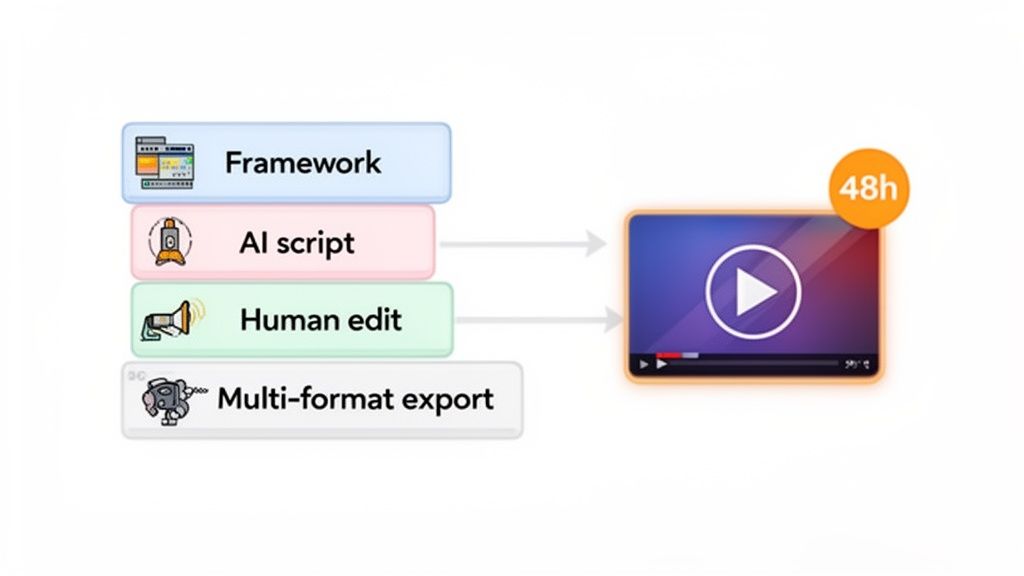
The whole Forgeclips philosophy is built on a hybrid production pipeline. We blend the raw speed of AI with the critical polish that only a human editor can bring to the table. This isn't about letting a robot make your video. It's about letting technology handle the grunt work so our team can focus on what really matters: clarity, storytelling, and quality.
Here’s how it works in practice:
You pick a framework: Choose a pre-built video structure designed for a specific job, like a landing page demo or a new feature announcement.
You give us the details: Send over your core script points, UI screenshots, and brand assets.
We build your video: Our system uses AI to help with the initial script and voice-over, then immediately hands it off to human editors for meticulous polishing, motion graphics, and sound design.
The result? A studio-quality video, delivered in multiple formats for every marketing channel you use, in just 48 hours. This approach is our direct answer to the time, cost, and quality headaches that plague most SaaS video projects.
Why This Model Actually Works for Modern SaaS
This structured, hybrid model isn't just a theory; it's a massive shift in how marketing assets get made. A staggering 51% of video marketers now use AI tools for video creation, a 128% increase in just two years. Why? Because these tools can slash production costs by up to 80% and turn a typical three-week timeline into just 24 hours.
This is what makes professional video accessible for the startups and indie hackers who need both speed and quality to compete.
We believe structure is the most powerful creative tool you have. By providing a proven framework, we remove the guesswork and let you focus on your product’s story, not the technical hurdles of video production.
Our system is built for the realities of running a software business. You don't have six weeks to burn waiting on a video to launch a new feature. You need to move fast, test ideas, and get high-quality assets out into the world. You can see how we apply these principles by looking at our examples of AI-powered video creation in action.
This isn’t just a service; it's a smarter, scalable way for modern SaaS companies to stop wrestling with video and start using it as a serious tool for growth.
Common Questions We Hear About Product Videos
Even with a solid plan, you're going to run into questions. It just happens. Over the years, we've heard the same ones pop up again and again from SaaS founders, indie hackers, and product teams trying to get this right.
Let's clear up some of that confusion with direct answers.
How Long Should My Product Video Be?
The honest answer? As long as it needs to be, but not one second longer.
For a landing page hero or a promotional video, the sweet spot is almost always between 60 and 90 seconds. You have to work under the assumption that you've got less than ten seconds to hook someone. If you haven't made your core value crystal clear in that tiny window, they're already gone. Keep it punchy and laser-focused on a single, powerful outcome.
Now, for deeper content like feature explainers or tutorials, you can absolutely go longer—think two to three minutes. But the key here is to make these videos skippable. Use chapters or clear visual cues so a user can jump straight to the part that solves their problem. No one wants to sit through a five-minute video just to find a 30-second answer.
The guiding principle is to respect your viewer's time. Data consistently shows that for product discovery, videos between 30 seconds and two minutes get the most engagement. Always prioritize clarity and brevity.
Should I Use a Professional Voice-Over or Just Do It Myself?
Unless you’re making an internal-only video, you should absolutely go with a professional voice-over.
Poor audio is one of the fastest ways to make your product feel amateurish. It’s a subconscious red flag that erodes trust before a viewer even understands what you do. Recording it yourself might seem like a quick, cheap fix, but a tinny, uneven voice-over can do more damage to your brand's credibility than you realize.
The good news is you don't need to hire an expensive voice actor anymore. Modern AI voice-over tools have become shockingly realistic and offer a fantastic middle ground. They give you a clean, consistent, and professional sound at a fraction of the cost. This is a core part of the hybrid approach we use—it gets you high-quality results without the traditional agency price tag.
What's the Single Biggest Mistake People Make in Product Videos?
Making the video about your features instead of your customer's problem. Full stop.
It’s an incredibly easy trap to fall into. You’re proud of what you’ve built, so you instinctively create a video that’s just a tour of the UI—"First you click here, then this screen pops up, then you see this button." This approach completely misses the mark because it fails to answer the only question your viewer cares about: "What's in it for me?"
An effective video doesn't just show the 'what'; it explains the 'why'.
Start with their pain: Acknowledge the frustration they're feeling right now.
Show how you fix it: Connect their problem directly to your solution.
Illustrate the outcome: Show them the better, smarter, faster world your product creates for them.
Always frame features as benefits. Instead of saying, "Our dashboard has a new filter function," say, "Find the exact data you need in seconds without endless scrolling." Focus on the customer's transformation, not the mechanics of your product.
Do I Need Fancy Animations and High-Production Graphics?
No, you really don't. In fact, for most SaaS product videos, "high-production fluff" can actually be a major distraction.
Clarity will always be more valuable than cinematic effects. Your goal is to make your product and its value easy to understand, not to win an award for special effects. Overly complex animations often draw attention away from your UI and can completely muddy your core message.
Instead of flashy graphics, just focus on the fundamentals of clean visual communication.
Text callouts to reinforce key benefits.
Strategic zooms to guide the viewer's eye to important details.
Smooth transitions to create a seamless, professional flow.
These simple motion graphics are all you need. Remember, the structure of your script and the clarity of your screen capture are responsible for 90% of your video's success. Everything else is just polish.
Ready to stop wrestling with video and start getting results? At Forgeclips, we provide a structured, framework-based approach to creating high-performing product demos and promos, delivering studio-quality videos in just 48 hours. See how it works.