When you add a video to your landing page, you’re doing more than just filling a space. You're showing your product in action, not just talking about it. A dynamic demo or a crisp explainer can get your value proposition across almost instantly, building trust and clarity in those first make-or-break seconds.
For SaaS products especially, this is critical. It directly tackles one of the most common conversion killers: high bounce rates on pages that feel too complex or abstract.
Key takeaways
Landing pages lose users when visitors cannot understand the product fast enough.
Video turns complex SaaS into a clear experience and builds trust quickly.
Agencies, freelancers, and DIY tools each have trade-offs in cost, speed, and control.
Fast production unlocks a distribution-first approach: more channels, more tests, more learning.
You’ve done the hard work. You built the product and you’re driving traffic to your site, but the sign-up numbers aren't there. It’s a common story for founders: a landing page that just doesn't convert as expected.
The problem often isn't your copy, your design, or even your features. It's a communication gap.
Potential customers land on your page needing to understand what you do for them, right now. Instead, they hit a wall of industry jargon, dense paragraphs, or static screenshots of a complex UI. Confusion sets in, and you have about five seconds to win them over before they click away.
The true cost of confusion
Every visitor who leaves your page confused is more than a single lost conversion. It's a leak in your growth engine with real downstream consequences.
Wasted ad spend: You pay to attract visitors who bounce before they understand your offer.
Lowered trust: Confusion makes your product feel difficult or unreliable, killing trust before it can form.
Inaccurate feedback: You might blame product-market fit when your messaging is the real issue.
Rule of thumb: If a visitor can’t figure out what problem you solve in 10 seconds, you’ve likely lost them.
Your landing page has one job: deliver the “aha” moment fast. For SaaS companies, this is harder because value is about the experience of using the software. Text can describe features, but it rarely captures the feeling of a smooth workflow.
Why video matters for SaaS
For a SaaS product, value isn't a feature list. It’s an experience: the workflow, the interface, and the moment a user solves a problem. Text and screenshots can only describe that. Video lets people see it.
This is why video is such a strong translator for complex software. It bridges the gap between your product's potential and a visitor's immediate understanding.
Demonstrating value beyond words
A potential customer lands with a specific problem in mind. They don’t want to decode a wall of text about features. They want to know if your product is the solution.
Instead of claiming your UI is “intuitive,” show it. A short demo can walk through a key workflow and turn an abstract concept into something tangible.
Note: You mention a chart here, but it’s not included in the HTML. If you have one, paste the image URL and I will place it as a figure in this exact section.
Building trust through transparency
Showing your product in action is an act of confidence. You’re not hiding behind clever copywriting. You’re putting the solution front and center.
A clear explainer sets expectations and gives users a realistic preview of what it’s like to use your software, which can lead to higher-quality sign-ups and lower churn. For more detail, see what is an explainer video.
Driving conversions with clarity
The lift from video isn’t magic. It’s communication. A good video ensures your value proposition lands clearly and fast.
Capturing attention: Video holds focus longer than text.
Simplifying complexity: Workflows become visual, step-by-step, and easy to follow.
Evoking emotion: You can show relief and success, not just describe it.
You reference early findings about conversion lift (86%) and link out to supporting context here: video impact findings.
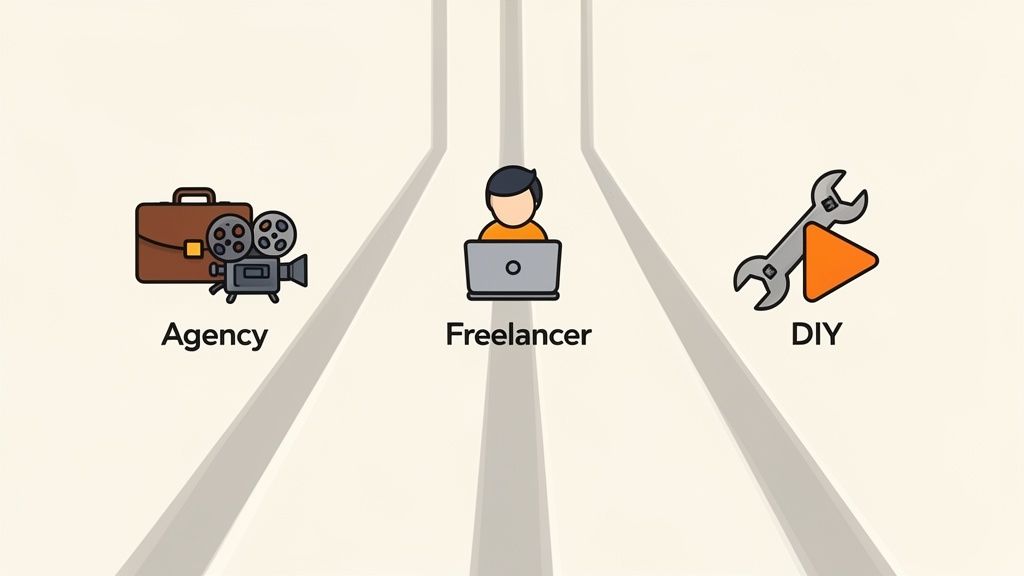
Common approaches to video production
Deciding to add a video is the easy part. The real question is how to get it made. As a founder, you're juggling quality, cost, and speed.
This isn’t about one “best” option. It’s about understanding the trade-offs so you can choose what fits your stage.
Path 1: Hiring a full-service agency
Agencies are the premium route. They handle strategy, script, storyboarding, animation, and delivery. The result is usually high-polish and brand consistency.
The trade-off is cost and timeline. Projects often start high and timelines of six to twelve weeks are common. This path fits well-funded teams where brand polish is the top priority.
Path 2: Working with a specialized freelancer
Freelancers can deliver strong results for less than an agency. You can find specialists on platforms like Upwork.
The trade-off is management. You become the project manager, responsible for direction, briefs, feedback, and keeping things on track.
Path 3: Using DIY or template-based tools
DIY tools are the fastest and cheapest option, letting you produce something quickly and update whenever you want.
The downside is the learning curve and the risk of a generic look. Templates can work across many types of video, but making them feel unique takes time and skill.
The cost and time reality check
The invoice tells you the price. It rarely shows the true cost: lost momentum. Every hour spent in feedback loops is an hour not spent shipping, selling, or learning from customers.
The opportunity cost of slow production
Hidden costs never appear on a bill, but they drain your startup’s most valuable resources.
The time sink: Traditional production can take six to twelve weeks, with constant stages and approvals.
The momentum killer: Long timelines can derail launches. By the time the video is ready, the market and narrative may have moved on.
Strong reminder: The most expensive video is often the one that arrives too late to matter.
The rigidity of a “perfect” video
High-production videos can become unchangeable. But SaaS changes constantly: UI updates, messaging updates, feature shifts. If updating your video is painful, your ability to iterate gets crushed.
For early and growth-stage SaaS companies, agility is a major advantage. Traditional production often cannot keep up with the pace of product and marketing changes.
This is where an agile video solution comes in. Forgeclips is built to deliver production-quality videos in days, not months.
Why it’s fast: proven frameworks for SaaS communication. You start with a structure designed to communicate clearly, rather than starting from a blank page.
This approach aims to deliver most of the result of a custom project at a fraction of the time and cost. The goal is simple: get a high-performing video live fast so you can collect data and convert users, not get stuck in production.
Example: a product launch video that drives sign-ups
Imagine your Product Hunt launch is two weeks away. You have one shot to make a strong first impression. A sharp, clear video is non-negotiable.
You don’t have six weeks for an agency, and managing a freelancer can feel like a second job. In this moment, speed and clarity are everything.
From idea to asset in days
With an agile approach, you can go from submitting product inputs to having a polished video quickly. You provide key messaging, UI screens, and core value props. The system turns those inputs into a professional video ready for launch day.
Hook viewers in the first three seconds.
State the problem clearly.
Demonstrate the solution with clean UI motion.
End with a call to action that drives sign-ups.
For a launch, your video isn’t just content. It’s a salesperson working 24/7 to turn visitors into trial users. See more examples in product marketing video case studies.
A distribution-first mindset
Here’s a hard truth: a great video on a landing page with zero traffic is worthless. The goal isn’t only to create a great video. It’s to get it seen by the right people.
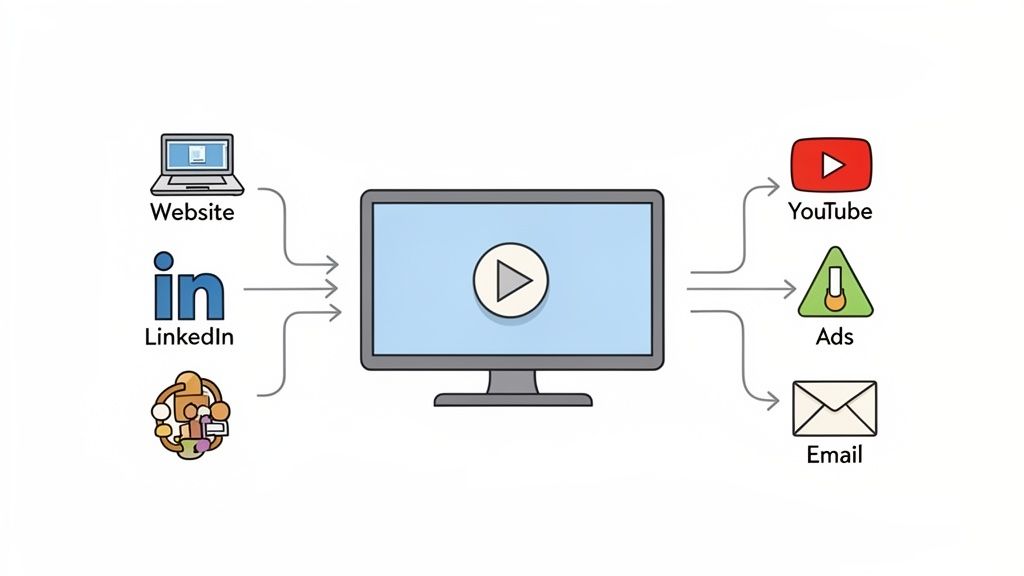
When production is fast and affordable, video becomes a scalable asset. You can repurpose a core video across channels:
Website hero video: the main explainer on landing pages.
Short ad cuts: 15 to 30 second versions for LinkedIn and paid social.
Full product demo: an in-depth version on YouTube to capture search traffic.
Feature highlights: short clips for email and social.
By spending less on production, you buy runway for testing, learning, and reach. If you want to build a scalable video pipeline, Forgeclips can help you start quickly.
Next steps
When you choose a practical video solution, you aren’t just saving money. You are investing in distribution, iteration, and growth. You spend less time managing production and more time getting your product in front of the right customers.
If you want to see how a faster video process can support your growth, explore what Forgeclips offers.
Ready to create high-performing videos that communicate your product clearly?
With Forgeclips, you can get studio-quality SaaS videos in days, not months.