That feeling of dread when you think about getting a new promotional video made? You know the one. You’re stuck between two bad options: a slow, overpriced agency or a messy, time-consuming DIY tool.
In simple terms, promotional video production is the craft of creating a strategic video—like a product demo or explainer—that’s engineered to do two things: clarify your product's value and drive conversions. It's not about winning an Oscar. It’s about structured communication that delivers a real return on your investment.
The Reality of Modern Promotional Video Production
Let's be real. For most SaaS founders and product teams, the whole video production process feels like a trap. One path bleeds your budget dry with high-production fluff, while the other produces amateur results that can actually hurt your brand.
It’s a frustration we hear all the time. You've poured months, maybe years, into building a beautiful piece of software that solves a real problem. But when you try to show it off, the video project becomes a painful distraction from what you should be doing—growing your business. This is where the old models for promotional video production are failing fast-moving tech companies.
The Broken Paths to a Promo Video
The problem isn't a lack of options; it's a lack of good options. The two most common routes are loaded with issues that are especially painful for lean, agile teams.
You’re basically forced to pick your poison.
The Agency Drain: This path is paved with high costs, endless meetings, and timelines that stretch for 6-8 weeks for a simple 90-second video. Agencies often get lost in "high-production fluff" instead of focusing on the structured clarity your software needs. You end up paying a premium for a slow process that's often misaligned with your real goal: clear communication and fast ROI.
The DIY Trap: On the other end of the spectrum are the do-it-yourself tools. They promise speed and savings but leave you wrestling with confusing templates, generic stock assets, and a final product that just looks unprofessional. You might save some money upfront, but you burn brand credibility and valuable hours you simply don't have.
This frustrating dilemma is exactly why so many SaaS teams struggle to create videos that actually work. To break the cycle, you need to adopt modern Video Production Best Practices that prioritize performance, not just pretty visuals.
The table below breaks down these common pain points.
Two Paths of Video Production and Their Pain Points
Challenge
The Traditional Agency Drain
The Do-It-Yourself Trap
Budget & Cost
High retainers and project fees ($15k-$30k+). Hidden costs for revisions.
Low initial cost, but high opportunity cost from wasted team hours.
Timeline & Speed
Extremely slow. 6-8 weeks is standard for a short video. Endless feedback loops.
Appears fast, but hours are lost to a steep learning curve and template wrestling.
Quality & Brand
Over-produced and often misses the mark on clear, conversion-focused messaging.
Amateurish results. Generic look and feel that damages brand credibility.
Process & Effort
Requires constant meetings, hand-holding, and management from your team.
Consumes your team's focus. Turns marketers and founders into reluctant video editors.
Ultimately, both paths fail to deliver what modern SaaS companies need most: a high-quality, strategic video asset, produced efficiently and affordably.
The goal isn’t just to have a video; it's to have a strategic asset that works for you. A great promotional video should function like your best salesperson—tirelessly explaining your product’s value with perfect clarity, 24/7.
The solution isn't about choosing between slow and expensive or fast and cheap. It’s about rethinking the entire approach. A successful promo video is built on a solid framework, not a creative whim. It’s a logical, structured asset designed to guide a viewer from problem to solution—and, most importantly, to conversion.
Understanding the Production Workflow Step by Step
Thinking about promotional video production can feel like staring at the blueprint for a skyscraper. It looks complex, with dozens of moving parts. But just like building a house, it all comes down to a logical, three-phase process: planning, building, and finishing.
Getting this workflow right is the secret to avoiding the all-too-common traps of wasted time and spiraling costs. A solid plan in the first phase saves you from expensive tear-downs in the last one.
The diagram below shows the classic forks in the road for video creation.
This visual highlights a familiar dilemma: Do you go with the high cost of an agency or the high effort of DIY? Understanding a structured workflow helps you find a much smarter middle ground—and that’s where real efficiency lives.
Phase 1: Pre-Production and Planning
This is easily the most critical stage, yet it’s the one most often rushed. Think of pre-production as creating the architectural blueprint for your entire video. Get this part right, and the rest of the project flows smoothly. Get it wrong, and you're setting yourself up for painful, costly revisions down the line.
The core components here are:
Strategy and Concept: What is the single most important message you need to communicate? Who is your audience, and what action do you want them to take? This isn't about some grand artistic vision; it's about hitting clear business objectives.
Scripting: Your script is the absolute foundation of the video. For SaaS products, that means using clear, concise language to explain a problem and position your software as the only logical solution. Especially for platforms like YouTube, focusing on writing a viral YouTube video script lays the groundwork for everything that follows.
Storyboarding and Shot Lists: This is where you translate the words on the page into a visual plan. A storyboard is a sequence of rough sketches mapping out each scene, while a shot list details every single angle and action needed. It gets everyone on the same page before a single second of footage is recorded or animated.
Think of pre-production as your architectural drawing. You wouldn't let a construction crew start building a house without a detailed blueprint, and the same discipline should apply to your video. A strong script is the most important part of that blueprint.
Phase 2: Production and Asset Gathering
With a solid plan in hand, you can move into the production phase. For a typical SaaS promotional video, this stage is less about a big film crew and more about gathering the right digital assets. It’s where your blueprint starts turning into a tangible structure.
This phase usually involves:
Screen Recordings: Capturing clean, high-resolution footage of your software in action. This needs to be methodical, following the storyboard to show the user's journey with absolute clarity.
Voice-Over Recording: A professional voice-over adds instant credibility and authority. This is not the place to cut corners with an AI-generated voice or a cheap microphone. Clean, professional audio is non-negotiable for building trust.
Asset Collection: Pulling together all the other necessary elements—your company logo, brand color codes, specific fonts, and any stock footage or music that will be used.
Phase 3: Post-Production and Polish
This final phase is where everything comes together. An editor takes all the raw materials gathered during production and assembles them according to the storyboard and script. It's the finishing work—the painting, wiring, and interior design that turns a frame into a home.
Post-production is where the magic happens, but it’s guided entirely by the logic established back in pre-production. An editor will assemble the footage, add motion graphics to highlight key features, handle the sound design and mixing, and apply color correction to ensure everything feels on-brand.
To see what a finished project looks like after this process, feel free to review some of our final product videos. This step-by-step assembly is exactly why the advertising video production market continues to expand. The market is projected to hit $80 billion by 2025, with a staggering 93% of businesses now using video as a core marketing tool.
Why Frameworks Beat Improvisation for SaaS Videos
You know that feeling of dread before a sales call? The one where you have no script, no plan, and you’re just hoping to “wing it”? It rarely ends well. The best sales pitches, the ones that consistently close deals, follow a proven structure.
Your promotional video is no different—in fact, it's your most important sales pitch, running 24/7.
And yet, so many SaaS videos are built on creative whims. They’re packed with what we call “high-production fluff”—slick animations and trendy music that do absolutely nothing to explain the product’s core value. For a software product, where clarity is the only metric that matters, this approach is a recipe for a wasted budget and confused prospects.
A framework, on the other hand, is a repeatable, logical structure designed to guide a viewer’s journey from confusion to understanding. It’s an opinionated approach to promotional video production that prioritizes conversion over creative indulgence.
The Power of a Structured Narrative
Imagine trying to explain a complex new feature to a coworker. You wouldn't just throw random facts at them. You'd probably start with the problem it solves, show how the current workflow is frustrating, and then introduce your new feature as the obvious solution.
That’s a framework in action. It’s a natural, persuasive way to communicate. When you apply these structures to video, you ensure every single second of your runtime serves a strategic purpose.
Two of the most effective frameworks for SaaS are:
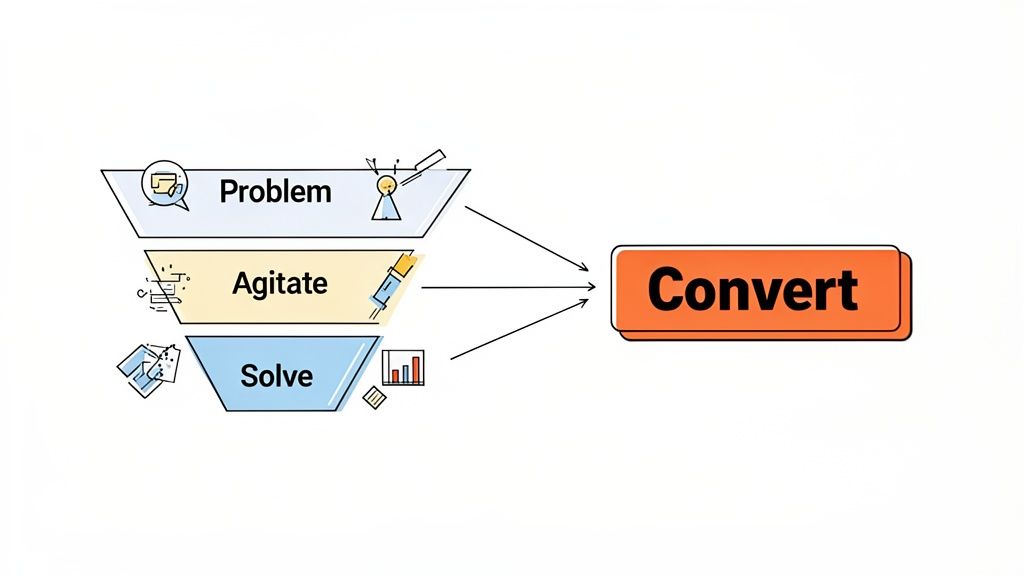
Problem-Agitate-Solve (PAS): This classic copywriting formula is incredibly effective for video. You start by identifying a painful problem your audience faces, agitate that pain by highlighting its consequences, and then present your software as the clear, relieving solution.
Feature-Benefit-Proof (FBP): Perfect for product demos, this framework connects the dots for the viewer. You show a feature (like "one-click integration"), explain the direct benefit ("saves you an hour of setup time"), and offer proof (by showing it happen seamlessly on screen).
This disciplined approach stops you from getting lost in the weeds and keeps the focus squarely on what the user gains.
Your video's job isn't to win an art award. Its job is to make a potential customer think, "Finally, someone understands my problem and has the exact tool I need to fix it." A framework makes that happen reliably.
Frameworks Align Your Entire Team
The benefits of a framework extend far beyond just the script. For product managers and development teams, a structured video becomes a powerful internal tool. It creates a single source of truth for explaining a feature's value, ensuring everyone from sales to support is on the same page.
No more repeating the same explanation on five different calls. The video does the heavy lifting, scaling your ability to communicate with perfect consistency.
For founders and indie hackers, the value is even more direct: ROI. A framework-based video isn't a gamble; it's a calculated investment in a conversion asset. By following a proven formula, you dramatically increase the odds that your video will actually move the needle on sign-ups, demo requests, and sales.
It’s the middle path between the "Agency Drain" and the "DIY Trap." You get the strategic thinking of a high-end agency without the crippling cost, and the speed of a DIY tool without the amateurish results. The framework is the system that makes it possible—it's the philosophy of structure that ensures your message lands every single time.
How to Budget and Set Realistic Timolines
Talking about money and deadlines is often the most stressful part of any project. When it comes to promotional video production, the numbers and calendars you see can feel all over the map, making it impossible to know what’s realistic.
Let's cut through the noise. Your budget and timeline are directly tied to the path you choose: the high-cost agency, the high-effort DIY tool, or something in between. Understanding this landscape is the first step toward making a smart investment.
Breaking Down the Costs and Timelines
When you're trying to budget for a promo video, the options generally fall into three tiers. Each comes with a different price tag and, just as importantly, a different demand on your time.
Here’s a realistic breakdown of what you can expect from each approach:
DIY Tools: The initial cost is low, often a small monthly subscription. The hidden cost, however, is your time. You’re looking at dozens of hours spent learning software, wrestling with templates, and just trying to get a decent result. The timeline is completely unpredictable.
Freelancers: This is the mid-range option. Costs typically run from $3,000 to $8,000 for a standard 90-second SaaS promo. Timelines can be faster than an agency, around 2-4 weeks, but quality and reliability can be a gamble. Finding a freelancer who truly gets SaaS product clarity is a challenge in itself.
Traditional Agencies: This is the premium tier, where a single 90-second explainer can easily cost $15,000 to $30,000+. The biggest shock for most teams is the timeline. A 6-8 week production cycle is standard due to endless meetings, layered feedback loops, and a process heavy on "creative exploration."
That massive time commitment from agencies is a major bottleneck for fast-moving tech companies. Every week spent in a feedback loop is a week your video isn't on your landing page converting customers.
Why Do Some Videos Take So Long to Produce?
It’s a fair question: why does a 90-second video take two months to make? The answer lies in the traditional agency model, which is often inefficient by design. Multiple departments—from creative to production to client services—all need to coordinate, leading to delays.
A solid plan from day one can sidestep a lot of that friction. Using a storyboard template for your video helps align everyone and keeps the project moving.
The real cost of a slow video isn't just the invoice amount; it's the opportunity cost. A video that takes eight weeks to produce is a strategic asset sitting on the shelf instead of driving growth for two full months.
This sluggish process is becoming less tenable as video becomes an essential marketing tool. In fact, video adoption has reached staggering levels, with 93% of businesses now using it. Marketers are creating everything from quick social clips to in-depth explainers.
Fortunately, costs are also shifting. 30% of marketers report that video production is getting cheaper, largely thanks to AI tools making creation more accessible. You can discover more about these video marketing trends and statistics to see how the landscape is changing.
This shift highlights the growing gap between the old agency model and the needs of a modern SaaS business. You don't need a bloated, months-long process to get a high-performing video. You need an efficient system that respects your time and budget, delivering a strategic asset that starts working for you, fast.
The Forgeclips Method: A Smarter Middle Path
So, you’re stuck between the "Agency Drain" and the "DIY Trap." One path is slow and costs a fortune; the other eats up your time and often looks unprofessional. It’s a classic dilemma for SaaS teams, but what if it’s a false choice? What if there’s a third way that gives you the best of both?
This is where the Forgeclips philosophy was born. We're not just another tool or a cheaper agency. We’ve built a system around a simple idea: structure, speed, and performance are the pillars of modern promotional video production for SaaS. It’s the logical middle path, designed for teams that need studio quality without the usual friction.
This approach isn’t just about making videos; it’s about having a smarter way to create them. We built this method because we’ve lived the pain on both sides—the bloated agency invoices and the weekends lost to clunky DIY editors. We knew there had to be a better way.
The Hybrid Model That Actually Works
Our solution is a hybrid model that blends intelligent automation with expert human oversight. It’s engineered to solve the timeline and cost headaches that plague most video projects. Think of it as giving your team an AI assistant to handle the tedious prep work, while a seasoned human editor adds the final creative and strategic polish.
Here’s a look at how that works:
AI-Assisted Scripting: We start with frameworks proven to convert for SaaS. Our system guides you in structuring your message, turning your product’s value into a script that’s already 80% of the way there. This alone cuts out weeks of back-and-forth.
Human-Polished Editing: Once the script and assets are ready, our professional editors step in. They aren’t just assembling clips; they’re applying their expertise in pacing, visual hierarchy, and storytelling to make sure the final video is sharp, clear, and persuasive.
This combination lets us deliver studio-quality videos in days, not weeks. You get the strategic thinking of an agency and the speed of an automated tool, all without the compromises.
We believe technology should serve creativity, not replace it. Our hybrid model uses AI to eliminate tedious tasks, freeing up human experts to focus on what matters most: creating a video that connects with your audience and drives results.
Frameworks as Your Strategic Foundation
The secret to our speed and impact isn't just the tech—it's our belief in structure. We built our entire process on pre-built SaaS frameworks that ensure every video is strategically sound from the very start. These aren't just templates; they are narrative recipes for conversion.
When you start with a proven structure like Problem-Agitate-Solve, you aren’t starting from a blank page. You’re building on a foundation that’s already worked in countless successful campaigns. This immediately aligns your video with your business goals, whether that’s boosting sign-ups or cutting down user confusion.
This framework-first approach is what allows a founder to get a landing page video that actually converts in just a few days. It eliminates the guesswork and creative detours that can derail agency projects, keeping the focus squarely on performance. For SaaS teams that need to move fast and see real returns, this structured system is the only one that makes sense.
It's a complete system designed to help you create better videos, faster. If you're curious about the specifics, you can learn more about our smarter way to create videos and see how it fits into a modern workflow.
How to Distribute Your Video and Measure Success
Finishing the production on your new promotional video feels like crossing the finish line. But in reality, the race has just begun.
Creating the video is only half the job. The real value comes from a smart distribution plan and measuring what actually moves the needle for your business.
Too many great videos die a quiet death, buried on a YouTube channel with a handful of views. To avoid this fate, you need a plan to get your video in front of the right people at the right time. For a SaaS business, that means focusing on high-impact channels where your audience is already looking for solutions.
Strategic Distribution Channels for SaaS
Forget a scattergun approach. Your goal is to embed the video where it can do the most good. For most tech products, three channels deliver the best results for your promotional video production efforts.
Your primary targets should be:
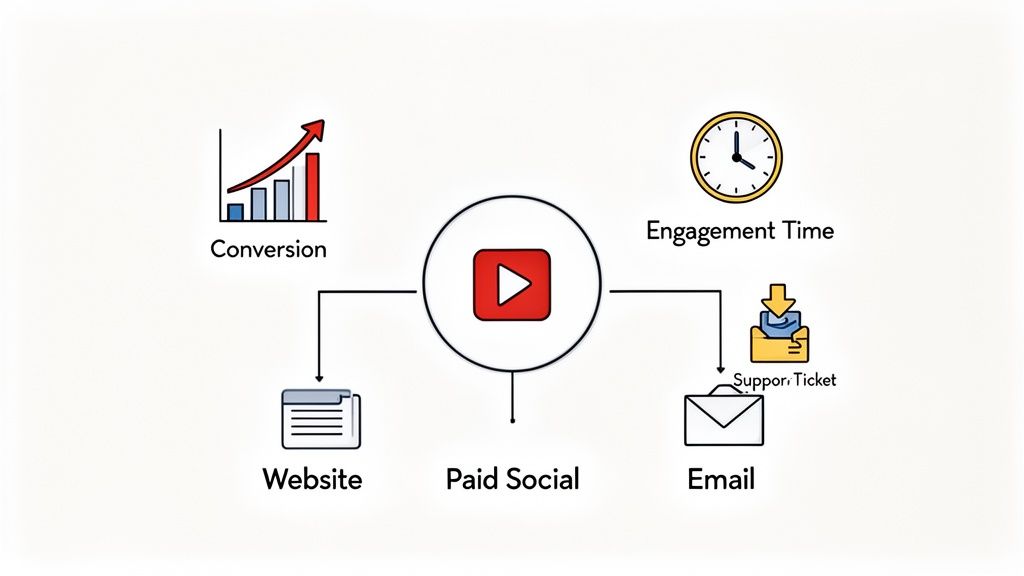
Your Website and Landing Pages: This is ground zero. Placing your new video hero-style on a landing page can significantly lift conversion rates. It acts as your best salesperson, explaining your value proposition 24/7 to high-intent visitors.
Paid Social Ads: Platforms like LinkedIn, X, and Meta are powerful for reaching specific professional audiences. Use shorter, punchier versions of your video to grab attention in the feed and drive targeted traffic back to your sign-up or demo page.
Email Campaigns: Video in email can do wonders for engagement. Use it in onboarding sequences to explain key features or in announcement emails to showcase a new update. It’s a direct, effective way to educate and activate your user base.
Measuring What Actually Matters
This is where many teams get it wrong. They chase vanity metrics like total views or likes, which feel good but tell you almost nothing about business impact.
A video with 100,000 views that generates zero sign-ups is a failure. One with 1,000 views that drives 50 high-quality leads is a massive success.
The only metrics that matter are the ones tied to growth. Your video isn't a piece of art; it's a strategic asset designed to achieve a business outcome. Measure it like one.
Instead of getting distracted by view counts, focus on tracking metrics that reflect real-world performance. The right ones will depend on the video's goal.
Focus on these performance indicators:
Conversion Rate Lift: If the video is on a landing page, what is the A/B test result? A great promo video should directly increase the percentage of visitors who sign up or request a demo.
User Engagement Time: On pages with your video, are users staying longer? Analytics can show you if the video is holding attention and leading to deeper exploration of your site.
Reduction in Support Tickets: For an onboarding or feature-explanation video, a key success metric is a drop in common "how-to" support questions. This shows the video is successfully clarifying the user experience, saving your team time and resources.
By focusing on these concrete outcomes, you can accurately assess the return on your investment. If you want a deeper dive, check out our guide on calculating video marketing ROI for SaaS. This turns your promotional video production from a cost center into a predictable growth driver.
A Few Questions We Hear All the Time
Jumping into promotional video production always brings up a few practical questions. You know a great video is a must-have, but the details—from length and assets to voice-overs—can feel a little fuzzy. Here are some straight answers to the questions we get most often from SaaS founders and growth teams.
What's the "Right" Length for a SaaS Promo Video?
For a landing page or top-of-funnel explainer, the magic number is 60-90 seconds. That's the sweet spot for grabbing attention, landing your core value prop, and nudging a visitor toward the next step before they have a chance to get distracted. You have to be ruthless with your message to make every second count.
But of course, length should always follow the goal.
Top-of-Funnel (Explainers, Ads): Keep it short and punchy. 60-90 seconds is perfect.
Mid-Funnel (Feature Demos): For an audience that’s already evaluating your product, you can stretch it to 2-3 minutes. This gives you room to walk through a specific workflow and show off tangible benefits.
Bottom-of-Funnel (Tutorials, Onboarding): Here, length doesn't matter nearly as much. These users are already committed and need detailed guidance, so videos can be as long as it takes to clearly explain a process.
How Important Is a Professional Voice-Over, Really?
It’s absolutely critical. In fact, a professional voice-over is arguably one of the highest-ROI elements in your entire video budget. It does far more than just read a script—it builds trust, signals authority, and makes your product feel legitimate. The difference between a clean, confident human voice and a robotic text-to-speech engine is something viewers feel instantly.
Think of it this way: your video is your digital salesperson. A polished, professional voice communicates competence and credibility. Skimping here can make your whole product feel cheap, which directly hurts a viewer's willingness to convert.
What Assets Should I Have Ready Before We Start?
Getting your assets organized from the get-go is a game-changer for a smooth, fast production process. It cuts down on back-and-forth and ensures the final video is perfectly on-brand. Before kicking off a project with any production partner, try to gather these essentials:
Brand Guidelines: Your official logo files (ideally in a vector format like .SVG or .AI), your primary and secondary brand colors (with hex codes), and the specific fonts you use.
Product Visuals: High-resolution screenshots or, even better, clean screen recordings of your software in action. Make sure they line up with the key features you want to show off.
Key Message Outline: A clear, concise summary of the main problem you solve and the value you deliver. It doesn’t need to be a full script, but a focused brief will speed up scripting dramatically.
Coming to the table with these assets is like showing up to a build with the blueprints and materials ready to go. It removes the guesswork and lets the real work begin immediately, saving everyone time and money.
Is It Okay to Use Stock Footage in My SaaS Video?
Yes, but do it carefully and with purpose. Stock footage can be a great tool for illustrating abstract concepts that are hard to show in your software—ideas like "teamwork," "growth," or "security." Used well, it can add a human touch or a layer of visual polish.
However, for a SaaS product, the star of the show has to be your actual software. Leaning too heavily on generic clips of people smiling in an office makes your product feel impersonal and disconnected from what it actually does. The golden rule is to show, don't just tell. Let your product take center stage and only use stock footage as a supporting actor.
Ready to create a high-performing promotional video without the usual friction? Forgeclips replaces slow agencies and clunky DIY tools with a structured, framework-based system designed for SaaS. Get studio-quality videos that convert in just a few days. Start creating your video today.