You’ve been there. You either spent weeks wrestling with editing software to create a promo video that looks, well, homemade. Or you paid an agency a small fortune for a slick video that’s all style and no substance.
Both paths lead to the same frustrating dead end: a video on your landing page that nobody watches, and a marketing budget that feels like it’s been set on fire. It’s a classic dilemma for SaaS founders and product managers. You're stuck between the time-suck of the "DIY Trap" and the bank-breaking "Agency Drain."
If your promotional videos aren't delivering, it’s not because video is broken. It’s because the process for making them is.
Promotional videos for companies are marketing assets designed to drive specific business outcomes like demos, trials, or sales. Their success depends on a clear, structured framework that prioritizes a core message and a call-to-action over high-production fluff.
The Two Paths That Drain Your Resources
Most companies fall into one of two common traps when producing promotional videos for companies:
The DIY Trap: You decide to save money and handle it in-house. You lose countless hours—precious time that could have been spent on product development or customer acquisition—trying to script, record, and edit. The final video often lacks clarity, has poor audio, and completely fails to communicate your core value proposition, ultimately hurting your brand's credibility.
The Agency Drain: You hire a traditional video agency. While the final product might look polished, it often misses the mark on substance. Agencies frequently prioritize "high-production fluff" over structured clarity, delivering a video that is beautiful but functionally useless for converting savvy SaaS customers. You just burned through your marketing budget for a video that won't move the needle on sign-ups or sales.
If your promotional videos aren't converting, the first step is to understand the core principles of how to create video ads that convert effectively. This isn't just about visuals; it's all about strategy.
The real problem isn't a lack of creative ideas or a small budget. The problem is the absence of a repeatable, structured framework that prioritizes clear communication and a specific business goal over everything else.
Without a solid plan, both the DIY and agency paths lead to the same destination: a video that doesn't perform. You can find excellent examples of how to improve engagement by checking out our guide to using videos on landing pages.
It’s time to stop blaming the video and start fixing the process.
Why a Structured Framework Beats Creative Fluff
Improvisation is great for jazz, but it's a disaster for product marketing.
The romantic idea of a lone "creative genius" having a spontaneous flash of inspiration that goes viral is mostly a myth. When it comes to promotional videos for companies, relying on that kind of guesswork is like building a house without a blueprint—it’s slow, expensive, and the final product is dangerously unpredictable.
The most effective videos aren't born from random brainstorming sessions; they are engineered with a clear, logical structure from the very beginning.
This is where a framework comes in. A framework doesn't stifle creativity; it channels it toward a specific business goal. It ensures that every single second of your video serves a purpose, from grabbing attention in the first three seconds to guiding the viewer toward a clear call-to-action at the end. It's the difference between a pretty-but-pointless video and a lean, effective marketing asset.
The Logic of Repeatable Success
A solid framework moves you away from one-off creative gambles and toward a repeatable system for getting results. It's built on a foundation of marketing logic and clean storytelling, always prioritizing what your customer needs to see and hear to make a decision.
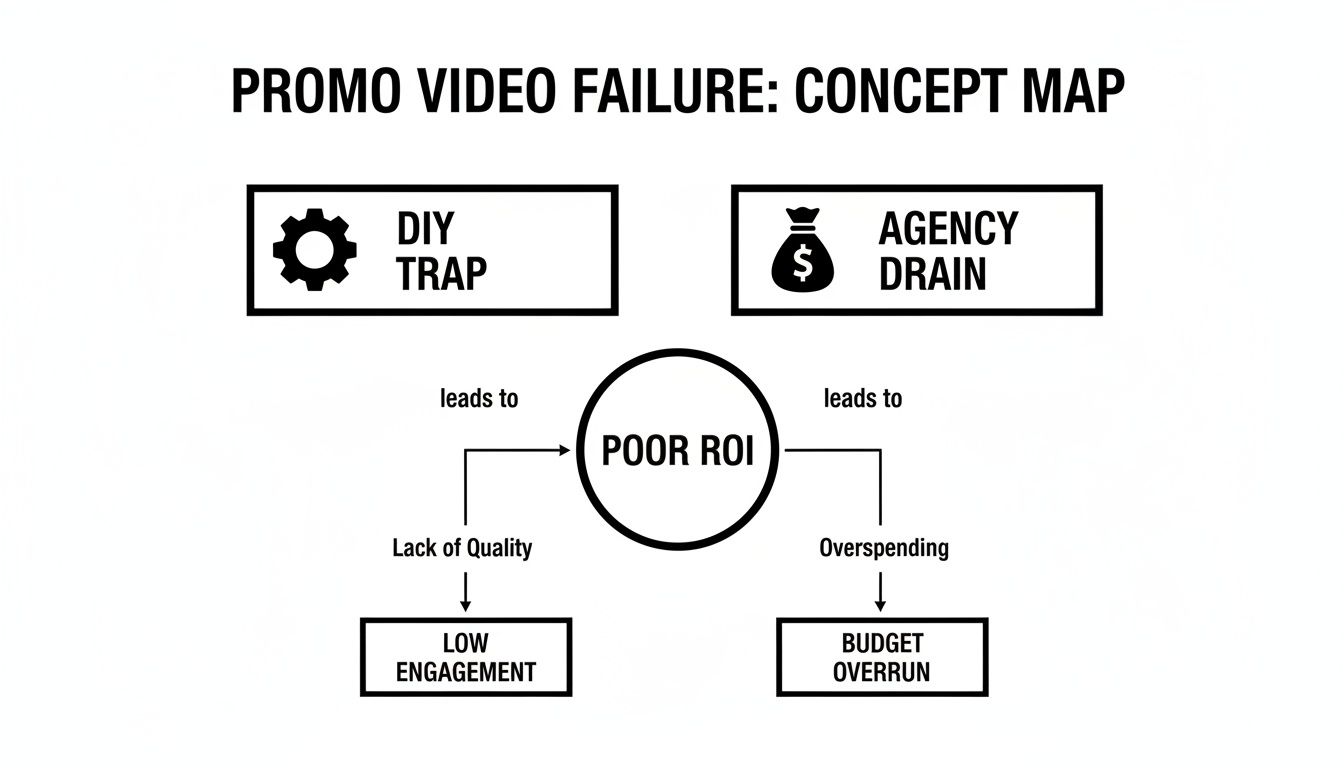
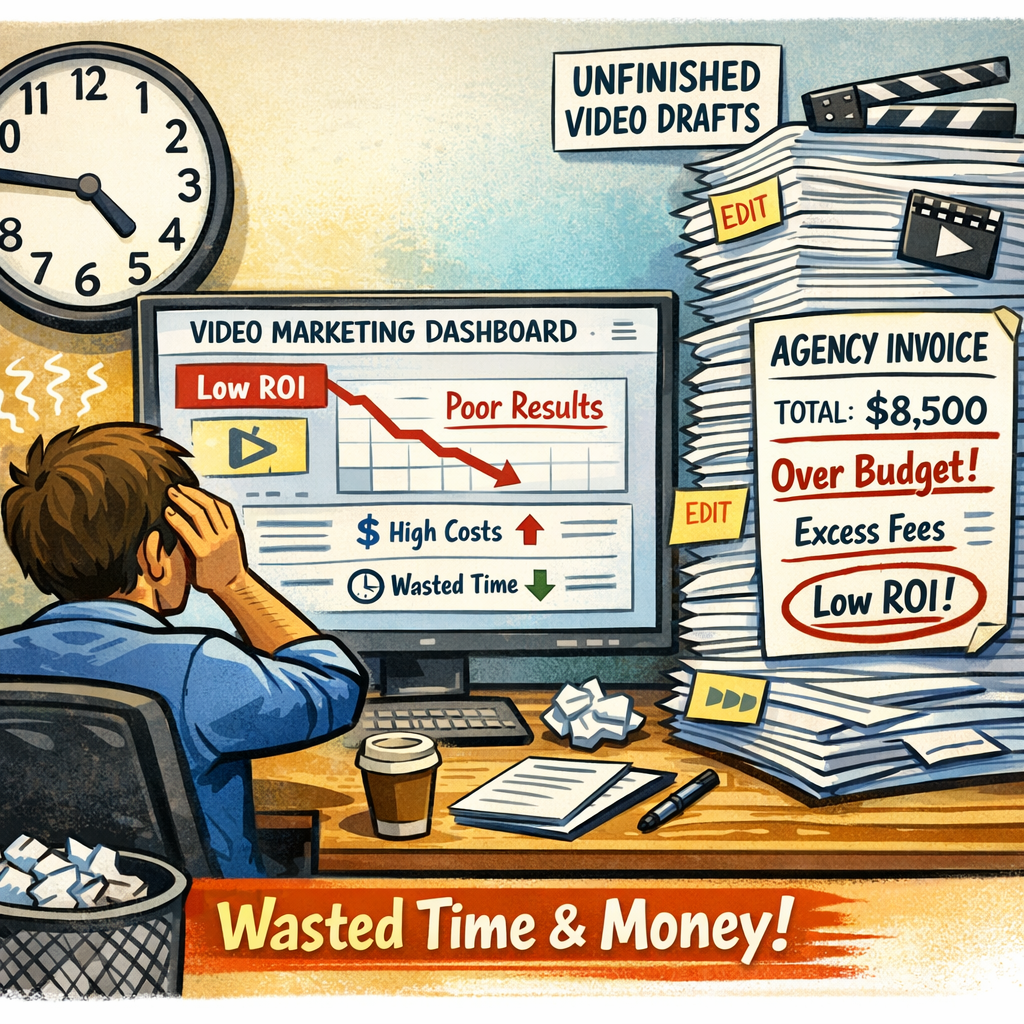
This map illustrates the two most common paths that lead to promo video failure.
As you can see, both the DIY Trap and the Agency Drain usually stem from the same root problem: a lack of a performance-focused structure. A framework is the middle path that avoids these costly pitfalls by focusing on a scalable, logical process.
When you're trying to decide how to produce your next video, it really boils down to three options. Each has its own set of trade-offs, from budget and speed to the final quality of what you get.
Comparing the Three Paths to Your Next Promotional Video
Attribute
The DIY Trap
The Agency Drain
The Structured Framework
Cost
Low initial cost, but high hidden costs in time and revisions.
$15k - $50k+. High, with retainers and scope creep.
Predictable, fixed cost. Often 90% less than an agency.
Speed
Slow. Weeks or months of learning, trial, and error.
Very slow. 2-4 month timelines are standard.
Extremely fast. Days, not months.
Process
Guesswork. Relies on templates and "creative" whims.
Complex. Endless meetings, briefs, and feedback cycles.
Defined and repeatable. Built on proven marketing logic.
Outcome
Unpredictable. Often looks amateur and fails to convert.
High-quality visuals, but often misses the business goal.
Consistent, high-quality results engineered to drive action.
Scalability
Not scalable. Every new video starts from scratch.
Difficult to scale without a massive budget.
Highly scalable. A repeatable system for all your video needs.
The choice you make here directly impacts not just your budget, but your ability to move quickly and get a positive return on your investment.
The goal of a promotional video isn’t to win a film award. It’s to get a qualified lead to book a demo, a new user to start a trial, or a confused customer to finally understand your product’s value. Structure ensures you stay focused on that outcome.
A solid framework forces you to answer the hard questions before you ever hit record:
Who is this actually for? Is it for a brand-new user who knows nothing about you, or a warm lead who just needs to see one specific feature in action?
What is the single most important message? If the viewer only remembers one thing, what do you need it to be?
What should they do next? Without a clear next step, you’re just making content for the sake of it.
Why Structure Is Essential Now More Than Ever
Business moves fast, and marketing needs to keep up with efficiency and clarity. A staggering 91% of businesses now use video as a core marketing tool, according to the latest report from Wyzowl.
Explainer videos are leading the charge at 68% usage—a format perfectly suited for SaaS founders. And with 93% of marketers reporting that video directly increases user understanding, a structured approach is the fastest track to converting that understanding into action.
A framework gives you that clarity. It helps you map out the entire customer journey within the video itself, from awareness to conversion. For a deeper dive, check out our guide on building your video marketing funnel blueprint.
Ultimately, structure is what separates a cost center from a revenue driver.
Crafting Your High-Conversion Video Plan
Alright, let's get practical. The difference between a video that gathers digital dust on your landing page and one that actually drives sign-ups comes down to the plan you make before hitting record.
Effective planning isn’t about writing a Hollywood script. It’s about making a few critical decisions that align every second of your video with a single, clear business goal.
Your video plan is a business document first and a creative brief second. Its primary job is to ensure your video delivers a measurable return on investment.
Without a plan, you’re just guessing. With one, every choice—from the script to the visuals to the call-to-action—has a purpose. This is how you turn a vague idea into a high-performance marketing asset.
Define Your Single Key Objective
Before you think about anything else, answer this one question: What is the single most important action you want someone to take after watching this video?
Be brutally specific. "Increase brand awareness" is too vague. A strong objective for a SaaS company looks like this:
Drive sign-ups for a 14-day free trial.
Get qualified leads to book a 30-minute demo.
Explain a complex new feature to reduce support tickets.
Build customer trust by showcasing a success story.
This single goal is your north star. It dictates the script, the tone, and the ideal length of your video. A video designed to get demo bookings will look and feel very different from one announcing a feature update.
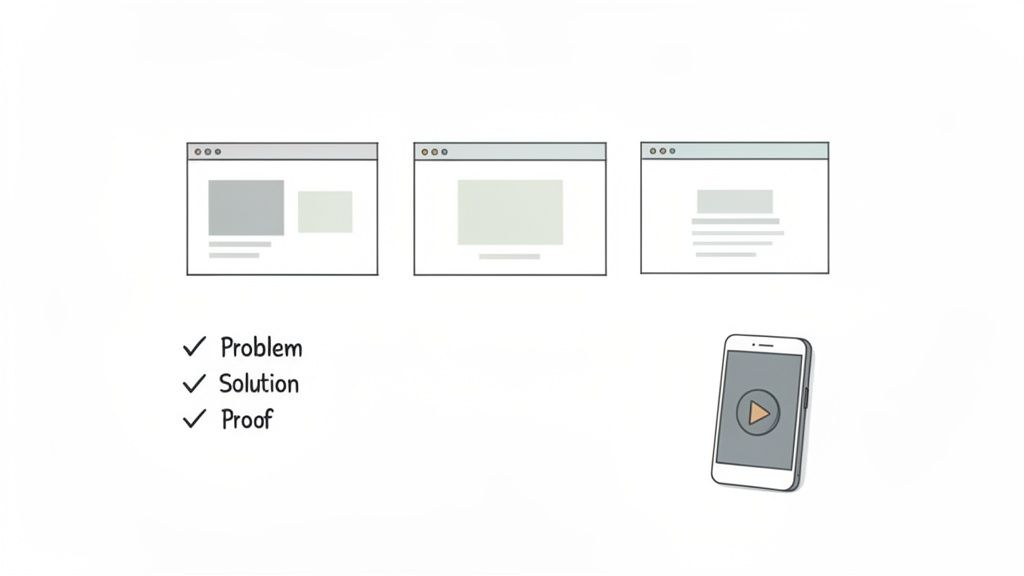
Script Around Problem, Solution, Proof
For SaaS products, the most effective narrative I've seen is the Problem-Solution-Proof model. It’s a simple but powerful structure that speaks directly to a user’s needs in a logical, compelling flow.
Here’s how it breaks down:
Problem: Start by articulating the exact pain point your customer is experiencing. Use their language. This builds immediate empathy and shows you get it.
Solution: Introduce your product as the clear, elegant fix. Don't just list features; show how it makes their work or life easier.
Proof: Now, show it in action. This is where you bring in clean screen recordings, UI animations, and social proof like testimonials or data points to build trust and prove your claim.
This simple structure keeps your message focused and ensures your promotional videos for companies connect with a pragmatic audience. To make sure the final cut is polished, always follow established video production best practices. And if you want to go deeper on scripting, we’ve put together a guide on how to make a compelling script.
Choose the Right Length and Tone
Your video’s length should be dictated by its platform and objective. Don't fall into the trap of making a one-size-fits-all video. It never works.
Landing Page Hero: Aim for 60-90 seconds. That’s the sweet spot for establishing the problem, presenting your solution, and showing proof without losing attention.
Social Media Ad: Keep it short and punchy, around 15-30 seconds. Your only job is to stop the scroll and drive a single click.
Detailed Feature Demo: These can be longer, maybe 2-5 minutes. The viewer is already invested and wants a deeper look.
Finally, match the tone to your audience. Are you talking to developers, founders, or product managers? A witty, peer-to-peer tone can work wonders for indie hackers, while a more polished, consultative voice might be better for enterprise decision-makers. Authenticity always wins.
Choosing the Right Video for Your SaaS Funnel
Not all promotional videos are built the same. Throwing a detailed, five-minute product demo on your homepage is like asking for a marriage commitment on a first date. It’s way too much, far too soon.
The secret to effective video marketing is matching the right video to the right moment in the customer’s journey. A visitor who just discovered your brand needs something completely different from a qualified lead who’s actively comparing you to three competitors.
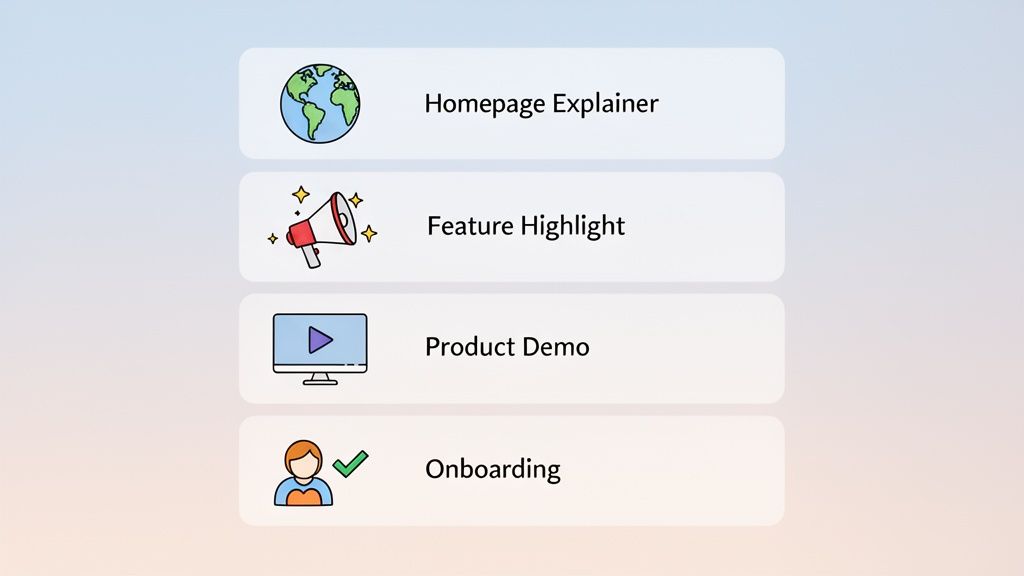
By strategically placing different promotional videos for companies throughout your funnel, you create a guided path from initial awareness to a happy, paying customer. Each video has one job to do. Let's break them down.
The Homepage Explainer Video
Think of this as your top-of-funnel workhorse. It’s often the very first real interaction a person has with your product, and its only goal is to answer one question in under 90 seconds: “What problem do you solve, and who do you solve it for?”
This isn’t the place for a feature list. It needs to be a sharp, concise story about your core value, usually built around a simple "Problem-Solution-Proof" narrative.
Recommended Length: 60-90 seconds.
Key Metrics:Play Rate (how many visitors bother to click play) and Average Engagement (what percentage of the video they actually watch).
Real-World Scenario: A first-time visitor lands on your homepage. They're skeptical and have about ten seconds to spare. Your explainer has to hook them and communicate value before they hit the back button.
The Feature Highlight Video
These are your short, punchy videos designed to announce product updates or showcase a single, high-impact feature. They’re perfect for social media feeds, email newsletters, and embedding in blog posts.
Unlike a broad explainer, a feature highlight is laser-focused. It zooms in on one workflow or benefit, showing its power quickly and visually.
Don't try to cram every new update into a single video. One powerful feature, clearly explained, is far more effective than a dozen rushed through in a confusing montage.
This approach keeps your existing users engaged and can even reactivate dormant leads by showing off new capabilities they’ve been waiting for.
The Detailed Product Demo
This is your mid-to-bottom-of-funnel heavy hitter. It’s for qualified leads who are past the "what is this?" stage and are now asking, "how would this actually work for my team?"
Here, you can take a bit more time—usually 2 to 5 minutes—to walk through specific use cases and workflows. This isn’t a sales pitch. It's a consultative walkthrough that builds confidence and answers detailed questions before they’re even asked.
Recommended Length: 2-5 minutes.
Key Metrics:Click-Through Rate on your CTA (e.g., to book a call or start a trial) and, ultimately, Conversion Rate.
Real-World Scenario: A prospect just read a case study or downloaded a whitepaper. They're on a dedicated feature page, seriously evaluating your product. This demo is your chance to seal the deal.
You can see more examples and find the best fit for your goals by exploring the different types of videos we’ve produced.
The Onboarding Video
Your job doesn’t end when a user signs up for a trial. A great onboarding video is a powerful tool for crushing churn and boosting activation rates.
These videos guide new users through their "first-win" moments—the key setup steps or initial actions that prove the product's value right away. They proactively answer common questions, which takes a load off your support team and helps users feel successful on their own. This is how you turn a fresh trial sign-up into a long-term, loyal customer.
Finding a Middle Path That Actually Works
So you're stuck. You can hire a pricey agency and wait forever, or you can try to make a video yourself and burn weeks of your own time. It feels like a lose-lose situation.
But what if the problem isn't the options themselves? What if the real issue is that neither path gives you a repeatable system built for speed, clarity, and most importantly, performance?
This is exactly why we built Forgeclips. It isn’t just another tool; it’s a philosophy of structure—the practical middle path designed to break this cycle. We created a framework-based system that blends the best of both worlds—AI-assisted speed to get you 80% of the way there, and human-polished quality to make sure the final video actually works.
Our entire approach was born from the specific pains we saw SaaS founders and product teams go through. We knew that waiting three months for a promo video was a non-starter, and a huge price tag was no guarantee of a high conversion rate.
Built for SaaS From the Ground Up
Let's be honest: traditional video production is not built for the speed of software development. A marketing agency might spend weeks on discovery calls and creative briefs while you're busy shipping code and iterating on your product. Forgeclips cuts right through that noise.
Our entire process is built around a structure that prioritizes business results over cinematic fluff. We’re obsessed with what actually drives sign-ups and demo requests for a SaaS product.
Performance Over Polish: A beautiful video that fails to explain your product's value is completely useless. We engineer videos to communicate your solution clearly and push viewers toward a specific action.
Structure Over Guesswork: Every video is built on a proven narrative framework, like the Problem-Solution-Proof model, that just clicks with a pragmatic SaaS audience.
Speed Over Endless Meetings: We replace long, painful feedback cycles with a streamlined, asynchronous process. You give us the details, and we can deliver a polished video in as little as 48 hours.
This isn't about finding a cheaper agency; it's about adopting a smarter, more efficient system. It’s a philosophy of structure that delivers predictable, high-quality results without the usual friction.
How a Framework-Based System Solves the Timeline and Cost Issue
The reason agencies are so expensive is the sheer amount of manual overhead—countless meetings, drawn-out revisions, and bloated project management hours. The reason DIY is so slow is the steep learning curve and the lack of a repeatable process. You’re just winging it.
Forgeclips solves both problems by systemizing the entire production.
By using pre-built structures tailored specifically for promotional videos for companies, we eliminate the guesswork and drastically shrink production time. Our AI handles the initial heavy lifting, like scripting outlines and generating voiceovers, while our human editors come in to handle the crucial final polish. That’s what ensures professional quality.
This hybrid approach allows us to deliver studio-grade videos at a fraction of the cost and time. It finally makes it possible to create high-impact promotional videos without draining your budget or your calendar. It's the practical, effective middle path that actually gets the job done.
Your Top Questions About Promotional Videos, Answered
I get it. Jumping into video production brings up a lot of questions, especially when you're a founder trying to make every single dollar and minute count. Let's get straight to the answers for the most common ones I hear.
How Long Should My Promotional Video Be?
Your promotional video should be between 60-90 seconds for a landing page, 15-30 seconds for social media ads, and 2-5 minutes for in-depth product demos. The right length depends entirely on the platform and the viewer's level of interest. A short, punchy video grabs initial attention, while a longer one serves leads who are already evaluating your solution.
On a website landing page, you’ll want to aim for 60-90 seconds. That's the sweet spot to clearly lay out your value proposition without your visitor’s attention drifting. But for social media ads on a platform like LinkedIn or Instagram, you have to move much faster. Stick to 15-30 seconds to stop the scroll and hammer home one powerful message.
Now, if you're creating a detailed feature demo for qualified leads, you can go longer—think 2-5 minutes. Those viewers are already invested and are actively looking for a deeper dive. The real key is to make every second earn its place and match the length to the viewer's mindset at that moment.
What Metrics Should I Actually Track to Measure ROI?
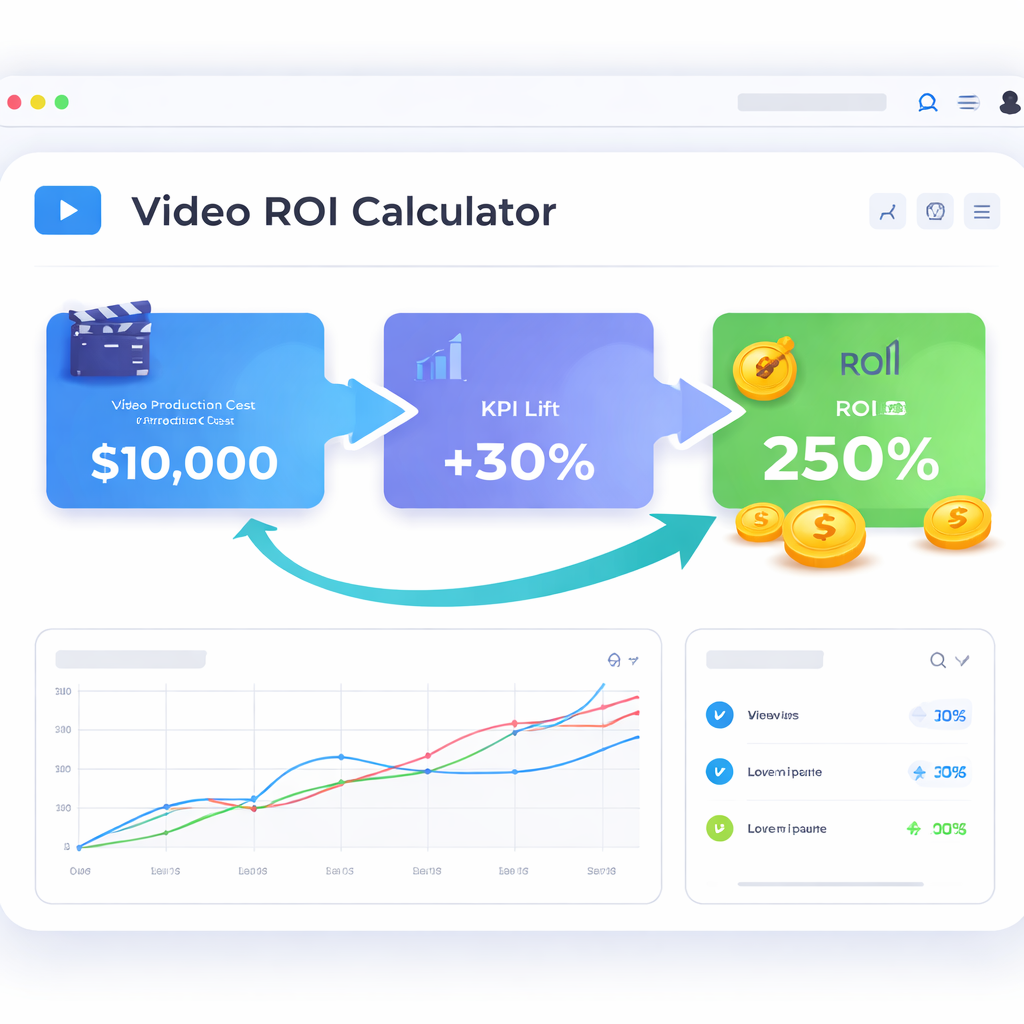
To measure the ROI of a promotional video, track conversion-based metrics like Play Rate, Engagement Rate, and Click-Through Rate (CTR) on your call-to-action. These metrics connect video views directly to business goals like demo requests or trial sign-ups, unlike vanity metrics such as total view count.
Here are the ones that really matter:
Play Rate: What percentage of people on the page actually clicked the play button? This tells you if your thumbnail and placement are grabbing attention.
Engagement Rate: How much of the video did people watch on average? If you see a steep drop-off in the first few seconds, your intro probably isn't working.
Click-Through Rate (CTR): Of the people who watched, what percentage clicked your call-to-action (CTA)? This is arguably the most important metric of them all.
Ultimately, your goal is to draw a straight line from video views to tangible business outcomes like demo requests, free trial sign-ups, or new feature adoption.
How Much Does a Good Promotional Video Cost?
A good promotional video can cost anywhere from $1,000 for a freelancer to over $50,000 for a full-service agency. However, cost doesn't guarantee performance. A more predictable and affordable option is a framework-based system, which can deliver high-quality, conversion-focused videos for a fraction of the typical agency price by streamlining the production process.
The cost can be all over the map, and honestly, that’s a big part of the problem. A freelance animator might quote you anywhere from $1,000 to $5,000. A full-service creative agency? They can easily run you $10,000 to $50,000 (or more) for a single high-end video.
The real issue isn't just the price tag; it's the shocking lack of correlation between high cost and high performance. An expensive, cinematic video isn't guaranteed to convert anyone.
This is where a structured, framework-based approach comes in. It offers a much more predictable and affordable path. By standardizing the creative process, you can get conversion-focused promotional videos for companies for a tiny fraction of the typical agency price.
Ready to create high-performing promotional videos without the agency headaches or DIY frustration? At Forgeclips, we use a framework-based system to deliver studio-quality videos in just 48 hours. See how it works at https://forgeclips.com.