You've been there. You need a crisp, compelling product video for your SaaS landing page, but the quotes you get back are staggering. A five-figure price tag for a two-minute demo? It feels completely broken.
The real video production cost for a quality SaaS demo or explainer video ranges from $2,500 to $7,000 for a specialized studio and $8,000 to $20,000+ for a traditional agency. The price is driven by the production process, talent, and complexity, not just the video's length.
Why Is Getting a Good Product Video So Hard?
Let’s be honest—the entire process of getting a professional video made feels stuck in the past. It’s a frustrating dance that pits your budget against your brand’s reputation. You’re caught between two equally bad options.
First, there's the ‘Agency Drain’. This is the traditional path, paved with endless meetings, bloated overhead, and timelines that stretch for weeks, if not months. You end up paying for layers of project managers and high-production fluff that often misses the point: explaining your product with absolute clarity.
On the other side, you have the ‘DIY Trap’. To save cash, you dive into complex editing software yourself. You sink valuable hours—time you could have spent talking to customers or shipping features—just wrestling with timelines and clunky templates. The result is often a video that looks amateurish, fails to build trust, and ultimately hurts your conversions. The money you "saved" is lost ten times over in opportunity cost.
This dilemma is getting worse because the demand for corporate video is exploding. The market is seeing wild shifts, with yearly demand growing by 15%. That's pushing spending past $30 billion by 2026.
Even basic videos now run $2,000-$5,000, with standard corporate projects hitting $5,000-$15,000. And if you want high-end cinematic visuals or 3D graphics? That can easily soar to $20,000-$50,000 or more, as you can see in a detailed look at corporate video production trends.
This forces a difficult choice for most SaaS founders, product managers, and indie hackers. Do you drain your marketing budget on an expensive agency or risk your brand's image by going it alone?
The core problem isn't just about the video production cost. It's about an outdated, inefficient system that fails modern, fast-moving tech companies. Getting a high-quality video that clearly explains your software and drives results shouldn't be a painful trade-off.
The real issue is the process itself. It’s a system that prioritizes either cinematic polish over clear communication or low cost over professional quality. Neither extreme serves a SaaS business that needs to demonstrate value, build user trust, and scale quickly. There has to be a better way.
So, what are you actually paying for when you get a quote for a professional video? The sticker price can feel like a black box, but the costs aren't arbitrary. They’re a direct reflection of the time, talent, and complexity that go into the work.
Think of it like building a custom piece of furniture versus assembling a flat-pack kit. One requires skilled artisans, detailed blueprints, and specialized tools. The other just needs an afternoon and an Allen key. Video production works the same way—costs are tied directly to the level of expertise and customization involved.
The Three Phases of Production
Every video project, whether it’s a simple screen recording or a polished brand film, moves through three distinct stages. Each phase has its own costs that stack up, and understanding them helps demystify that final number.
Pre-Production (The Blueprint): This is the planning stage, and it's where most projects are won or lost. It includes scripting, storyboarding, concept development, and casting. A rushed or vague script here almost guarantees expensive fixes down the line.
Production (The Shoot): This is the actual creation phase. For animated or product videos, this is where the screen recording, asset creation, and animation happens. For live-action, it involves the crew, cameras, lighting, and sound equipment.
Post-Production (The Polish): Here’s where everything comes together. Editing, color grading, sound design, mixing, voice-over recording, and adding motion graphics are all part of this phase. It can easily become the most time-consuming and expensive stage, especially if the pre-production was weak.
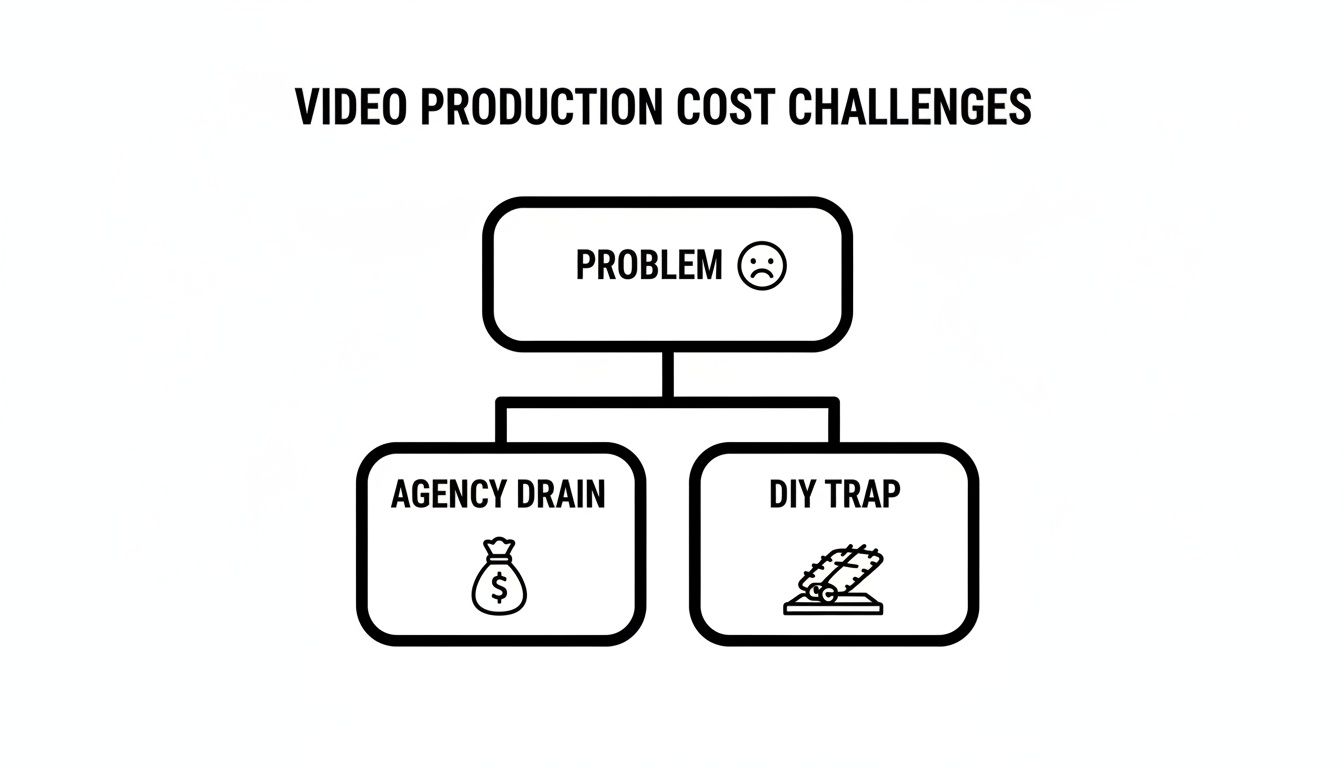
This next diagram breaks down the two frustrating paths most founders face when trying to get a video made.
As you can see, you’re often forced to choose between the high cost of the "Agency Drain" and the low quality of the "DIY Trap." Neither is an efficient way to get a great product video.
Key Cost Drivers Explained
Beyond the three phases, a few specific elements have an outsized impact on the final price tag. It’s almost never about the camera; it’s about the people and the complexity of the story you want to tell.
Professional projects typically run between $5,000 and $50,000. The final number is driven by story complexity, crew size, and how many final videos you need. Smaller digital ads might land in the $5,000-$15,000 range, while more involved campaigns can climb to $15,000-$30,000 or more.
Talent is a huge factor. A good motion graphics artist can bill $250-$1,000 per day, and a specialized 3D animator can command up to $2,500 per day.
The biggest mistake you can make is trying to cut costs in pre-production. A well-structured script and a clear storyboard are the best insurance you can buy against a ballooning budget and a video that doesn't perform.
This table provides a realistic cost comparison for common SaaS video types across different production methods, helping you budget effectively. For a deeper dive, check out our guide on practical video marketing pricing for SaaS founders.
Estimated Video Production Cost by Type and Model (2026)
This table provides a realistic cost comparison for common SaaS video types across different production methods, helping you budget effectively.
Video Type
High-End Agency
Freelancer or Small Studio
DIY (Software + Time)
Simple Product Demo (1-2 min)
$8,000 - $20,000+
$2,500 - $7,000
$100 - $500 (plus your time)
Explainer Video (Animated)
$10,000 - $30,000+
$3,000 - $10,000
$200 - $800 (plus your time)
Brand Story / About Us
$15,000 - $50,000+
$5,000 - $15,000
Highly variable, often low quality
Onboarding Series (3-5 videos)
$20,000 - $60,000+
$7,000 - $20,000
$300 - $1,000 (plus your time)
As you can see, the gap between a DIY video and a high-end agency is massive. This is where most SaaS companies get stuck, searching for a way to get professional quality without the enterprise-level price tag.
The Hidden Costs of Traditional Video Production
The sticker price on a video production quote is just the tip of the iceberg. The real costs aren't in the line items you see; they're buried in broken processes, endless meetings, and wasted time. The advertised price is almost never the full story.
Let's pull back the curtain on the two dominant—and deeply flawed—approaches that trap most SaaS companies.
The Agency Drain
First, you have the "Agency Drain." This is the path paved with good intentions but burdened by a model that’s fundamentally misaligned with the speed of modern tech. The high video production cost comes from layers of overhead you don't see. You’re not just paying for a video; you're funding the fancy office, the account executives, the project managers, and the endless meetings required to keep their machine running.
This structure breeds slowness. A simple request—like changing a scene or updating a UI element—can trigger a chain reaction of emails, internal huddles, and approvals that adds days, or even weeks, to your timeline.
Imagine a startup founder trying to get a straightforward product demo out the door. They submit clear feedback, then wait. And wait. What should have been a quick tweak turns into a six-week revision cycle, all while their launch date slips and competitors gain ground.
The agency model is also biased toward "high-production fluff." Their incentive is to create something that looks impressive in their portfolio, which often means adding cinematic flair that adds cost but not clarity. For a SaaS product demo, you need surgical precision, not a Hollywood epic. The goal is to show your user how to solve their problem, not distract them with lens flares. The focus shifts from ROI to art, and you’re the one who pays for it.
This inefficiency isn't a bug; it's a feature of the traditional agency model. The more time and resources they spend, the more they can justify their high fees. It's a system built for big brands with big budgets, not for agile teams that need to move fast.
The DIY Trap
On the opposite end of the spectrum is the "DIY Trap." This is the path of false economy, where you try to save money but end up paying a much higher price in lost opportunity. The true cost of DIY isn't the $40/month software subscription; it's the hours of your most valuable resource—your own time—that you burn trying to become a video editor overnight.
Founders and marketers spend weekends wrestling with complex tools, trying to fix bad audio, and forcing clunky templates to look halfway decent. Every hour spent on that is an hour not spent talking to customers, shipping features, or closing deals. This opportunity cost is massive.
A delayed campaign held up by a half-finished video can cost thousands in lost revenue. You can learn more about how a structured approach streamlines the creation of visuals, such as in the process of animation, to avoid this very trap.
Beyond your time, there's the direct financial impact of a low-quality video that just doesn't work.
It Erodes Trust: An amateurish video with poor audio or confusing visuals makes your product look unprofessional. If you can’t get your marketing video right, why would a user trust you with their data?
It Fails to Convert: A poorly structured video doesn't just look bad; it fails to communicate value. If viewers are confused, they won't sign up. It’s that simple.
It Wastes Ad Spend: Running paid ads to a landing page with a low-converting video is like pouring water into a leaky bucket.
Both extremes are deeply inefficient for a fast-moving tech company. One drains your bank account, and the other drains your time and kills your momentum.
Why A Better Process Beats A Bigger Budget
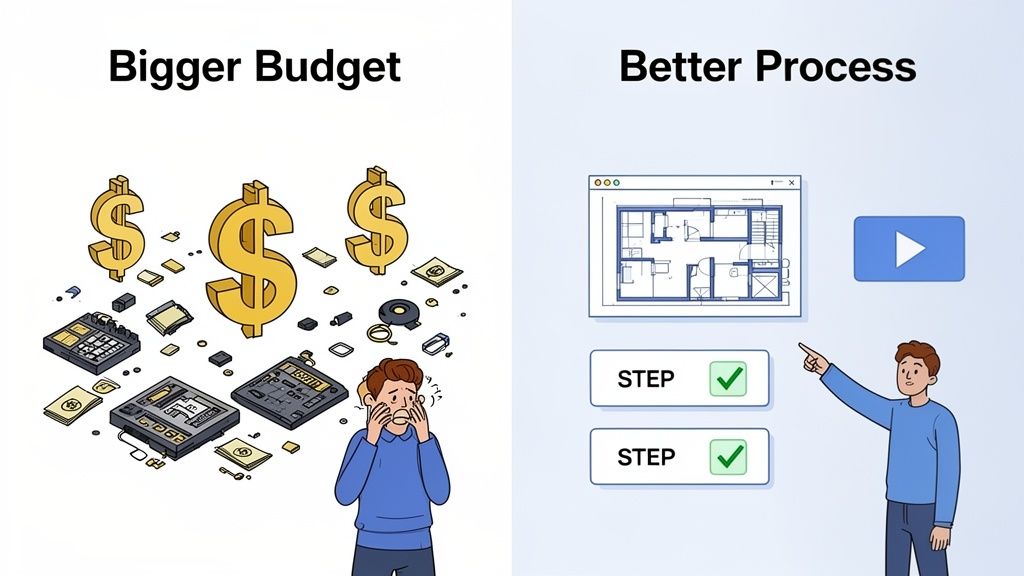
So, if expensive agencies are an inefficient drain and the DIY route is a trap that costs you time and conversions, what’s left? The answer isn’t just to throw more money at the problem. The secret to affordable, high-impact video isn’t a bigger budget—it’s a better process.
Think about it like building a house. You wouldn’t just hand a construction crew a pile of lumber and say, "Go be creative!" You'd start with a blueprint. That blueprint ensures every wall is load-bearing, every room has a purpose, and the final structure is sound. Without it, you get chaos, spiraling costs, and a house that might just fall over.
Video production is no different. A structured, framework-based approach is your blueprint. It eliminates the guesswork and wasted motion that inflate your video production cost and ensures every second of your video is doing a specific job.
From Blank Slates to Strategic Blueprints
The myth that great creativity demands a blank slate is one of the most expensive ideas in marketing. For a SaaS product video, where clarity is king, constraints aren’t the enemy; they’re your best friend. A good framework forces focus.
Instead of starting from scratch, a structured process defines the core narrative beats your video must hit to succeed. For a typical product demo, this often looks like:
The Hook: Open with a relatable pain point your target user knows all too well.
The Problem: Briefly show the clunky "old way" of doing things that causes this frustration.
The "Aha!" Moment: Introduce your software as the clear, elegant solution.
The How: Demonstrate the core functionality that actually delivers on the promise.
The Call to Action: Tell the viewer exactly what to do next, like starting a trial or booking a demo.
This isn't about stifling creativity; it's about channeling it. By defining the "what," you free up creative energy to obsess over the "how"—making each scene as clear, concise, and compelling as possible.
When you have a proven structure, you stop wasting time and money debating subjective creative choices. The conversation shifts from "Does this look cool?" to "Does this clearly communicate value and drive the user to act?" That shift is everything.
The Financial Upside of Structure
Adopting a framework has a direct and immediate impact on your video production budget. It systematically attacks the very sources of cost-inflation we’ve been talking about.
Minimized Revisions: When everyone agrees on the blueprint upfront, the endless back-and-forth of the "agency drain" all but disappears. A clear structure means fewer surprises and can lead to a 90% reduction in costly post-production changes.
Accelerated Production: With a defined path, production becomes an exercise in execution, not open-ended exploration. This speed collapses timelines from weeks into days, getting your video to market and working for you faster.
Focus on Performance: A structured process ensures your video is built for one purpose: performance. It prioritizes clarity and conversion over cinematic fluff that adds cost but not ROI.
This doesn't mean you can't be resourceful in other ways. In fact, smart processes and things like user-generated content (UGC) can work together. There are many affordable tools for UGC video marketing that complement a structured approach without draining your budget.
Ultimately, a better process lets you get a superior result for a fraction of the cost, sidestepping the false choice between quality and affordability. You get the polish of an agency-level video without the bloated price tag, and the speed of DIY without sacrificing professional quality. It’s simply the smarter path forward.
Finding a Smarter Path for SaaS Video
If agencies burn through your budget and DIY sucks up your time, you're left with a frustrating choice. But the solution isn't to pick the lesser of two evils. It's to find a completely different path that sidesteps the problems of both.
This isn't about a single magic tool. It's about a smarter system—a structured process that directly targets the biggest drivers of high video production cost. Think of it as part intelligent automation, part expert craftsmanship.
This path is a hybrid pipeline, an approach where AI and human expertise work together, with each one handling what it does best.
The Hybrid Model: AI and Human Polish
This new model isn't about replacing talented humans. It's about empowering them. It uses AI to take on the repetitive, time-draining tasks that inflate agency timelines and make DIY video feel like a chore. That frees up human experts to focus entirely on what makes a video great: nuance, storytelling, and final polish.
Here’s how that plays out when making a SaaS video:
AI-Assisted Scripting: Instead of staring at a blank page, AI can generate a solid first-draft script based on a proven framework and your product's value proposition. This gets you a workable script in minutes, not days.
Automated Asset Collection: A guided system helps you capture the exact UI elements needed for the story. This replaces messy, manual screen-capping and ensures everything looks consistent and professional right from the start.
Human-Driven Polish: Once the AI handles the heavy lifting, a human editor steps in. They refine the script, perfect the timing, adjust the pacing, and make sure every visual serves the narrative. This is where the magic happens—that final 10% of polish that makes a video feel trustworthy and professional.
This hybrid approach directly solves the cost issues we broke down earlier. It cuts pre-production time, gets rid of pointless meetings, and turns post-production into a phase for refinement, not rescue.
The goal is to make the creation process so efficient that high-quality video becomes accessible, not aspirational. It’s about delivering a studio-quality product demo in a couple of days, not six weeks, for a fraction of the agency price.
Structure as a Service
This philosophy of structure is the engine behind Forgeclips. We didn’t just build another template library; we built a system that embodies this hybrid model. We see video as a performance asset—a tool designed to do a specific job for your SaaS business.
Our frameworks give you the blueprint. Our hybrid pipeline executes it with speed and precision. You’re no longer forced to choose between the Agency Drain and the DIY Trap. You can get a video that looks professionally produced, clearly communicates your product's value, and actually helps you grow. If you're curious to see it in action, you can find out more about our approach to AI-powered video creation.
By focusing on a repeatable, structured process, you break free from the inflated costs of traditional production. You get a better result, faster, and at a price that makes sense for a fast-moving tech company. This isn’t just a new way to make videos—it’s the logical next step for any SaaS business serious about growth.
How to Budget for and Measure Video ROI
Thinking about video as a pure "cost" is the fastest way to get it wrong. It's time to hit reset on the conversation around your video production cost. This isn't about how much animation you can squeeze into a budget; it's about what business goal you absolutely need to hit.
Instead of asking, “How much for a two-minute video?”—start here: “What conversion lift do I need to make this a no-brainer investment?” That single question changes everything. It reframes video from a creative expense into a performance asset, turning a line item into a growth engine.
This approach forces you to build a budget tied to outcomes, not just flashy features. You stop paying for high-production fluff and start investing in what actually moves the needle: clarity and results.
Moving Beyond Vanity Metrics
First things first: you have to track the KPIs that actually matter to a SaaS business. Forget about raw view counts or likes. Those are vanity metrics, and they don’t pay the bills. The real value is measured in user action and operational savings.
For SaaS product videos, these are the indicators that count:
Conversion Rate Lift: Does the video get more visitors to sign up or book a demo? A/B test your page with and without the video to get a clean read.
Demo Viewer Retention: Are people watching your demo all the way through? A huge drop-off right when you explain a key feature is a massive red flag that your message is broken.
Fewer Support Tickets: A great onboarding video answers questions before users even think to ask. A measurable drop in "how-to" support queries is pure, undeniable ROI.
Increased Feature Adoption: Are users actually trying the new features you highlighted in an update video? Track the adoption rate of those specific features after the video goes live.
While some creators focus on monetization metrics like how many views you need to make money on YouTube, that’s a different game. For SaaS, the impact on conversions and customer lifetime value is where the real money is.
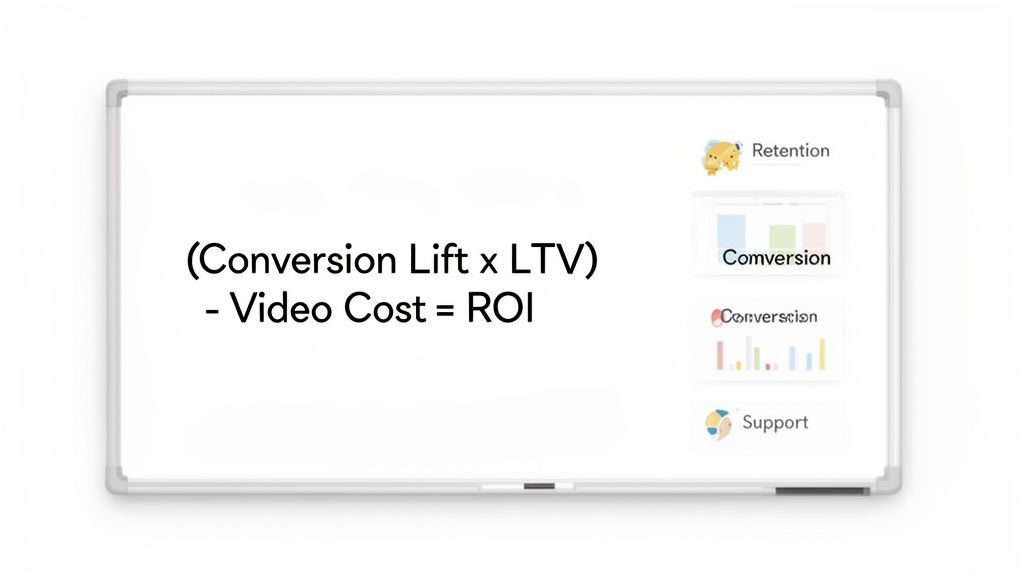
A Simple Formula for Video ROI
Once you’re tracking the right metrics, you can build a rock-solid business case for your video spend. You don’t need a complex financial model—a simple formula is all it takes to connect video performance to real dollars.
This moves the entire discussion from subjective creative opinions to objective data. If you want to dig deeper, you can learn more about how to use a SaaS video cost calculator to dial in your spending.
(Expected Conversion Lift x Customer LTV) - Video Cost = ROI
Let's run the numbers with a quick example.
Imagine your average customer lifetime value (LTV) is $2,000. You spend $4,000 on a tightly structured product demo video for your landing page. After launching it, your trial sign-up rate increases by just 5%.
If that page gets 1,000 relevant visitors a month, that 5% lift translates to 50 extra sign-ups. If your trial-to-paid conversion rate is 10%, that’s 5 new customers. Every single month.
Those 5 new customers are worth $10,000 (5 x $2,000 LTV). Your video paid for itself more than twice over in the very first month. That’s the power of shifting from "cost" to "investment."
Frequently Asked Questions About Video Cost
Figuring out video production costs can feel intentionally confusing. You get a dozen different quotes, a ton of vague promises, and no clear path forward.
Let's cut through the noise. Here are the straight answers to the questions we see founders and product teams wrestling with all the time.
How Much Should a SaaS Product Demo Cost?
For a professionally made SaaS product demo, you should expect to invest between $2,500 and $7,000 when working with a skilled freelancer or a specialized studio like ours. A traditional, high-end agency will often start their quotes at $8,000 to $20,000+ for the exact same outcome, mostly to cover their overhead.
Be very skeptical of any quote under $1,500. That low price usually signals a cookie-cutter template or a lack of real-world experience. A great demo isn't just a screen recording; it's a meticulously structured sales asset designed to convert.
Can I Just Make a Product Video Myself?
You absolutely can, but you have to be honest about the real cost. The "DIY Trap" isn't about the price of a software subscription—it's about the 20-40 hours of your own time you’ll burn learning editing tools, fixing rookie mistakes, and fighting with clunky templates.
If you value your time at more than $100/hour, you'll quickly realize that doing it yourself is often more expensive than hiring an expert who can do it right the first time.
The biggest hidden cost of DIY is a poor-quality video that fails to convert. Saving $2,000 on production only to lose $10,000 in potential customers is a terrible trade-off.
Why Are Revisions So Expensive?
Revisions get expensive because they break the production workflow. A "simple" change can force an editor to reopen a project, shift the timeline, re-sync the voiceover, and re-render everything. What seems like a small tweak can easily snowball into hours of tedious work.
This is precisely why a structured, framework-based process is so critical. By locking in the script and storyboard first, you eliminate almost all of the painful back-and-forth that bloats timelines and budgets. Solid pre-production is the best insurance you can buy against costly post-production fixes.
What's More Important: Budget or Process?
Process. Every single time. A bigger budget can’t save a broken, chaotic process. We’ve seen companies burn $30,000 on a "cinematic" product video that completely flopped because it never got around to clearly explaining what the product actually did.
On the flip side, a tight, well-defined process can turn even a modest budget into a powerful, high-performing video. It forces clarity from the start, cuts out wasted effort, and focuses every dollar on what matters: showing users exactly how you solve their problem. A better process is what ultimately lowers your effective video production cost by delivering a far better return on investment.
Ready to skip the agency drain and the DIY trap? Forgeclips offers a framework-based system to create studio-quality SaaS videos in days, not weeks. Get your high-performing product video today.