A great SaaS marketing video should be your best salesperson. It’s supposed to explain your product’s value so clearly that it turns curious viewers into active users. So why are most of them just slick-looking assets on a landing page that don't actually convert?
The problem usually isn't the production value—it’s the lack of a coherent structure. Without a clear framework designed for clarity, you're just making expensive noise.
Why Most SaaS Marketing Videos Fail to Convert
That video you poured your heart into? The one on your homepage? It probably isn't performing the way you hoped. Whether you spent endless nights wrestling with editing software or wrote a massive check to a creative agency, the sign-up needle just hasn't moved.
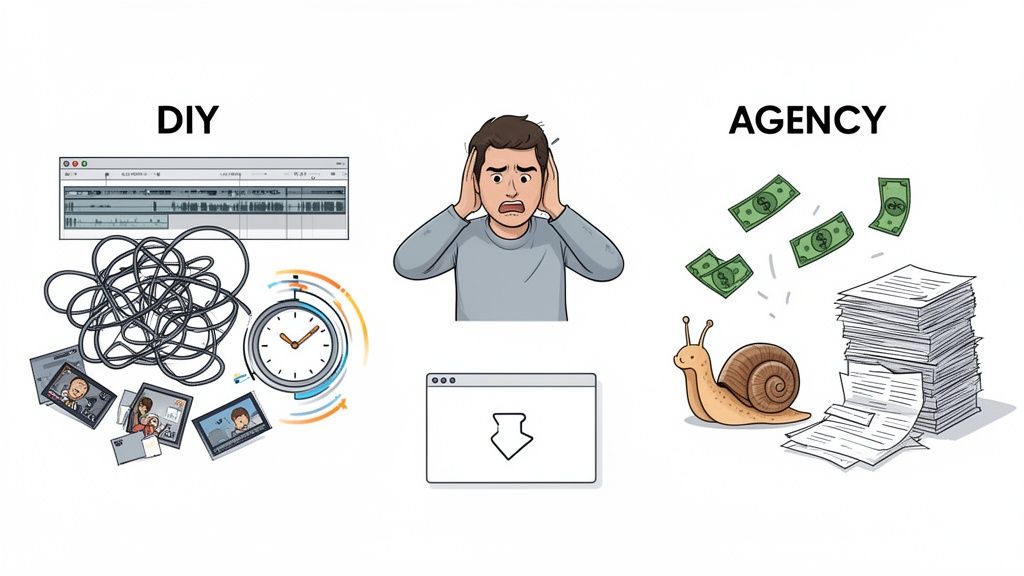
It’s a frustratingly common story, and it has almost nothing to do with your product. The real issue is the broken process most teams use to create videos. Founders and marketers usually find themselves stuck between two terrible options: the DIY Trap or the Agency Drain.
The Two Paths to Poor Performance
The DIY route feels great at first. You have total creative control and no eye-watering invoices. But it quickly spirals into a time-sucking vortex of confusing software, missed deadlines, and endless back-and-forth on revisions. The final product ends up as a jumble of feature callouts that never tells a clear story, leaving potential customers more confused than when they started.
Then you have the agency path. You hire pros who promise a cinematic masterpiece. Weeks bleed into months, and the budget quietly inflates. You finally get a video filled with high-production fluff—sweeping drone shots and abstract animations that look impressive but say nothing about how your software solves a real, painful problem. Your core value gets lost in the creative chaos.
The root cause of failure for most SaaS marketing videos isn't the camera or the editing software—it's the absence of a clear, logical framework. Without structure, you’re just making expensive noise.
The Real Cost of a Flawed Video
A video that doesn't convert is more than a missed opportunity; it actively hurts your business. It sends bounce rates soaring, torches your ad spend, and forces your support team to field the same basic questions over and over again. To get results, your videos need to be built on a solid foundation, which starts with a modern video content marketing strategy.
The fix isn’t about spending more money or becoming an editing wizard. It’s about a fundamental shift in thinking—one that prioritizes structured clarity over artistic improvisation. It's about building your video on a framework designed for one thing: turning a curious viewer into a happy user.
The Unfair Advantage of a Structured Video Framework
Improvisation is great for a jazz solo, but it’s a conversion killer for product marketing. When it comes to a SaaS marketing video, a structured framework isn’t just a nice-to-have—it's the single most important element for turning curious viewers into paying customers.
Think about the last time you watched a confusing product video. It probably jumped between random features, burying the one thing you actually wanted to know. That mental friction is exactly what tanks conversion rates.
A great framework prevents this by acting as a trusted guide. It systematically answers your viewer's unspoken questions in the exact order their brain needs to hear them: ‘What is this?’, ‘How does it solve my specific problem?’, and ‘What does it look like in action?’.
Structure Creates Clarity and Trust
An unstructured "feature tour" video is like handing someone a user manual and expecting them to get excited. It forces them to do all the cognitive work, connecting the dots between features and their own real-world problems. Most won't bother.
A framework-driven video, on the other hand, tells a story. It starts with the viewer’s struggle, introduces your product as the obvious hero, and then shows that ‘aha!’ moment where their problem just… disappears. This narrative approach makes your value proposition stick.
A video framework is like a well-architected API—it’s designed for a specific, predictable, and successful outcome. It doesn't limit creativity; it channels it toward a single goal: user acquisition.
This structured clarity is also a huge benefit for what we call Answer Engine Optimization (AEO). Just as a well-organized blog post helps Google understand its purpose, a clearly structured video helps both humans and search algorithms recognize the exact problem you solve.
Frameworks Deliver Faster ROI
Speed and efficiency are everything. Data shows that 91% of SaaS businesses now use video in their marketing, and for good reason—video content delivers ROI 49% faster than text alone. This isn't a luxury; it's a critical tool for managing rising customer acquisition costs.
A framework pours fuel on that fire by eliminating the guesswork. Instead of getting stuck in endless creative debates and revision cycles, you start with a proven blueprint. This structured approach is the entire philosophy behind a good storyboard template for your video, making sure every single second serves the ultimate goal of conversion.
Deciding how to create your video is just as important as deciding what to put in it. Let's break down the three common paths founders and marketers take.
The SaaS Video Dilemma: DIY vs. Agency vs. Framework
Attribute
DIY (Do-It-Yourself)
Traditional Agency
Framework-Based System (Forgeclips)
Speed
Excruciatingly slow; depends entirely on your learning curve.
Very slow; typically a 4-8 week slog from kickoff to delivery.
Fast; predictable timelines, often under 48 hours.
Cost
"Free" in cash, but incredibly expensive in founder time.
High upfront cost; often $5,000 to $50,000+.
Affordable and built to scale for multiple video assets.
Clarity
Often confusing; a jumble of features with no clear benefit.
Prone to "creative fluff" that buries the core message.
Built on a clear narrative: Problem > Solution > Proof.
Outcome
Unpredictable; usually results in a video that doesn't convert.
Polished but often lacks a direct impact on sign-ups.
Predictable; optimized for user understanding and action.
Ultimately, a framework gives you an almost unfair advantage.
While others are stuck in the messy middle of DIY trial-and-error or the slow lane of agency production, a framework gives you a direct path to a clear, compelling, and high-converting video. It’s the most reliable way to build a SaaS marketing video that doesn’t just get views—it gets users.
Choosing the Right SaaS Video for Your Business Goal
Not all videos are created equal. Trying to use the wrong video at the wrong time is like bringing a hammer to turn a screw—it’s a frustrating waste of effort that will get you nowhere. The trick is to match the video format to a specific business goal and the person you're trying to reach.
This goes way beyond just slapping a label like "explainer" or "demo" on a video file. It's about understanding the job each video is meant to do. An explainer video is your top-of-funnel workhorse, built to snag attention and make your value proposition crystal clear in seconds. A product demo, on the other hand, is for warmer leads who are already looking for a solution and need to see exactly how your software solves their problem.
Using the right tool for the job makes all the difference. Get it wrong, and you’ll see confusion and high drop-off rates. Get it right, and you’ll guide viewers smoothly to the next step.
The Explainer Video: Your Top-of-Funnel Hook
Think of an explainer as your 90-second elevator pitch. It has one mission: to answer a first-time visitor's question, "What is this, and why should I care?" This isn't the place for a laundry list of features or a deep technical dive.
Its only job is to communicate your core value with absolute clarity. These videos are perfect for building broad awareness and belong on your homepage, in social media ads, and at the very top of your marketing funnel. The goal isn’t to close a deal on the spot; it's to earn another few minutes of someone's time.
Ideal Length:60-90 seconds. Keep it short, sweet, and to the point.
Key Story Beats: Kick off with the customer's problem, introduce your solution as the hero, and stick the landing with a clear benefit.
Primary Channels: Homepage, landing pages, LinkedIn posts, and paid ad campaigns.
The Product Demo: Turning Interest into Action
Once a prospect gets what you do, they’ll want to know how you do it. This is where the product demo steps into the spotlight. A great demo isn't just a boring screen recording; it’s a value-packed showcase for someone actively evaluating their options. It shows your product in action, solving the very problem your explainer video introduced.
This video is for your mid-to-bottom-of-funnel audience. They've done their homework and are now comparing you to competitors. Your demo has to build confidence by showing off a clean, intuitive user experience that delivers on your marketing promises.
A great demo doesn't just show features; it builds a bridge between your product's functionality and the user's desired outcome. It makes the solution feel tangible and within reach.
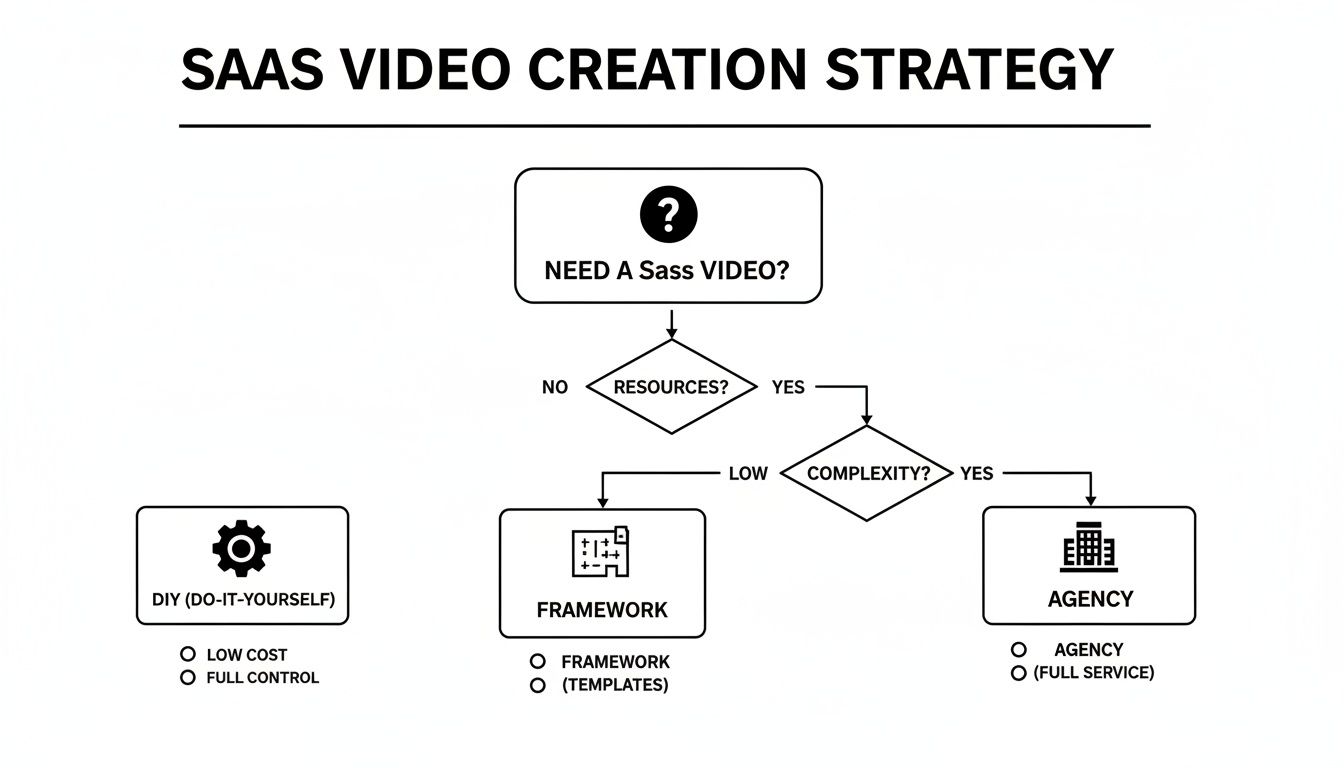
When it comes to actually creating these videos, SaaS teams usually go one of three ways: the messy DIY route, the expensive agency path, or a structured, framework-based approach. This decision tree shows why the third option often wins.
As you can see, a framework acts as the logical middle path, giving you the speed and control of DIY with the quality you'd expect from a high-end agency.
Beyond the Funnel: Videos for Retention and Growth
Your video strategy shouldn't grind to a halt after you've made the sale. Videos are incredibly powerful for improving user onboarding and announcing new features—two things absolutely critical for long-term retention.
Onboarding Videos
An onboarding video is your secret weapon against churn. It acts as a friendly guide for new users, walking them through the first few critical steps to find real value in your product. This takes a load off your support team and helps users hit that "aha!" moment much, much faster.
Ideal Length:2-5 minutes, but often broken into smaller, task-specific clips.
Key Story Beats: Start with a warm welcome, give a quick tour of the core UI, and guide them to complete their first valuable action.
Primary Channels: In-app modals, welcome email sequences, and your help center.
Feature Highlight Videos
When you ship a new feature, a short, punchy video is the best way to get the word out. These are made for your existing customers and are designed to drive adoption of new functionality. They show you're constantly improving the product and help users get more value out of their subscription.
Exploring the different types of video content available can spark even more ideas for engaging your audience. By deliberately picking the right video for each goal, you build a cohesive system that not only attracts new customers but keeps them happy and successful for the long haul.
How to Write a High-Converting SaaS Video Script
A great SaaS marketing video starts with a killer script, not with fancy animations or high-production fluff. So many founders obsess over the visuals first, only to end up with a beautiful video that says absolutely nothing. The words on the page are what connect with your audience and drive them to act.
The good news is you don’t need to be a professional copywriter to write a script that actually converts. All you need is a solid framework that guides your viewer on a logical and emotional journey. Let’s deconstruct a proven template that any founder can use right now.
The Five Pillars of a Performance Script
A high-performing script is built on a simple problem-agitate-solution structure, but it’s been tailored specifically for a skeptical SaaS buyer. This approach systematically breaks down barriers to trust and guides the viewer toward taking that next step.
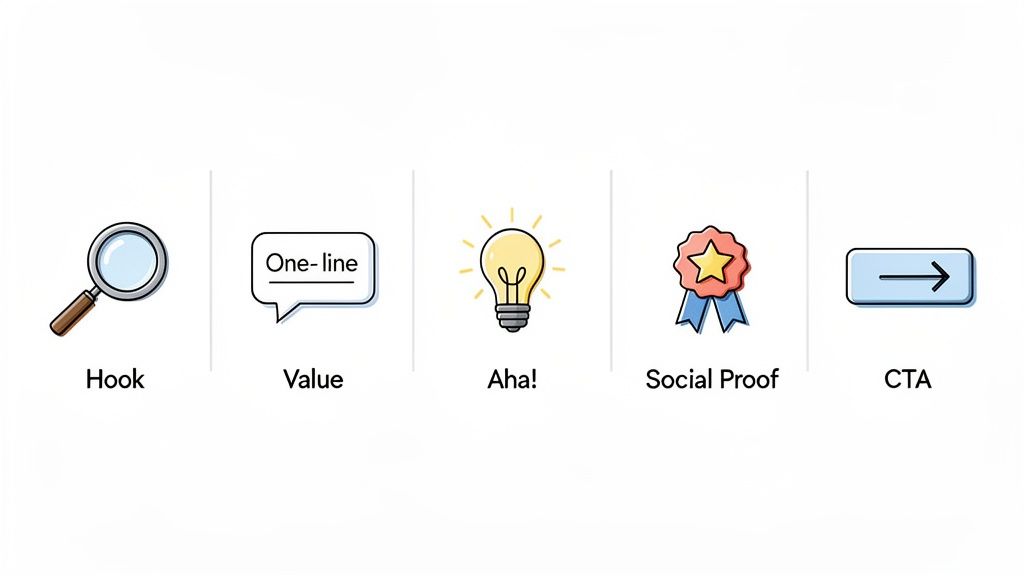
Every effective script is made of these five essential components:
1. The Hook: Start with their struggle, not your solution. Grab attention in the first three seconds by articulating a pain point they know all too well.
2. The Value Prop: In a single, clear sentence, explain what you do and for whom. No jargon, no buzzwords. Just a direct statement of value.
3. The ‘Aha!’ Moment: This is the heart of your video. Show your product solving the exact problem you mentioned in the hook. Let them see their frustration simply melt away.
4. The Social Proof: Briefly build trust by showing you’re not the only one who thinks your product is great. This could be a customer logo, a quick testimonial, or a key metric.
5. The Call to Action (CTA): End with a clear, low-friction next step. Instead of "Buy Now," try something like "Start Your Free Trial" or "See a Live Demo."
From Theory to Action: A Script Breakdown
It’s easy to talk about these pillars in theory, but let’s see what they look like in practice. Imagine a SaaS tool that automates reporting for marketing teams. A generic script would say something vague like, "Our tool streamlines workflows." A high-converting script, on the other hand, gets specific.
Here’s how you’d apply the framework:
The Hook (Start with the struggle): "Stop wasting your Monday morning copy-pasting data between spreadsheets and slide decks. You know there has to be a better way."
The Value Prop (Explain what you do): "Our platform automatically pulls all your marketing data into beautiful, shareable reports in seconds."
The ‘Aha!’ Moment (Show it solving the problem): Show the UI connecting to a data source, a report being generated with one click, and the clean dashboard that appears.
The Social Proof (Build trust): "Join over 2,000 marketing teams who are already saving 10 hours a week on reporting."
The Call to Action (Provide a next step): "Click the button below to start your free 14-day trial and get your first report in minutes."
See the difference? One is corporate-speak; the other is a conversation. It speaks directly to the user’s pain and offers an immediate, tangible solution. Clarity and empathy are your most powerful scripting tools.
The right script is an engine for lead generation. SaaS video marketers are already generating 66% more qualified leads annually compared to teams using other formats. To get these results, the message must be perfectly tuned to the audience's needs.
Practical Tips for Sharpening Your Script
Writing a script is an iterative process. Your first draft won’t be perfect, and that’s okay. The goal is to refine it until every word serves a purpose: moving the viewer forward.
Read It Out Loud: Does it sound like a real human talking over coffee? If it sounds stiff or robotic, rewrite it until it feels natural.
Cut Mercilessly: Go through your script and remove every single word that doesn’t add value. Aim for conciseness. Every second of your video has to earn the viewer's attention.
Focus on Benefits, Not Features: Don't just list what your product does; explain what it means for the user. Instead of "real-time analytics," say "make smarter decisions faster."
Building from a proven structure is the fastest way to a script that works. To make it even easier, you can grab our free explainer video script template and start filling in the blanks.
The Forgeclips Approach: Where Structure Meets Speed
Let’s be honest. When it comes to video, most SaaS companies are stuck between two terrible options.
You can go the traditional agency route—slow, expensive, and often more focused on winning awards than driving sign-ups. Or, you can try the DIY approach, which quickly becomes a black hole for your time, your most valuable resource. It's the classic video dilemma: you're forced to pick two between speed, cost, and quality, but you never get all three.
We built Forgeclips to break that compromise. This isn’t just another video tool; it's a completely different philosophy. We believe you shouldn't have to choose. Our system is the logical middle path, giving you the clarity of a proven framework with the speed you actually need to keep up with your marketing.
We didn’t invent new storytelling principles from scratch. We simply took the proven scripting frameworks we've already discussed and built a production pipeline around them—one that’s designed to eliminate friction for fast-moving SaaS teams.
The Hybrid Pipeline: AI-Fast and Human-Polished
So, how do we deliver both speed and studio-grade quality? The secret is our hybrid production model. We combine the raw power of AI-assisted processes with the irreplaceable touch of human expertise. It’s a system built to solve the trade-offs that hold most marketing teams back.
Here’s a look under the hood:
AI for Acceleration: We use AI for the grunt work. Think organizing content, structuring your script based on a chosen framework, and generating initial voice-overs. This automates the most tedious, time-consuming parts of the process, slashing production timelines from weeks down to hours.
Human for Precision: AI is fast, but it has no taste. It can’t feel the rhythm of a story or add the subtle visual polish that separates a decent video from a great one. That's where our team steps in. Every single video goes through a human-led editing and polishing phase to perfect the timing, sharpen the visuals, and ensure the final cut is genuinely professional.
This hybrid approach isn’t about replacing people; it’s about augmenting them. It lets us deliver a high-performance SaaS marketing video in multiple formats in as little as 48 hours—without ever sacrificing the quality your brand deserves.
A System Built for SaaS Workflows
Traditional video production was built for a different era. It was never designed for the pace of modern software development. When you ship a new feature or pivot your messaging, you can't afford to wait six weeks for a video to catch up.
Our system is designed to match your sprint cycle, not slow it down.
For teams embracing this new reality, advanced tools like the Plexigen AI Video Generator With Sound can automate video creation right from your scripts, aligning perfectly with a philosophy of using technology to move faster.
The Forgeclips approach is simply the logical next step for founders and marketers who need to ship great work without burning through their budget. We're not here to give you a hard sell. We’ve just built a structured, repeatable system for creating videos that actually work.
It’s the way video production should have been all along: clear, fast, and built to convert.
Distributing and Measuring Your SaaS Video Performance
So you’ve created a fantastic video. That’s the hard part, right? Not quite.
You can have the most compelling, crystal-clear SaaS marketing video in the world, but it won't do you any good just sitting on a landing page gathering dust. A great video is an asset, but a killer distribution strategy is what turns that asset into a revenue-generating machine.
This is where so many teams drop the ball. They pour weeks into production, hit "publish," and then… they wait. The real work actually begins after the video is done. It’s time to get it in front of the right people, on the right channels, and then figure out what really happens next.
Where to Unleash Your Video for Maximum Impact
Think of your video less like a single piece of content and more like a campaign you can deploy across multiple fronts. Each channel needs a slightly different approach, but the core message stays the same. The goal is to create multiple touchpoints that guide prospects along their journey.
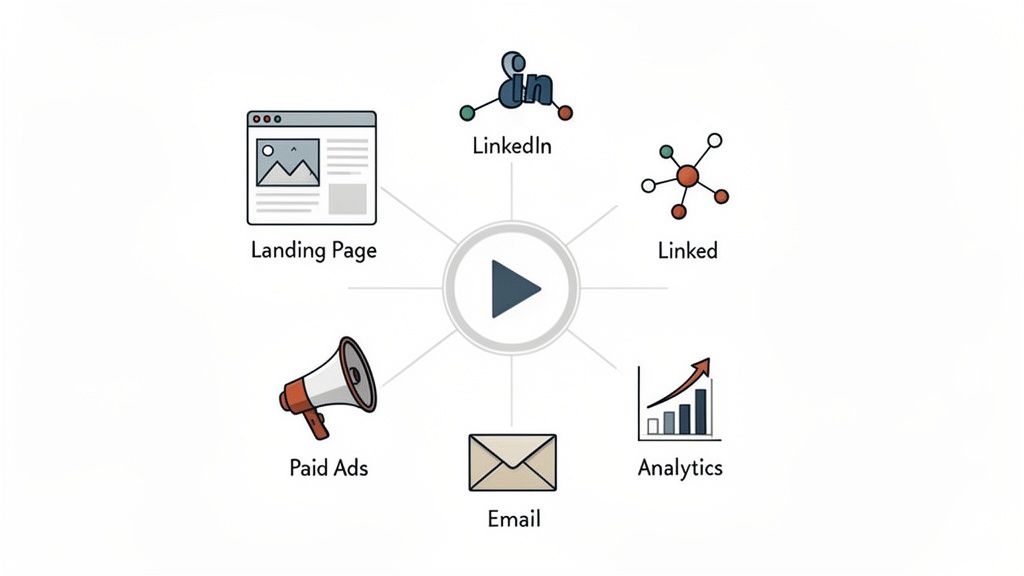
Here are the must-have channels for any SaaS video:
Your Landing Page: This one’s a no-brainer, but it's also the most critical placement. A video right above the fold can instantly clarify your value proposition and give conversion rates a serious boost. Keep it front and center.
Paid Ad Campaigns: Short, punchy cuts of your video are perfect for platforms like LinkedIn, Facebook, and YouTube. Think 15 or 30-second clips that hook viewers fast and drive them back to your site to learn more.
Email Marketing Sequences: Drop a video thumbnail into your onboarding or nurture sequences. It’s a simple trick that can dramatically increase click-through rates and wake up leads who’ve gone quiet.
LinkedIn and Social Media: Don’t just link to your video—post it natively on LinkedIn to reach a professional audience. Create a looping, caption-heavy version for organic posts that can stop the scroll in a crowded feed.
By 2026, video is projected to account for a staggering 82% of all global internet traffic. For SaaS marketers, this means doubling down on high-ROI channels like YouTube and LinkedIn, where video ads can deliver 15% lower CPCs.
Metrics That Actually Move the Needle
Let's be honest: vanity metrics like total views are a waste of time. A million views means nothing if no one signs up for your product. To figure out if your video is actually working, you need to track metrics tied directly to user behavior and business goals.
The goal isn't to get more eyeballs on your video; it's to get more qualified users into your product. Ditch the vanity metrics and focus on what drives action.
To get this kind of data, you’ll need a video hosting platform built for marketers, like Wistia or Vidyard. These tools go way beyond what YouTube offers, giving you granular analytics that show exactly how people are engaging with your content.
Here’s what you should be tracking:
Play Rate: This is the percentage of page visitors who actually click the play button. A low play rate could mean your thumbnail is weak, the video is poorly placed, or the headline above it isn’t compelling enough.
Audience Retention: This graph is your best friend. It shows you exactly where viewers are dropping off. See a big dip at the 10-second mark? Your hook isn’t working. Notice people re-watching a certain section? You’ve just found your "aha!" moment.
Video-Influenced Conversions: This is the holy grail. By connecting your video player’s analytics to a marketing automation platform like HubSpot or Marketo, you can see who watched your video and then signed up for a trial. This is how you prove the ROI of your video, plain and simple.
Focusing on these performance-driven metrics helps you move from guessing to knowing. You’ll have the data you need to tweak your video, optimize your distribution, and build a scalable system that consistently turns viewers into users. For a deeper dive, check out our guide to building your video marketing funnel blueprint.
Frequently Asked Questions About SaaS Video
You've got questions, we've got answers. Here are some of the most common things we hear from founders and marketers about making a SaaS marketing video that actually works.
How Long Should a SaaS Marketing Video Be?
For a top-of-funnel explainer video on your homepage, the sweet spot is 60-90 seconds. That’s just enough time to hook someone, show them your value, and give them a clear next step before their attention wanders. For deeper-funnel content like product demos, you can go a bit longer, maybe 2-3 minutes. The rule is to be as long as necessary, but as short as possible.
What Matters More: The Script or Production Quality?
The script. Always the script.
A clear, compelling message in a simple, clean video will beat a confusing message in a slick, high-budget production every single time. It's the structure, clarity, and empathy in your story that convince people to act—not cinematic lens flares or flashy effects.
Start with a rock-solid, framework-based script first. Then, make sure your visuals look professional and support the story without getting in the way.
A polished video with a weak story is just expensive noise. A simple video with a powerful story is a conversion machine.
How Much Should I Budget for a SaaS Marketing Video?
This is where a lot of founders get stuck, because the costs are all over the place.
Here’s a quick breakdown of your options:
Traditional Agency: This is the priciest route, running anywhere from $5,000 to $50,000+ for a single video.
DIY (Do-It-Yourself): This is technically "free," but it will cost you dozens of hours of your—or your team's—valuable time. The hidden cost is often huge.
Framework-Based Systems: A smart middle ground like Forgeclips gives you studio-quality, structured videos for a fraction of the agency price tag. This approach makes it affordable to create multiple videos for different parts of your funnel without breaking the bank.
Can I Just Use AI to Create My Entire Video?
Not quite yet. While AI tools are incredible for generating clips and voice-overs, they still can't nail the strategic storytelling needed for a high-converting marketing video. An AI can assemble the pieces, but it doesn't understand your customer or how to build an emotional connection.
The best results today come from a hybrid approach. Use AI to get a head start on tasks like scripting and asset gathering, but rely on human expertise for the structure, editing, and final polish. That’s the magic combo that ensures your video actually connects with real people.
What's the biggest mistake SaaS teams make with video?
Focusing on features instead of outcomes. Viewers don't care about your "synergistic AI-powered dashboard"; they care about how you can save them time, reduce their stress, or help them make more money. Your video's job is to connect your product's features to a tangible improvement in their work life. Always frame your message around the user's success, not your product's capabilities.
Ready to create a high-performing SaaS video without the agency price tag or the DIY headache? Forgeclips uses a proven framework-based system to deliver studio-quality videos in 48 hours.