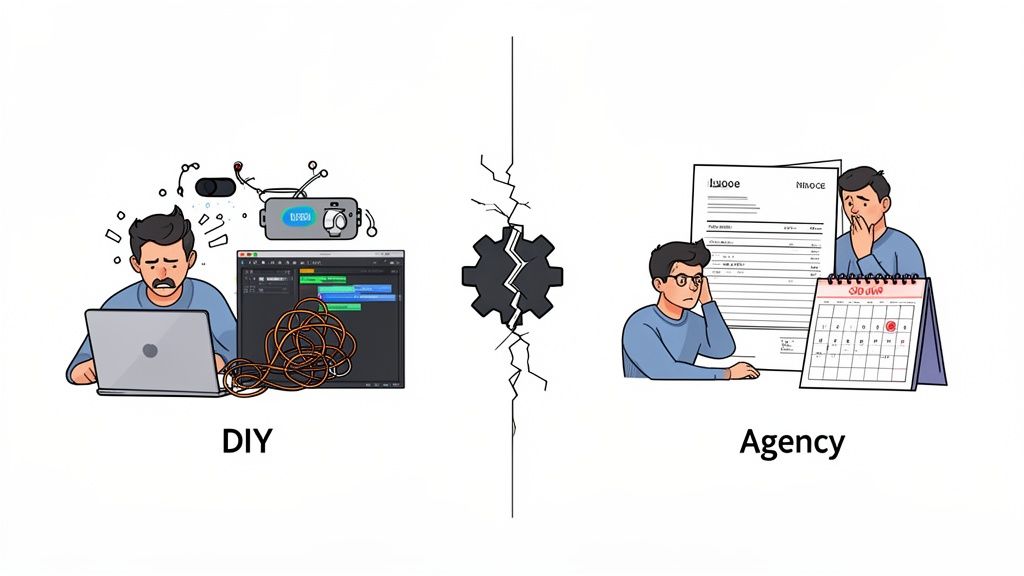
You know that feeling? You need a great product video, so you get stuck picking between two terrible options. Path one is the DIY trap: you lose a week wrestling with editing software, only to end up with a clunky demo that makes your product look unprofessional. Path two is the agency drain: you write a check with way too many zeros, then wait six weeks for a video that’s already outdated by the time it’s delivered.
Either way, you lose. Your landing page doesn't convert, and you just burned time and money you can't get back.
SaaS video marketing is the practice of using structured video content—like product demos, explainers, and feature highlights—to guide users through the buyer's journey. Done right, it clarifies your product's value, builds trust, and directly drives conversions and user adoption.
Why Most SaaS Video Marketing Fails
You know you need video. Text and static screenshots just can't show off your software's magic. But the process of actually getting a video made is a soul-crushing cycle that drains your two most valuable resources: time and money.
This leads most teams down one of two frustrating paths. Let's call them what they are: the "DIY Trap" and the "Agency Drain." Neither one gets you where you need to go.
The Inefficiency of the DIY Trap
At first, the DIY approach feels productive. You download some editing software, watch a few tutorials, and start piecing together a product demo. Simple, right?
But then the hours stretch into days. You’re wrestling with audio levels, glitchy animations, and a confusing timeline instead of building your product or talking to customers.
The final result? A video that looks amateur, fails to communicate your product's actual value, and ends up hurting your conversion rates. For founders, that lost time is a direct hit to the bottom line. For product managers, it just means more support tickets because the "helpful" video created more confusion.
The Problem with the Agency Drain
So you swing the other way and start looking at agencies. The sticker shock is immediate—we’re talking thousands of dollars for a single two-minute explainer. But what's worse than the cost is the timeline.
Weeks are eaten up by meetings, creative briefs, and endless back-and-forth revisions. By the time the "final" video is delivered, your UI has already changed twice.
The core problem isn't the video itself. It's the broken, improvised process used to create it. Both the DIY and agency models are built on guesswork, which is the exact opposite of how great software is built.
Agencies are just too slow and expensive for the agile reality of software development. A massive, one-off production project can't keep up with feature updates and new releases. You don't need a single expensive asset; you need a system.
This is why a structured, framework-based approach is so critical for making SaaS video marketing actually work. It’s the path between chaos and cost.
Comparing Traditional vs Structured SaaS Video Production
To really see the difference, let’s compare the old way of doing things with a modern, structured approach.
Challenge
The Old Way (DIY or Agency)
The Structured Framework Approach
Speed & Agility
Weeks or months of production; impossible to update quickly when UI changes.
Videos are produced in hours or days; easily updated to match new features.
Cost
Unpredictable. DIY costs your time; agencies cost thousands per video.
Predictable and scalable. A flat, manageable cost for repeatable assets.
Consistency
Every video is a brand new project, leading to inconsistent quality and style.
Frameworks ensure every video maintains consistent branding, pacing, and quality.
Focus
Process is focused on "making a video," often losing sight of the business goal.
Process is focused on communicating value and driving a specific action (sign-up, demo).
Scalability
Impossible to scale. Each new video requires starting from scratch.
Designed to scale. Create videos for every feature, use case, and funnel stage.
The old methods force you to treat every video like a monumental effort. A structured system turns video creation into a repeatable, efficient part of your marketing engine, just like writing a blog post or sending an email.
The Power of Structured Video Frameworks
What if you could create high-impact videos without the guesswork?
Most teams treat every new video like a blank canvas, hoping inspiration strikes. This usually leads to wasted time, creative dead ends, and a final product that doesn’t actually move the needle.
The solution isn't more brainstorming—it's a better system. We believe in a simple truth: structure beats improvisation every single time. It’s the difference between building a house with a blueprint and just starting to nail boards together, hoping it all holds up.
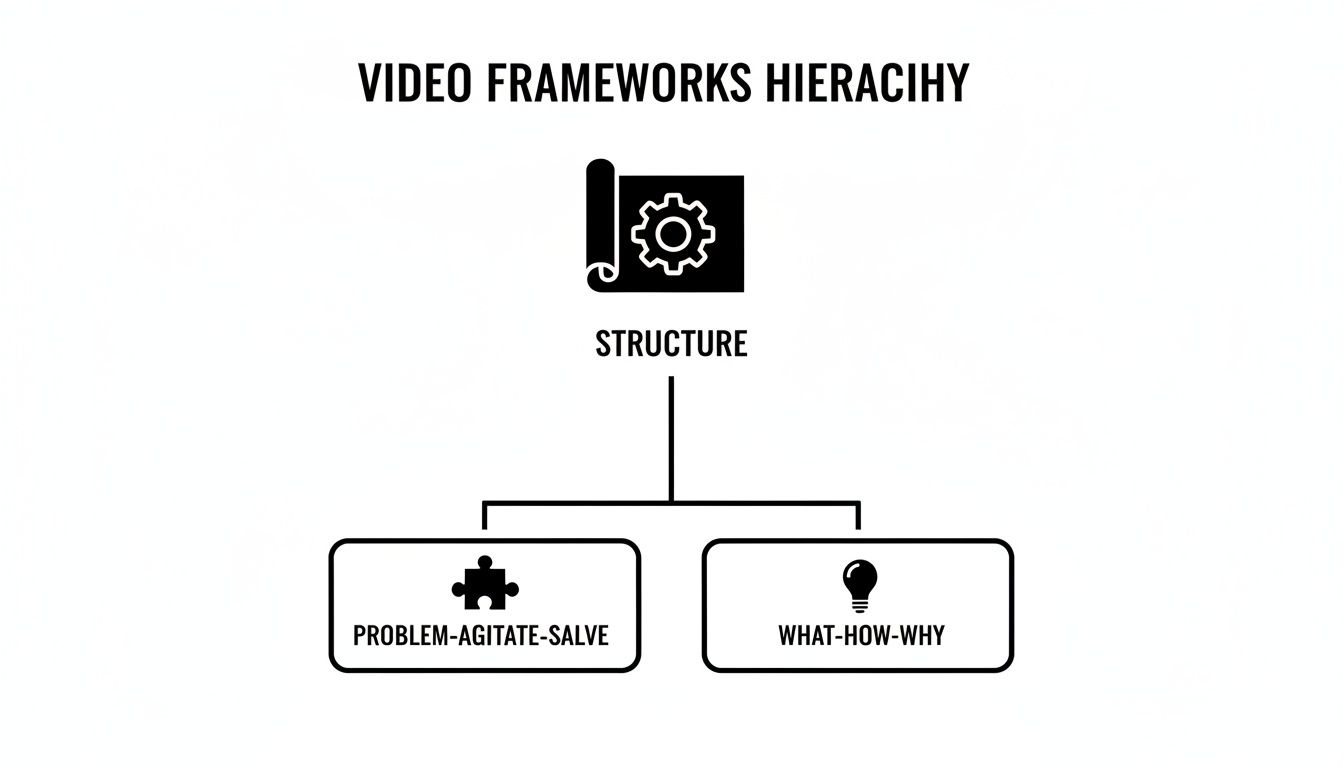
Think of a SaaS video marketing framework as that blueprint for clear communication. It's a proven, repeatable formula that gives every second of your video a specific job. It de-risks the entire process, guaranteeing you end up with something polished and effective.
Why Structure Wins
Starting from scratch is draining. Improvisation forces you to spend most of your energy on basic questions: Where do I start? How should I introduce the problem? When do I show the UI?
A framework answers those questions for you. It provides a logical flow that guides the viewer from one point to the next without friction. This frees you up to focus on what really matters—communicating your product's unique value with clarity and precision.
A great video framework doesn’t limit creativity; it channels it. By providing a solid foundation, it allows you to build a powerful, persuasive story without getting lost in the process.
Instead of fighting with a blank page, you start with a proven structure designed to convert. This is the key to making great videos, quickly and consistently.
Two Essential SaaS Video Frameworks
There are tons of storytelling models out there, but two frameworks are especially powerful for software products. They're simple, direct, and incredibly good at translating complex features into clear user benefits.
One of the biggest mistakes teams make is trying to cram too much information into a single video. Frameworks force you to be disciplined, focusing only on what the viewer needs to know to take the next step.
Let's break down two of the most effective structures.
1. The Problem-Agitate-Solve (PAS) Framework
This classic copywriting formula is devastatingly effective for ads and top-of-funnel explainer videos. It works because it taps directly into your user's pain points.
Problem: Start by calling out a specific, relatable frustration your target user deals with every day. Hook them by showing you get their struggle. You can find some useful tips on how to effectively grab the attention of your SaaS audience on Forgeclips.
Agitate: Don’t just state the problem—pour a little salt on the wound. Describe the consequences. What time is being wasted? What opportunities are being missed? Make the pain tangible and real.
Solve: Now, introduce your software as the clear, obvious solution. Show exactly how it eliminates the problem you just agitated, providing immediate relief and a clear path forward.
2. The What-How-Why Framework
This structure is perfect for product demos and feature highlight videos where the goal is clarity and adoption. It systematically answers the three core questions every user has about your product.
What: What is this feature, and what problem does it solve for me? Start with a direct, benefit-oriented statement.
How: How does it actually work? This is where you show the UI. Walk through the key steps in a clean, logical sequence, and steer clear of jargon.
Why: Why should I care? Connect the feature back to a bigger outcome. Will it save time, reduce errors, or unlock new capabilities? This final step justifies the action you want them to take.
By standardizing your storytelling with frameworks like these, you eliminate creative blocks and de-risk your SaaS video marketing efforts. You stop gambling on one-off projects and start building a reliable engine for customer acquisition and education.
Matching Video Content to Your SaaS Funnel
Trying to use the wrong video at the wrong time is a classic mistake. It’s like throwing a complex product demo at someone who doesn’t even know they have a problem yet—a surefire way to burn time and money. A powerful video only works if it meets the viewer where they are.
Your SaaS video marketing success boils down to one thing: alignment.
This is where the marketing funnel becomes your roadmap. It’s not just some textbook theory; it’s a practical guide for delivering the right message at the perfect moment, guiding a prospect from casual observer to happy customer without friction.
To help you map this out, here’s a quick-glance table that connects the dots between funnel stages and the videos that win at each one.
The SaaS Video Funnel Matrix
This matrix lays out which videos to use, when to use them, and what you're trying to achieve at each step of the customer journey.
Funnel Stage
Video Type
Primary Objective
Key Channels
ToFu
Explainer Videos, Social Ads
Spark curiosity, Educate
Social Media, YouTube, Blog Posts
MoFu
Product Demos, Feature Highlights
Build trust, Demonstrate
Landing Pages, Email, Webinars
BoFu
Customer Testimonials, Onboarding
Remove doubt, Convert
Pricing Page, Email, In-App
Think of this as your playbook. Now let's break down exactly what to do at each stage.
Top of Funnel (ToFu): Awareness and Attention
At the top, your audience has a problem, but they don't know about your solution. They might not even know your company exists. The goal isn’t to sell; it's to earn a few seconds of their attention. You need to interrupt their scroll and make them think, "Huh, that's interesting."
Your videos here need to be short, sharp, and focused entirely on the pain point.
Explainer Videos (60-90 seconds): Think of these as your digital elevator pitch. They need to quickly frame a common problem and introduce your product as the answer. Stick to the "what" and the "why," not the nitty-gritty "how."
Social Media Ads (15-30 seconds): These are built for platforms like LinkedIn and YouTube. They have to be punchy and visually engaging, with a strong hook in the first three seconds to stop the scroll. Agitate the problem, then briefly tease the solution.
Your main metric here is Audience Retention. If you’re losing viewers in the first few seconds, your hook is broken.
Middle of Funnel (MoFu): Consideration and Education
Once you have their attention, the game changes. These prospects are now actively researching solutions. They’re comparing you to competitors and they need details. This is your moment to build trust and show them your product's real-world value.
This is the perfect place for more detailed, structured content. Knowing how to create video content that converts is absolutely critical here.
Product Demo Videos (2-5 minutes): This is your most important sales asset. A great demo walks a qualified lead through a key workflow, showing exactly how your software solves their specific problem. Keep it clean, concise, and focused on benefits, not just features.
Feature Highlight Videos (1-2 minutes): Don't cram everything into one long demo. Break out your highest-value features into their own short, digestible videos. These are perfect for targeted email campaigns or for users exploring a specific capability.
Here, you should obsess over the Click-Through Rate (CTR) on your video’s call-to-action. Is the video compelling enough to make them book a call or start a trial?
This is where using proven frameworks gives you a massive advantage by ensuring your message is always clear and consistent.
The image above shows how a structured approach, like the classic Problem-Agitate-Solve framework, gives you a reliable blueprint for communicating value effectively every single time.
Bottom of Funnel (BoFu): Decision and Conversion
At the bottom of the funnel, your prospects are on the verge of a decision. They just need that final nudge of confidence—that social proof that tells them they're making the right choice. Your videos here should erase any lingering doubt and make it easy to say "yes."
Customer Testimonials (1-2 minutes): Hearing a peer rave about your product is ten times more powerful than anything you can say yourself. Authentic stories from happy customers build incredible trust and demolish final objections.
Personalized Onboarding Videos: The journey isn't over when they sign up. Short, task-focused videos that guide new users through setup and their first key actions can dramatically boost activation rates and slash early churn.
At this stage, your most important metric is Conversion Rate or Task Completion Rate. Is the video directly driving sign-ups and helping new users find value? To dig deeper, check out our full guide on building a video marketing funnel blueprint.
Why Short-Form Video Is a Goldmine for SaaS
Let’s be honest, attention spans aren't what they used to be. The way everyone—including your B2B buyers—consumes content has completely changed. Long, meandering demos have given way to quick, impactful moments, and at the center of this shift is short-form video.
A lot of SaaS teams still write off platforms like YouTube Shorts or TikTok as being purely for consumer brands. That’s a huge mistake. Short, vertical videos are one of the most efficient ways to grab attention, communicate value, and drive action.
This isn’t just some fleeting trend; it’s a strategic opportunity for SaaS companies to get ahead of the curve. The format forces clarity and cuts through the noise with a single, powerful message that respects your viewer's time.
The Undeniable ROI of Going Short
Short-form video is a dominant force in SaaS video marketing, and for good reason. It provides the highest ROI for a growing number of marketers, and platforms like YouTube Shorts are pulling in over 70 billion daily views. That's a massive, engaged audience that most software companies are completely ignoring.
The format is also incredibly efficient. Video content can boost organic traffic from search engines by as much as 157%, as they reward dynamic, engaging visuals. In a time where customer acquisition costs are always climbing, finding high-impact channels isn’t just smart—it’s essential for survival.
The beauty of short-form video is its constraint. A 60-second time limit forces you to ditch the fluff and focus on the one thing that truly matters to your user. It’s a masterclass in concise value communication.
This format gives you a low-cost, high-leverage way to stay top-of-mind and consistently educate your audience without demanding a huge time commitment from them.
Practical Strategies for Short-Form SaaS Video
Getting into short-form video doesn't mean you need to start from scratch. Your existing long-form content is a goldmine of potential clips. The key is to think in terms of single-serving solutions—one video, one problem, one clear takeaway.
Here are a few practical ways to weave short-form video into your strategy:
Repurpose Your Demos: Take that comprehensive 10-minute product demo and slice it into bite-sized feature highlights. Each clip should focus on a single workflow or benefit, making it perfect for targeted social posts or email campaigns.
Create Quick-Tip Videos: What's a common question your support team is always answering? Turn the solution into a 30-second screen recording. These "how-to" videos are incredibly valuable and position you as a helpful expert.
Build Hype for Launches: Launching on a platform like Product Hunt? A series of short, snappy videos teasing new features is far more effective than a single long announcement. They build anticipation and give you more assets to share throughout the day.
The vertical format is also perfectly suited for how people actually use their phones. Optimizing for mobile isn't just a best practice; it's a necessity. We have a few examples of compelling videos for mobile on our site that show this principle in action.
Ultimately, short-form video aligns perfectly with the agile nature of SaaS. It’s fast, iterative, and focused on delivering value quickly—just like your product.
Building a Modern SaaS Video Workflow
The future of video production isn’t about picking sides between humans and AI. It's about building a smarter process that gets the best out of both.
For too long, SaaS teams have been stuck with a bad choice: wait forever for high-quality video, or get something mediocre out the door tomorrow. That dilemma is a trap, and it’s driven by outdated workflows.
A modern, hybrid model shatters that compromise. It blends AI tools with human expertise, giving you the raw speed needed to keep up in SaaS without sacrificing the polish that actually builds user trust.
This isn't about replacing talented people; it’s about giving them superpowers. It’s a workflow where machines do the tedious grunt work, freeing up humans to provide the final, critical touch that makes a video feel right.
AI-Fast for the Initial Heavy Lifting
Let’s be honest: a huge slice of video production is just a grind. Generating a first-draft script, recording a clean voice-over, or sifting through hours of screen recordings—these are the tasks that burn time and kill creative momentum. This is exactly where AI shines.
We can now use AI to tear through these repetitive steps, crushing production timelines from weeks down to a matter of days.
Script Generation: Instead of fighting a blank page, AI can generate a structured first draft from a simple brief and your raw notes.
Voice-Over Recording: Clean, professional voice-overs can be created in minutes, skipping the cost and scheduling headaches of hiring voice actors.
Initial Editing: AI can handle the first pass of an edit, syncing audio to visuals and laying down a basic foundation for an editor to build on.
This "AI-fast" first step smashes the biggest bottlenecks and gets the project moving instantly. But that’s only half the story.
AI gets you 80% of the way there, fast. But in video, that last 20% is where trust is won or lost. Relying on AI alone often leaves you with a video that feels sterile, robotic, and just a little… off.
That final, nuanced layer is what separates a video that merely informs from one that truly connects and persuades.
Human-Perfect for the Final Polish
Once AI has done the heavy lifting, the real craft begins. A skilled human editor steps in to turn those raw materials into a polished, high-performing asset. This is the non-negotiable step for getting a professional outcome.
This crucial stage is all about finesse:
Refining Timing and Pacing: An editor fine-tunes cuts and on-screen motion with millisecond precision, creating a smooth, engaging rhythm that holds a viewer's attention.
Perfecting the Visual Flow: This means ensuring UI animations are clean, transitions feel seamless, and the overall story is compelling and easy to follow.
Ensuring Emotional Connection: A human editor makes sure the final video resonates. They align the tone, music, and visuals to build confidence and make your product feel trustworthy.
This ‘AI-Fast, Human-Perfect’ approach is the core of an effective modern SaaS video marketing workflow. To get even more mileage from your efforts, learn how to repurpose webinars for SaaS and turn a single live event into a long-lasting content engine.
By combining automated speed with human skill, you get a system that’s both agile and exceptional. For a deeper dive, check out our guide to video marketing automation for SaaS teams.
Common Questions About SaaS Video Marketing
Jumping into SaaS video marketing always kicks up a storm of questions. You know you need video, but the path from a good idea to an asset that actually performs feels tangled up in unknowns—cost, time, and what success even looks like. It’s easy to get stuck just thinking about the details.
This section cuts right through the noise. No fluff, no vague theories. Just direct, practical advice grounded in what it actually takes to grow a software business. Let's clear up the confusion so you can start creating with confidence.
How Much Should a SaaS Company Budget for Video?
This is the big one, and the honest answer isn't a single number. Instead of fixating on a total budget, it’s much smarter to think in terms of cost-per-asset.
A traditional agency might quote you anywhere from $5,000 to $15,000 for a single explainer video. For most startups, that’s just not realistic. That kind of spending turns video into a high-stakes gamble instead of a repeatable part of your growth strategy.
The DIY route might seem "free," but it’s loaded with hidden costs. Every hour you or your team spends wrestling with editing software is an hour not spent improving your product or talking to customers. Even worse, a poorly made video can actively damage your brand and kill conversion rates, making that "free" video incredibly expensive.
A modern approach builds a scalable system. Your budget should let you create multiple high-quality videos—demos, feature updates, social ads—for what you'd normally pay an agency for one project. A healthy starting point is allocating 10-15% of your marketing budget to a structured video system that delivers consistent assets without the wait. The goal is to invest in a repeatable process, not a one-off spectacle.
What Are the Most Important Video Metrics to Track?
It’s so tempting to get excited about view counts, but for SaaS, that number is one of the least important. Vanity metrics don't pay the bills. You need to track metrics that tie directly back to business goals, connecting video performance to actual user action.
Forget total views. Focus on these instead:
Play Rate: This shows how many people who saw the video player on a page actually clicked play. A low play rate might signal a weak thumbnail or bad placement. For a landing page video, a play rate of 10-20% is a solid benchmark.
Audience Retention: This is arguably the most critical metric. It’s a graph that shows you the exact moment viewers get bored and leave. See a massive drop in the first 5-10 seconds? Your hook is broken. You’re looking for a smooth, gradual decline, not a steep cliff.
Click-Through Rate (CTR): For any video with a call-to-action (like "Start a Trial" or "Book a Demo"), this is your money metric. It tells you, point-blank, if your video is persuasive enough to make someone take the next step.
Conversion Rate: This is the ultimate measure of ROI. Using your analytics tools, you can track which users watched a key video right before they signed up or made a purchase. It connects the dots between a view and revenue.
Task Completion Rate: For onboarding or support videos, this is the only metric that matters. Did the user successfully set up their profile after watching? Did they connect their integration? This links video directly to user activation and retention.
Your video's success isn't measured by how many people watched it, but by how many people did something because they watched it. Tie every video to a specific, measurable business outcome.
Tracking these metrics transforms your SaaS video marketing from a creative nice-to-have into a data-driven growth engine. You’ll know exactly what’s working, what’s not, and where to put your energy.
How Long Should a SaaS Product Demo Video Be?
There’s a golden rule for video length: as long as necessary, but not a second longer. The perfect length isn't a fixed number; it depends entirely on the video's purpose and where the viewer is in their journey. A one-size-fits-all approach just doesn't work.
Think of it like a conversation. You wouldn't launch into a 10-minute deep dive with someone you just met. You’d start with a quick intro. Your videos should follow the same logic.
Here’s a practical breakdown by use case:
Landing Page Explainer: Keep it tight. Aim for 60-90 seconds. The job here is to grab attention, land your core value prop, and get the visitor curious enough to learn more. You're selling the "what" and "why," not the "how."
Detailed Feature Demo: You have more runway with prospects who are already interested and evaluating solutions. Two to five minutes is perfectly fine if the content is well-structured and genuinely valuable. This video should be a clean, concise walkthrough of a key workflow that solves their exact problem.
Onboarding and Support Videos: Go shorter and more focused. Instead of one long "getting started" video, break it down into a series of 30-60 second clips. Each one should focus on a single task, making it easy for new users to find exactly what they need without scrubbing through a long timeline.
Remember, a well-structured three-minute video that respects the viewer's time will always beat a rambling, unfocused 90-second one. Clarity and structure matter far more than the number on the clock.
Ready to stop guessing and start creating SaaS videos that actually convert? At Forgeclips, we replaced the slow agency model with a structured, framework-based system designed for speed and clarity. Get studio-quality demos, explainers, and promos without the high costs or long timelines.