Let's get one thing straight. You've got an idea, but starting a company isn't about rushing to build an app. It's a methodical process of de-risking that idea, one assumption at a time. It’s about finding a real problem, getting confirmation that people will actually pay to solve it, and then building the most stripped-down version possible to prove you're right.
Starting a startup is a marathon, not a sprint. A methodical approach is what prepares you for the long haul.
The Unfiltered Truth About Starting Up
Forget the glamorous stories of overnight success and massive funding rounds you see on social media. That's not reality for most founders figuring out how to get a startup off the ground. The journey is less about a single "aha!" moment and more about a gritty, persistent effort to solve a painful problem better than anyone else.
And yes, the stakes are incredibly high.
Statistics from the U.S. Bureau of Labor Statistics paint a stark picture: 20.4% of new businesses are gone within the first year. By year five, that number jumps to 49.4%. For tech startups, the odds are even tougher, with a 63% failure rate in the same timeframe.
This isn't to scare you off. It's to ground you in reality. These failures aren't random bolts of lightning; they’re often the result of completely avoidable traps.
A quick look at the major milestones and failure rates founders face in the first decade.
Startup Survival Milestones and Hurdles
Milestone
Failure Rate By This Point
Key Challenge
Year 1
~20%
Finding product-market fit.
Year 2
~30%
Running out of initial cash.
Year 5
~50%
Scaling operations and team.
Year 10
~70%
Staying relevant in a changing market.
The hurdles change, but the need for resilience and smart decision-making never does.
Why Most Startups Really Fail
Forget the dramatic tales of corporate espionage or sudden market crashes. The most common reasons startups die are painfully practical and almost always self-inflicted. It usually boils down to a few core missteps:
Building something nobody wants. This is the cardinal sin. Founders fall in love with their solution before ever confirming that the problem is real and painful for a specific group of people.
Running out of cash. This isn't just about failing to raise money. It's about poor financial planning, hiring too fast, or spending money on scaling before the business model is proven. It’s a killer.
A broken founding team. You can have the best idea in the world, but if the founders aren't aligned, it's doomed. Unresolved conflicts, mismatched expectations, and poorly defined roles will tear a company apart from the inside out.
The single biggest mistake is confusing a cool product with a viable business. A business exists to solve a customer's problem at a profit. Every single decision has to be measured against that simple truth.
A Mindset Shift: From Building to De-Risking
So how do you sidestep these landmines? You have to shift your entire mindset.
Stop thinking, "I need to build an app." Start thinking, "I need to prove my assumptions are correct."
Every step you take, from your initial idea to your first line of code, should be an exercise in de-risking. This is where a clear plan becomes non-negotiable. A founder’s playbook, like this detailed start a startup company roadmap, gives you the structure to navigate these treacherous early stages.
The goal isn't just to launch a product. It's to build a sustainable company by making smart, evidence-based decisions right from day one.
Validate Your Idea Before You Write a Single Line of Code
Every founder shares the same nightmare: spending months, maybe years, and a life-altering amount of cash building a product, only to launch to absolute silence. The costliest mistake in the startup world isn’t a sloppy marketing campaign or a bug in the code. It’s dedicating your life to building something nobody actually wants.
This is why your first "product" shouldn't be a piece of software. It should be a compelling pitch backed by hard evidence that a real, painful problem exists. Before you even think about features or design, your entire focus must be on validation.
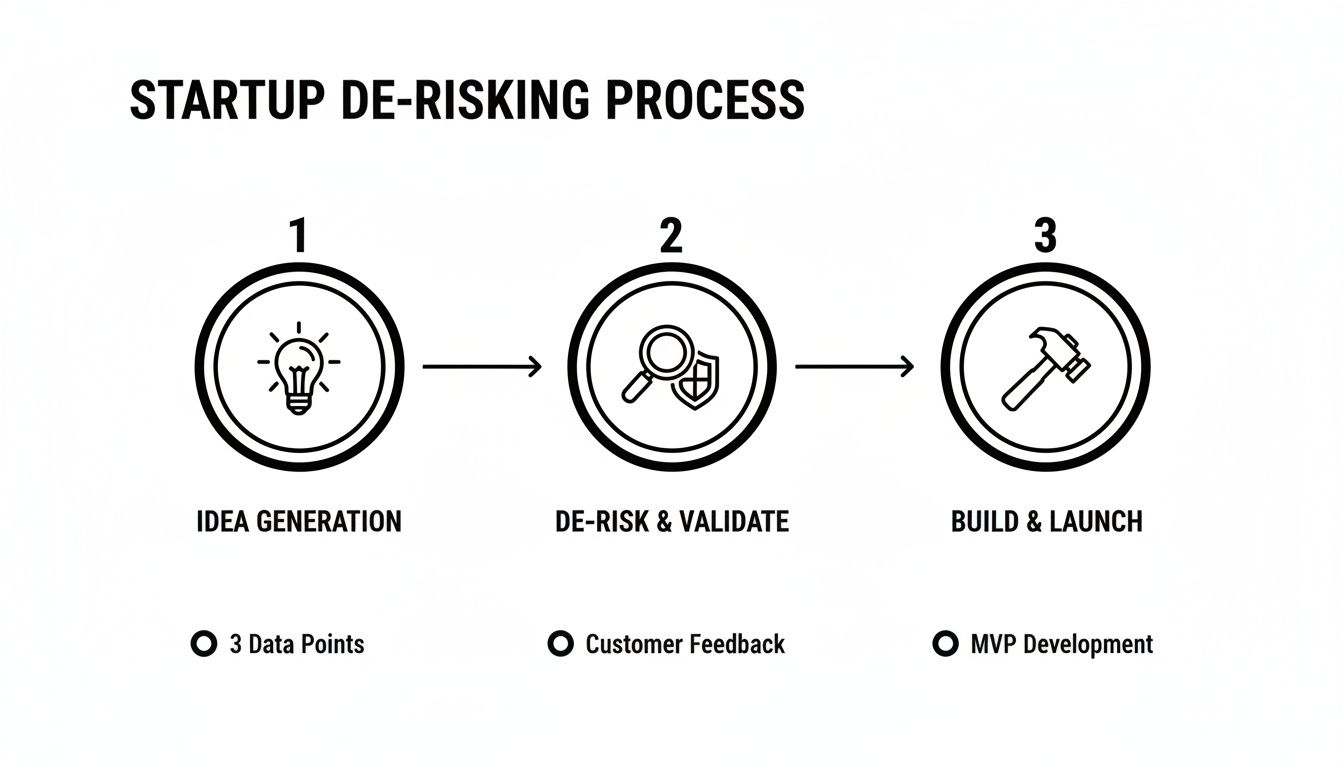
This simple visual breaks down the de-risking process. You have to move from a raw idea to solid validation before you even consider building.
Skipping that middle step is the single biggest reason startups fail, turning promising concepts into expensive learning experiences.
Get Out of the Building
The answers you need aren't rattling around in your head or buried in a spreadsheet. They're out in the real world, held by the very people you think you're going to serve. Validation is an active, investigative process—not a thought experiment.
A crucial starting point is to nail down exactly how to identify a target audience. This lays the foundation for everything that follows. Once you know who you’re talking to, you can start gathering real data.
Here are a few cheap ways to do it:
Customer Discovery Interviews: Don't pitch your solution. Seriously. Set up 15-20 interviews where your only job is to ask about someone's workflow, their biggest frustrations, and what they've already tried to fix it. You’re hunting for genuine pain, not polite nods about your "cool idea."
The "Smoke Test" Landing Page: Before you build anything, spin up a simple landing page that explains your value proposition. Add a clear call-to-action like "Join the Waitlist" and run a small ad budget (even $100 is enough) to drive some traffic. If nobody signs up, your message—or the problem itself—isn't connecting.
Smarter Competitor Analysis: Don't just look at what your competitors do. Dig into their customer reviews, community forums, and social media comments. Look for patterns of complaints and feature requests. This is a goldmine for finding gaps in the market your solution can fill.
Ask Questions That Uncover the Truth
During your interviews, you have to avoid leading questions like, "Wouldn't it be great if you had a tool that did X?" People are generally nice and will agree with you to be polite. Instead, ask open-ended questions that reveal past behavior. Behavior is a much stronger signal than opinion.
The most dangerous thing you can hear from a potential customer is, "That's a neat idea." What you're actually listening for is, "When can I have this? I need this yesterday. How can I pay you for this right now?"
Here are some better questions to ask:
"Tell me about the last time you dealt with [the problem]."
"What was the hardest part of that?"
"What have you already tried to do to solve this?"
"If you did nothing, what would happen?"
The answers will tell you if the problem is a minor annoyance or a "hair on fire" emergency. People only pay to solve emergencies.
Your First and Most Powerful Asset
So, how do you validate an idea quickly and effectively? You explain it. If you can't articulate your value proposition in 60 seconds in a way that makes someone lean in, the idea is probably too complicated or the problem isn't clear enough.
This is where a simple, structured explainer video becomes your most powerful validation tool. It forces you to distill your concept down to its absolute core. It’s a shareable pitch that works for you 24/7, testing your message on landing pages, in emails, and with potential early adopters. You can see some great startup business examples that absolutely nail their messaging.
Ultimately, validation is about gathering evidence. Your goal is to kill your bad ideas quickly and cheaply so you have the time, money, and energy to pour into the one that truly has a shot.
Assembling Your Founding Team and Legal Foundation
An idea, no matter how brilliant, doesn’t build a company. People do. Your startup is only as strong as the human and legal bedrock it's built upon.
Get this part right, and you create a foundation that can withstand the inevitable storms. Get it wrong, and even the most promising product will crumble from the inside out.
This isn’t a "nice-to-have" step; it’s mission-critical. Choosing the wrong people is a leading cause of death for new companies. Team composition is so crucial that a staggering 23% of startup failures are attributed directly to co-founder conflict or skills gaps—a figure that even surpasses failure due to competition.
For first-time founders, who already face an uphill battle, getting the team dynamic right from day one is your single best defense. You can find more details in this in-depth guide on startup statistics.
Finding Your Co-Founders
The solo-founder journey is incredibly tough. Finding a co-founder isn’t just about splitting the workload; it's about finding complementary skills and emotional resilience. The classic (and still relevant) model is the trio of:
The Hacker: The person who builds the product. They live and breathe code, architecture, and technical execution.
The Hustler: The person who sells the product. They are focused on customers, growth, marketing, and bringing in revenue.
The Hipster: The person who designs the product experience. They obsess over user interface, branding, and making the product feel intuitive and delightful.
You don't necessarily need three people, but you absolutely need these skill sets covered. A team of three engineers might build a technical marvel that no one ever hears about. A team of three marketers might generate incredible hype for a product that constantly breaks. Balance is everything.
Beyond skills, however, is a much deeper layer: values and vision alignment. This is non-negotiable. You and your co-founders must be in absolute agreement on the big questions.
What kind of company are we building? What is our ultimate mission? How do we define success? If you can't get a straight, unified answer to these, you're building on quicksand.
The Tough But Essential Conversations
It's easy to avoid awkward conversations about money and power when everyone is excited. But that initial excitement fades, and ambiguity is what kills partnerships. Have these conversations before you're in too deep.
Equity Splits
A 50/50 split might seem "fair," but it's often a lazy default. Equity should reflect contribution—past, present, and future. Discuss factors like initial capital invested, who had the original idea, and who is taking the biggest career risk. It’s a tough talk, but it’s better than a bitter fallout later.
Vesting Schedules
This is your safety net. A standard vesting schedule is four years with a one-year cliff. This means no one gets any equity until they’ve been with the company for a full year. After that, they earn their shares monthly over the next three years. This protects the company if a founder leaves early.
Roles and Responsibilities
Define who owns what. Who has the final say on product decisions? On marketing spend? On hiring? Write it down. Ambiguity creates conflict when the pressure is on.
Your Legal Shield
Finally, you need to make it all official. Don't operate on a handshake.
Choose Your Business Entity: For most tech startups planning to seek investment, the C-Corporation is the standard choice because it allows for issuing stock. For bootstrapped or lifestyle businesses, an LLC (Limited Liability Company) can be simpler and more flexible.
Protect Your Intellectual Property (IP): Your code, brand name, and logo are valuable assets. Ensure all founders legally assign the IP they create for the company to the company. This prevents someone from walking away with a critical piece of the puzzle.
Draft a Founder's Agreement: This document is the culmination of all those tough conversations. It formalizes equity, vesting, roles, and what happens if a founder wants to leave. Spend the money on a lawyer to get this right. It’s one of the best investments you’ll ever make.
Navigating the Confusing World of Startup Funding
For most founders, the word "startup" is practically synonymous with "venture capital." We've been conditioned by tech headlines and breathless success stories to believe the only path forward starts with a massive check from a Sand Hill Road VC.
That’s a dangerous myth.
Funding isn't the goal; it's just fuel. Pouring high-octane racing fuel into a car that hasn't even passed a basic inspection is a recipe for a spectacular explosion right on the starting line. The real objective? Build a self-sustaining business first.
The Bootstrap-First Philosophy
Bootstrapping means funding your company’s growth with the only money that truly matters: revenue from actual, paying customers. It’s a trial by fire. It forces discipline, creativity, and an obsessive focus on creating something people genuinely want to pay for.
Before you even think about putting together a pitch deck, your default mindset should be: How do I get this business to ramen profitability on its own? This keeps you in the driver's seat and ensures that if you do seek outside capital, you're doing it from a position of strength, not desperation.
Getting funded is often seen as the ultimate validation, but the numbers tell a different story. An incredible 99.95% of startups never land a single dollar of venture capital. The reality for the vast majority—about 75% of new businesses—is that their initial financing comes from far more grounded sources like personal savings, credit cards, and small business loans.
A Simple Map of the Funding Landscape
When you finally have a proven model and you're ready to hit the accelerator, the world of funding can feel like a foreign country with its own language. Let's break down the typical journey into plain English.
Friends & Family / Personal Funds (The "Pre-Seed" Stage): This is the very first money in. It usually comes from your own savings or from people who believe in you, not necessarily your metrics. It's just enough to get the initial setup done, build a prototype, and find your first scraps of validation. Think small—a few thousand dollars, maybe up to $50,000.
Angel Investors (The Seed Stage): These are wealthy individuals, often with their own startup experience, who invest their own money into early-stage companies. They can provide incredible mentorship along with the capital. An angel round might range from $100,000 to $1 million, and its purpose is to help you nail product-market fit and build out a small, core team.
Venture Capital (The Series A and Beyond): This is institutional money. VCs manage huge funds from other investors (like pension funds and endowments) and are hunting for businesses with the potential for massive, 100x returns. They invest millions of dollars to fund rapid scaling, but only after you’ve already proven your business model works.
The most persuasive tool you have when talking to an investor isn't a flawless slide deck. It's a high-converting landing page with a clear product demo and a growing list of paying customers. Traction speaks louder than projections, every single time.
When to Raise and How Much to Ask For
Raising money is a full-time job. It will pull you away from building your product and talking to your customers. Don't even start the process until you absolutely have to.
So when is the right time? It’s when you have a clear, repeatable process for acquiring customers, and you need capital to simply do more of it, faster.
Before you take a single meeting, you need to be able to answer these questions with hard data:
Do you know your Customer Acquisition Cost (CAC)? How much, on average, does it cost you in sales and marketing to get one new paying customer?
Do you know your Lifetime Value (LTV)? Once you have a customer, how much total revenue will they generate for you over time?
Is your LTV at least 3x your CAC? This is the golden ratio most investors look for. It proves you have a sustainable and profitable business model.
If you can't answer these questions, you're not ready. But if you can, your fundraising "ask" becomes a simple math problem: "We need $X to acquire Y new customers, which will generate $Z in new revenue."
Ultimately, remember that every dollar of investment comes with expectations and a loss of control. Build a real business first. The funding can wait.
Building Your Go-To-Market Strategy and First Assets
That brilliant product you’ve been building in the dark? It doesn’t exist until a customer knows about it. A painful truth for many founders is that building the product is often the easier part; getting people to notice, care, and pay for it is the real mountain to climb.
This is where your go-to-market (GTM) strategy comes in. It's not just a marketing plan. It's the operational playbook for how you’ll reach your target customers and gain a competitive edge—the bridge between having a great product and having a great business.
Without a clear GTM, you’re just shouting into the void, burning through your limited cash and runway with nothing to show for it.
Defining Your Beachhead Market
You can't sell to everyone. Trying to be everything to everybody is the fastest way to be nothing to anyone. Your first move is to get hyper-specific about your Ideal Customer Profile (ICP). This isn't just a vague persona; it's a detailed definition of the exact company and user who will get the most value from your product and who you can most easily sell to right now.
Forget "small businesses." Get granular.
Think "B2B SaaS companies with 10-50 employees in the fintech sector who just raised a seed round and are hiring their first product manager." That level of specificity focuses all your efforts.
Once you have your ICP, you can write a positioning statement that actually sticks. A simple framework I've used time and again is:
For [your specific ICP]
Who [struggle with a specific pain point]
Our product is a [new category of solution]
That provides [a key, quantifiable benefit]
Unlike [the primary competitor or old way of doing things]
Our product [delivers a unique differentiator].
This isn't just marketing copy. It’s your strategic North Star, guiding every decision from product features to ad campaigns.
Choosing Your First Channels Wisely
With a shoestring budget, you can't afford to place bets everywhere. You need to focus on high-impact, low-cost channels where your ICP already lives. The goal isn't to go viral; it's to get your first 10, then 100, paying customers.
Here are a few proven channels for early-stage SaaS and indie hacker products that won't break the bank:
Community Engagement: Don't just spam links. Genuinely participate in communities like Indie Hackers, specific subreddits, or LinkedIn groups. Answer questions, offer help, and build a reputation as an expert. Your product becomes the natural solution when the time is right.
Strategic Content: Write blog posts that solve the actual problems your ICP faces. Don’t just write about your product's features. Write about the pain your product solves. This builds trust and attracts qualified traffic through search.
A Killer Product Hunt Launch: A well-executed launch on Product Hunt can bring a massive wave of early adopters. But it requires planning—building relationships beforehand, prepping your assets, and being ready to engage with the community all day.
Your Most Critical Marketing Asset: The Product Video
In the early days, you don't have a big sales team or a massive brand. You have your product and your story. And the single most effective way to combine them is with a clear, concise product video.
Your first product demo video isn’t marketing fluff; it’s your best salesperson. It works 24/7, never has a bad day, and delivers a perfect pitch every single time. It communicates value faster and more effectively than any wall of text ever could.
This is where the philosophy of structured clarity becomes a competitive advantage. Founders often get trapped between two bad options: the DIY Trap of a messy, unscripted screen recording or the Agency Drain of a budget-breaking, slow-moving production. There's a smarter middle path.
A framework-based video focuses on one thing: communicating value as efficiently as possible. It’s not about flashy graphics; it’s about showing a user how your product makes their life better in under 90 seconds.
This asset becomes the centerpiece of your GTM strategy. It sits on your landing page, gets shared on social media, anchors your launch, and even helps onboard new users. It’s a core sales tool that scales your ability to explain what you do and why it matters.
When you're starting out, every dollar and every hour counts. Choosing where to invest in marketing assets can feel overwhelming, but some assets punch far above their weight.
Early-Stage Marketing Asset Comparison
Marketing Asset
Typical Cost
Time to Create
Conversion Impact
Product Demo Video
$500 - $5,000
1-2 weeks
Very High
Landing Page
$200 - $3,000
1-3 weeks
High
Case Study (PDF)
$300 - $1,500
2-4 weeks
Medium
Blog Post (SEO)
$100 - $500
4-8 hours
Low to Medium
Social Media Graphics
$50 - $250
1-4 hours
Low
As you can see, a well-made product video offers an incredible return on investment, both in time and money. It sits right at the sweet spot of high impact and reasonable production effort, making it the most logical first big asset for most startups.
Burning Questions Every First-Time Founder Asks
A good playbook is one thing, but the startup journey is really a series of tactical, in-the-weeds questions that show up when you least expect them. It’s the random Tuesday afternoon decisions that separate theory from reality.
Let's dig into some of the most common—and critical—questions that pop up the moment you start building.
How Do I Price My SaaS Product for the First Time?
Pricing feels like a dark art, but you can bring some sanity to it. The biggest trap is cost-plus pricing—where you just calculate your costs and tack on a margin. Don't do it. Instead, you need to be thinking about value-based pricing.
Your price should be anchored to the value your product delivers, not what it costs you to keep the lights on.
Talk to potential customers. But don't ask, "What would you pay?" Instead, ask, "How much is this problem costing you right now, in either time or money?" Their answer is a powerful clue to the value you’re creating.
Look at competitors, but strategically. Don't just copy their pricing page. Use it to understand the market's perceived value for tools like yours. It's almost always better to price a bit higher than you're comfortable with and offer early-bird discounts than to start too low and have to raise prices on your first users.
Keep it simple. Start with 2-3 straightforward tiers. Think "Basic," "Pro," and "Business." A confusing pricing grid is a recipe for analysis paralysis, and you'll lose potential customers before they even start.
A free trial or a tightly focused freemium plan can be your best friend here. It gets people in the door, lets them experience that "aha!" moment, and gives you a firehose of invaluable feedback.
What Metrics Actually Matter in the First Six Months?
It's so easy to drown in data at the beginning. Most of it is just noise. You have to fight the urge to obsess over "vanity metrics" like website traffic or how many followers you have. Focus on the numbers that tell you if you have a real, breathing business on your hands.
Your early dashboard should be brutally simple.
Your first 100 users are not a data set; they are a focus group. The qualitative feedback you get from talking to them directly is infinitely more valuable than any chart on a dashboard in the first six months.
Obsess over these core metrics:
User Activation Rate: What percentage of people who sign up actually complete the one key action that shows they get it? This tells you if your product’s value is obvious.
User Retention (Cohort Analysis): Of the users who signed up in week one, how many are still around in weeks two, three, and four? Strong retention is the clearest signal you're on your way to product-market fit.
Monthly Recurring Revenue (MRR): Even if it’s a tiny number, this is the lifeblood of a SaaS business. You need to be watching its growth rate every single month.
It's also a good idea to start a simple spreadsheet to track your Customer Acquisition Cost (CAC) and get a rough estimate of Lifetime Value (LTV). They’ll become mission-critical as you start to scale. And for a deeper dive on welcoming those first users, our guide on customer onboarding best practices has some great, actionable advice.
What's the Biggest Legal Mistake Early Founders Make?
The most common—and most destructive—legal mistake is not formalizing the founder relationship in writing from day one. When you're starting, excitement and trust are at an all-time high, but ambiguity is a time bomb waiting to go off.
A handshake agreement is worthless when things get stressful.
The answer is a Founder's Agreement. This is a legal document that outlines all the "what ifs" before they happen. It absolutely must define:
Equity Ownership: A crystal-clear breakdown of who owns what percentage.
Vesting Schedules: How equity is earned over time (a 4-year schedule with a 1-year cliff is standard). This protects the company if a founder bails early.
Roles & Responsibilities: Who has the final say on what.
Intellectual Property Assignment: A clause confirming that all work done for the startup is owned by the company, not the individual who built it.
Skipping this can lead to messy, company-killing lawsuits down the line. And don't just grab a generic template online—that’s another huge risk. Spend a little on a lawyer now to save a fortune later.
Should I Build in Public or Stay in Stealth Mode?
For the vast majority of SaaS startups and indie hackers, the answer is a no-brainer: build in public.
"Stealth mode" is mostly for companies with deeply proprietary, patentable tech or those in hyper-competitive spaces where revealing your hand too early could be fatal. For pretty much everyone else, it’s just a massive missed opportunity.
Building in public simply means sharing your journey—the wins, the setbacks, the lessons—on platforms like Twitter, LinkedIn, or Indie Hackers. The advantages are huge:
You build an audience before you even launch. You're gathering a tribe of potential first customers who are already invested in your story.
You get priceless feedback. Sharing mockups or early features can tell you if you're on the right track and help you avoid building the wrong thing.
You build credibility and trust. Transparency makes you relatable and shows you're in it for the long haul.
For 99% of founders, the benefits of community and feedback far outweigh the tiny risk of someone stealing your idea.
You've got the playbook, you know the common traps, and you have answers to the tough questions. Now for the hard part: execution. As you build your product and hone your message, remember that clarity is your greatest weapon. A user who understands your value is a user who converts.
When you're ready to show the world what you've built, Forgeclips offers a philosophy of structure to create a high-performing product video. Our framework helps you explain your value in under 90 seconds—without the cost of the Agency Drain or the mess of the DIY Trap. Start creating videos that actually work at https://forgeclips.com.