Let's be honest—the term ‘startup’ gets thrown around so much it’s almost lost its meaning. You spend months, maybe years, wrestling with an idea, trying to build something that solves a real problem. Then you hear your cousin's new Etsy shop described as a "startup" and you can't help but sigh.
The frustration is real. Because a true startup company isn't just a new business. It's a completely different animal, built for a different kind of race.
A startup is an organization formed to search for a repeatable and scalable business model. Unlike a traditional small business, which executes on a known model (e.g., opening a coffee shop), a startup's primary goal is rapid growth fueled by innovation and technology. It operates under conditions of extreme uncertainty to disrupt existing markets or create new ones.
This intense focus on growth creates a unique culture. The core DNA of a true startup has a few key traits that set it apart.
Growth as the North Star
A startup’s primary measure of success isn't immediate profitability; it's the rate of growth. Every decision is weighed against its potential to scale the user base, revenue, or market share exponentially. This isn't about small, steady gains; it's about explosive acceleration.
Innovation at the Core
Startups don't just enter an existing market; they aim to disrupt it. They tackle a significant problem with a novel solution, a new business model, or a technology that creates an entirely new category. They challenge the status quo.
Reliance on Technology
Technology is the engine that allows a startup to scale rapidly without a proportional increase in resources. SaaS products, apps, and platforms are classic examples. This is why having a clear way to explain your SaaS product with video is non-negotiable from day one. You have to communicate value quickly and at scale.
High-Risk, High-Reward
The pursuit of massive scale comes with inherent uncertainty and a high failure rate. Many startups don't make it. But for those that do, the potential upside is industry-changing success.
A startup is a human institution designed to deliver a new product or service under conditions of extreme uncertainty. The goal isn't just to make money, but to learn how to build a sustainable business.
This relentless pace means teams are small and agile, roles are fluid, and the pressure is constant. The sheer volume of new ventures is staggering. Imagine this: every single day, around 137,000 new startups burst onto the global scene.
That adds up to 50 million fresh ventures each year. You can see more surprising startup statistics that highlight just how competitive this path is. This flood of ideas underscores a key truth: just having an idea isn't enough to survive.
To put this into sharper focus, it helps to see the two models side-by-side. While both are businesses, their fundamental goals and operational DNA are worlds apart.
Startup vs Small Business Key Differences
This table breaks down the fundamental distinctions between a startup company and a traditional small business across key operational and strategic areas.
Characteristic
Startup Company
Traditional Small Business
Primary Goal
Rapid growth and market capture
Profitability and stable, long-term revenue
Innovation
Aims to disrupt markets with a new model or technology
Operates within an existing, proven market model
Funding
Seeks venture capital, angel investors, or external funds
Self-funded, bank loans, or revenue-financed (bootstrapped)
Scale
Designed for massive, often global, scale
Typically serves a local or niche market
Risk Profile
High-risk, high-reward; high failure rate accepted
Lower-risk; focused on predictable returns
Exit Strategy
Acquisition (M&A) or Initial Public Offering (IPO)
Often passed down to family or run until retirement
Technology
Core to the business model; enables scalability
A tool to support operations, but not the core product itself
As you can see, a startup isn’t just a "new business." It's a completely different kind of machine, designed from the ground up for a very specific, high-stakes mission.
Navigating The Four Stages of a Startup Journey
Every founder’s story feels one-of-a-kind, but look closely, and you'll see most startups follow a similar—and almost never straight—path. It’s less of a neat timeline and more like a chaotic video game with distinct levels. Each one demands different skills, resources, and an almost superhuman will to win. Knowing which level you’re on is the first step to not getting lost.
The startup journey is a relentless cycle: you build, you test, you learn, and you grow. We can break this down into four core stages: Ideation, MVP, Product-Market Fit, and Scaling. Each stage has its own primary goal, a unique set of challenges, and specific signs that tell you if you’re actually making progress or just spinning your wheels.
Stage 1: The Ideation and Validation Phase
This is where it all begins—the spark. But an idea, on its own, is worth absolutely nothing. The ideation stage is all about the messy, unglamorous work of turning a "what if?" into a validated problem that real people actually have.
Your goal here isn't to build anything yet. It’s to fall in love with the problem, not your brilliant solution. This means getting out of the building and talking to potential customers. You're doing customer discovery interviews, digging into market research, and sizing up the competition. You’re laser-focused on answering one question: Do people care enough about this problem to pay for a solution?
At this point, your key metrics are all qualitative.
Interview Insights: Are you hearing the same pain points over and over without prompting them?
Problem-Solution Resonance: When you pitch a rough solution, do people’s eyes light up, or do they just give you a polite nod?
Willingness to Pay: Have you collected any early signals—even just verbal commitments—that people would trade money for what you’re imagining?
Stage 2: The Minimum Viable Product (MVP)
Once you’ve confirmed the problem is real and painful, it’s time to build the smallest possible thing to solve it. The Minimum Viable Product (MVP) is one of the most misunderstood concepts in the startup world. It’s not a buggy, feature-light version of your final vision. It’s a functional tool that delivers your core value promise and absolutely nothing more.
Think of it as the skateboard version of a car. It gets a user from point A to point B, successfully testing the core assumption that people want personal transportation. No radio, no air conditioning, but it works. The whole point of the MVP is to get a usable product into the hands of early adopters so you can start collecting real-world feedback and data.
This is a make-or-break phase where you prove your solution isn't just a good idea, but a viable product people will actually use. If you're building software, you need a crystal-clear way to show what it does. If you want to see how other early-stage startups tackle this, check out our examples of how to get a startup off the ground.
Stage 3: The Quest for Product-Market Fit
Product-Market Fit (PMF) is that almost mythical state every startup is chasing. It’s the magic moment when your solution connects so deeply with a market that the product feels like it’s being pulled from you, not pushed by you. Word-of-mouth takes off, users stick around, and growth starts feeling almost automatic.
You’ll know you've hit PMF when:
Users would be genuinely disappointed if your product vanished tomorrow.
Your retention curve flattens out, proving that users aren't just trying it—they're staying.
You have a steady stream of new users coming from referrals and organic discovery.
This is where companies are made or broken. According to some analyses, a staggering 42% of startups fail because they build something nobody wants. Achieving PMF is the single most important milestone you need to hit before you even think about stepping on the gas.
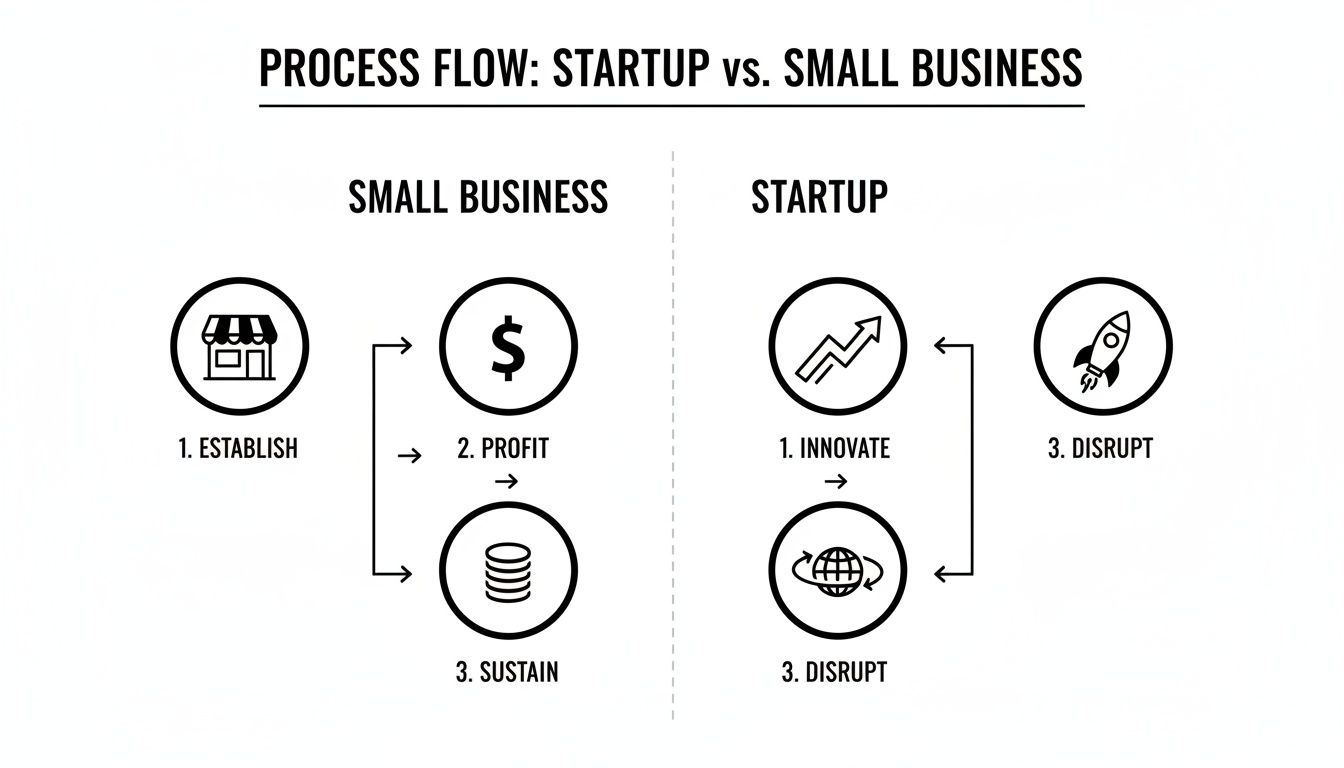
This infographic shows the fundamental difference in goals between a small business and a startup, highlighting the startup’s relentless drive toward massive scale.
As you can see, a small business is built for a direct path to profit. A startup is engineered for a much different journey—one that leads to the final stage: massive growth.
Stage 4: Hitting The Accelerator and Scaling
Scaling is what you earn the right to do after you’ve found product-market fit. This is where you finally pour fuel on the fire. You invest heavily in marketing, sales, and your team to capture the market you’ve already validated. The goal is simple: grow as fast as you can without breaking the company.
In the scaling stage, your activities shift from searching to executing. You're optimizing customer acquisition channels, building out a sales team, and hiring to fill operational gaps. Your metrics become gospel: Customer Acquisition Cost (CAC), Lifetime Value (LTV), and churn rate are now on your daily dashboard. As your company grows, mastering effective Series A startup sales strategies becomes critical to success.
This is the stage where you build a repeatable, predictable engine for growth. It’s the moment a startup transforms from a scrappy team searching for a business model into a structured organization executing on one.
How to Secure Funding For Your Startup
Money is the fuel that gets your startup off the ground, but raising it is a journey all on its own. The classic founder's dilemma is a constant tug-of-war. Do you trade speed for control, or give up a slice of ownership for a massive injection of resources? There’s no single right answer, only the one that aligns with your specific vision and your stomach for risk.
How you get that cash isn’t just a financial decision—it’s a strategic one that will define your company’s culture, its speed, and even its mission. Choose the wrong path, and you could stall out just as fast as if you’d run out of money.
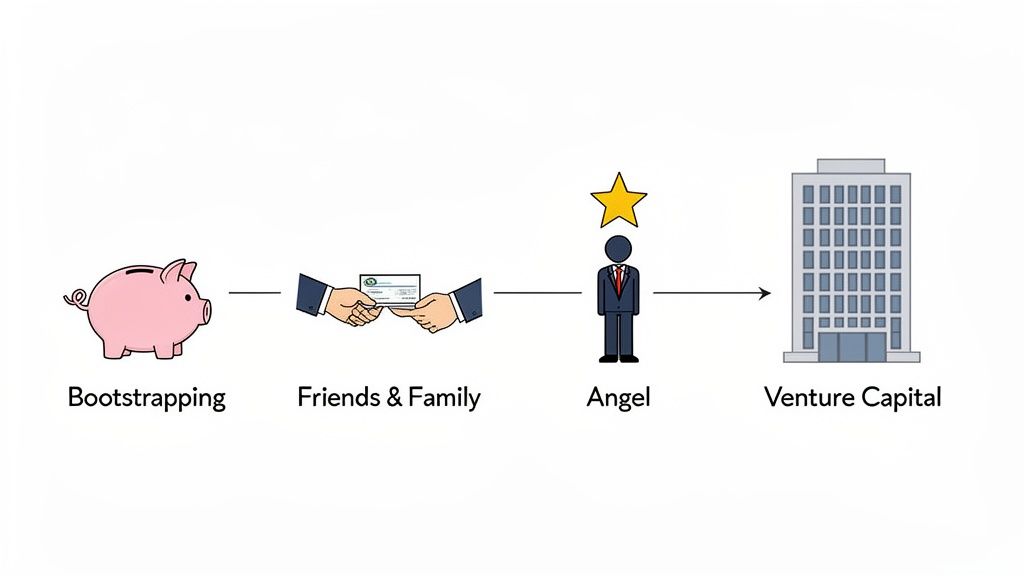
Bootstrapping: The Scrappy Path
Bootstrapping is the art of funding your startup with nothing but your own grit—and your own money. You might use personal savings, revenue from your very first customers, or cash from a side hustle to keep the lights on. It's the ultimate path to independence.
The upside is total control. You answer to no one but your customers and yourself. Every decision is yours to make, and every piece of the company stays in your pocket. This builds a kind of discipline that many funded startups never learn; you have to build something people will actually pay for, and you have to do it fast.
But the trade-off can be brutal. Growth is often slow, painfully constrained by your own cash flow. You might watch a competitor fly past you because you can’t afford to hire the right team or launch a big marketing campaign. Bootstrapping is a high-wire act without a safety net.
Bootstrapping isn't just a funding method; it's a mindset. It forces you to build a resilient, customer-focused business from day one because you have no other choice.
Friends, Family, and (Hopefully Not) Fools
For many founders, the first check comes from the people who already know and trust them. This "Friends & Family" round involves taking small investments from your personal network, and it’s often the first outside cash a startup ever sees.
The main advantage here is trust. These people are betting on you far more than your business plan. The terms are usually founder-friendly, and you can close the round much faster than with formal investors.
But this path is loaded with personal risk. Mixing money and relationships can create a lot of tension if things go south. It's absolutely critical to treat it like a real business transaction—complete with clear documentation—even if the check comes from your parents. Our guide on how to structure a startup company loan can be helpful here.
Angel Investors: The Early Believers
Angel investors are wealthy individuals who invest their own money into early-stage companies, usually in exchange for equity. Many are successful entrepreneurs themselves, so they bring invaluable mentorship and connections along with their capital.
Angels are perfect for startups that have an MVP and some early signs of traction but aren't quite ready for the big leagues of venture capital. They write smaller checks than VCs—typically from $25,000 to $100,000—and are more willing to bet on a brilliant team and a bold idea before all the metrics are perfect. The biggest challenge is just finding the right angel who gets your industry and vision.
Venture Capital: Fuel for Hyperscale
Venture Capital (VC) is institutional money. It comes from a professional fund that invests other people's money into high-growth startups with the potential for enormous returns. When you hear about a startup raising a "Series A," this is what they're talking about.
VCs offer huge checks, an incredible network, and the strategic guidance to help you scale at lightning speed. But this rocket fuel comes with intense expectations. VCs will take board seats, demand a significant chunk of equity, and expect a massive exit (like an IPO or acquisition) within 5-10 years. Taking VC money is a commitment to a high-pressure, grow-at-all-costs path.
The market for VC is hotter than ever, especially for tech. In 2025, venture capital hit a fever pitch, with investors pouring a record $425 billion into over 24,000 private companies worldwide. The real story was AI, which snagged about 50% of all global VC dollars. To even get in the door, you have to nail your pitch and understand exactly what investors are looking for. This guide on how to get venture capital funding breaks down their screening process. You can learn more about these trends in startup investment statistics on RevenueMemo.com.
Modern Alternatives: Crowdfunding and Grants
Finally, a couple of other popular routes have emerged that give founders more options than ever:
Crowdfunding: Platforms like Kickstarter or Indiegogo let you raise money from a large group of people, who often get early access to your product in return. It’s an amazing way to validate market demand and build a loyal community before you even launch.
Grants: Government agencies and private foundations offer non-dilutive funding—meaning you don't give up any equity. This is "free" money, but it's typically reserved for startups tackling specific challenges in areas like scientific research or social impact, and the competition is fierce.
Why Your Startup Ecosystem Matters
Where you decide to build your startup is far more than an address on a business card. It’s a strategic choice that directly impacts your access to talent, funding, and mentorship. Think of it like a gardener choosing a plot of land—the soil quality determines what can actually grow.
A startup ecosystem isn't just a place; it's a dense network of people, resources, and shared ambition. It’s what happens when driven founders, active investors, seasoned mentors, and skilled talent all exist in the same place, creating a powerful flywheel where one success story fuels the next.
What Makes an Ecosystem Thrive
Not all cities are built to support new companies. A thriving ecosystem isn’t just a city with a few tech offices; it's a place with a critical mass of specific ingredients that work together to create a truly supportive environment.
A High Density of Startups: When startups cluster together, it sparks a competitive but collaborative energy. Founders trade notes, employees move between companies spreading knowledge, and a real culture of innovation takes hold.
Active and Accessible Investors: Being close to angel investors and venture capital firms is critical. Investors in these hubs are often more willing to back early-stage ideas because they are deeply connected to the network and can vet opportunities more effectively.
Strong University Ties: Top universities act as a constant pipeline for fresh talent and groundbreaking research. Schools like Stanford in Silicon Valley or MIT in Boston are the bedrock of their ecosystems, spinning out both founders and foundational technologies.
Supportive Policies and Infrastructure: This covers everything from favorable tax laws and government grants to the simple availability of co-working spaces and professional services—like lawyers and accountants—who specialize in startups.
Major Hubs vs. Emerging Cities
Deciding where to build comes with a classic trade-off. Established hubs like Silicon Valley and New York offer incredible access to resources, but they also bring intense competition and sky-high costs for everything from office space to salaries.
An ecosystem's real value is its 'serendipity potential'—the likelihood of a chance encounter with a future co-founder, investor, or key hire. Major hubs maximize this, but you pay a premium for every square foot and every salary.
On the other hand, an emerging city might offer a lower cost of living and less cutthroat competition, giving a bootstrapped startup a much longer runway. The catch? You may find a smaller talent pool and fewer investors who understand your specific industry. The landscape is also shifting fast.
The startup world in 2026 is a story of rapidly evolving ecosystems. The Global Startup Ecosystem Report 2025 shook things up: London fell to #3, Boston surged back into the top five, Paris jumped to #12, and Bengaluru skyrocketed seven spots to #14. This shuffle proves that where you build heavily influences your access to capital, talent, and successful exits. You can dive into the complete analysis and see how top global ecosystems compare on StartupGenome.com.
This constant movement means founders need to look beyond the big names and evaluate locations based on their specific goals. Below is a look at what top ecosystems are best known for, helping you align your startup's needs with the right location.
Top Startup Ecosystems by Key Strengths (2026)
City/Region
Primary Strength
Ideal For Startups In
Silicon Valley, USA
Deep Tech & AI, Venture Capital
AI/ML, SaaS, Hardware, Enterprise Tech
New York City, USA
Finance & Media, Market Access
FinTech, AdTech, Media, E-commerce
London, UK
FinTech & Global Talent
FinTech, RegTech, International Expansion
Boston, USA
Life Sciences & Robotics
BioTech, HealthTech, Robotics, Deep Tech
Tel Aviv, Israel
Cybersecurity & Engineering Talent
Cybersecurity, SaaS, AI, Defense Tech
Bengaluru, India
Tech Talent & Cost Efficiency
B2B SaaS, E-commerce, Mobile Tech
Paris, France
Deep Tech & Government Support
AI, Gaming, Luxury Tech, GreenTech
Singapore
Market Gateway to Asia
FinTech, Logistics, Cross-Border E-commerce
Choosing a hub isn't about picking the #1 ranked city; it's about finding the ecosystem whose strengths give your startup the biggest advantage, whether that's FinTech in London, AI in Silicon Valley, or a rising star that better fits your budget and industry.
Building Your Go-to-Market Strategy
You’ve built a brilliant product. It’s elegant, it solves a real problem, and your first users love it. But a great product is useless if nobody knows it exists.
This is the frustrating wall so many startups hit. It’s the moment your Go-to-Market (GTM) strategy becomes the most important thing you do.
Think of a GTM strategy as your playbook for reaching customers and carving out a competitive advantage. It guides everything from your pricing and marketing channels to the very story you tell. For a new startup, this is where the rubber meets the road. You don’t have an established brand or a massive marketing budget. All you have is your product and your story—and you need to make them work overtime.
Choosing Your Growth Motion
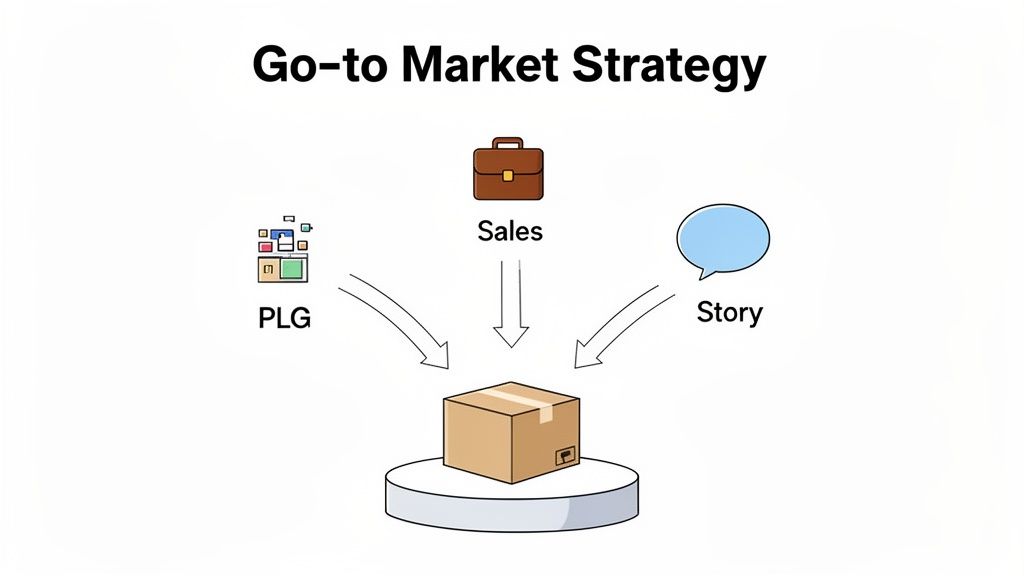
Not all GTM strategies are created equal. The right approach depends entirely on your product, price point, and target customer. Most modern startups follow one of two primary growth motions.
Product-Led Growth (PLG): Here, the product itself is the main engine for customer acquisition. Think of tools like Slack or Figma. Users sign up for a free version, experience its value firsthand, and then upgrade to unlock more features or invite their team. PLG is built for speed and low-friction adoption, making it perfect for products with a broad user base and a self-service model.
Sales-Led Growth (SLG): This is the classic approach for more complex, high-value B2B solutions. If your product requires a long sales cycle, custom implementation, or a major contract, you need a sales team to guide prospects. SLG is all about building relationships, demonstrating deep value, and navigating complex organizations.
Many companies eventually land on a hybrid model, using a PLG motion to attract a wide base of users and an SLG team to convert larger enterprise accounts. The key is to start with the motion that best fits your product’s initial design and your ideal customer.
The Underrated Power of Storytelling
For a new startup, your story is your most powerful marketing asset. You’re not just selling a feature list; you’re selling a new way of working. A compelling narrative helps people understand the problem you solve, why it matters, and why your solution is the only one that makes sense.
This is where many founders get stuck in one of two traps: the DIY Trap of creating content that fails to connect, or the Agency Drain of spending a fortune on high-production fluff that misses the point. Effective storytelling doesn’t need a Hollywood budget. It needs structured clarity.
For a SaaS startup, your product demo video is your 24/7 salesperson. It's often the single most important Go-to-Market asset you can create, responsible for explaining your value proposition when you're not in the room.
A strong GTM strategy relies on clear communication. This is the core of the Forgeclips philosophy of structure. We believe a framework-based approach to video is the smartest path for a growing startup, a middle ground between the DIY Trap and the Agency Drain. It ensures your message is structured for maximum impact, avoiding the common pitfalls that waste time and money. Our approach to product marketing video creation focuses on delivering this clarity at speed.
Key Components of a GTM Strategy
A complete GTM plan integrates several moving parts. Each one has to work in harmony with the others to create a cohesive engine for growth.
1. Market and Customer Definition:
Who is your Ideal Customer Profile (ICP)? Get specific about their industry, company size, and job role.
What are their most urgent pain points? This is the "struggle" you must address immediately.
Where do they look for solutions? Identify the channels where you can actually reach them (e.g., social media, industry forums, search engines).
2. Pricing and Positioning:
How will you price your product? Consider tiered pricing, usage-based models, or flat-rate subscriptions.
What is your unique value proposition? In one sentence, why should a customer choose you over a competitor or just doing nothing?
3. Marketing and Sales Channels:
Which channels will you focus on first? Don’t try to be everywhere at once. Pick one or two, like content marketing or targeted outreach, and master them.
How will your marketing and sales teams work together? Define exactly how leads are generated, qualified, and handed off.
A GTM strategy isn't a static document you create once and then forget. It’s a living plan you must test, measure, and refine as you learn more about your customers and market.
Avoiding The Most Common Startup Pitfalls
The startup world runs on success stories, but the path to get there is paved with failures. Knowing what traps snag even the most brilliant founders is your first line of defense. These aren't just hypotheticals from a business textbook; they're the real-world forces that quietly sink promising companies before they ever get a chance to swim.
The good news? While these mistakes are common, they aren’t mandatory. Learning from the missteps of others is the cheapest tuition you’ll ever pay.
Building A Solution In Search Of A Problem
This is the original sin of startups. A founder gets what feels like a brilliant idea, spends months or even years building it in a vacuum, and then launches to complete silence. The technology might be elegant, but if it doesn't solve a real, nagging problem for a specific group of people, it’s just an expensive hobby.
The antidote is relentless customer discovery.
Talk to potential users before you write a single line of code. Don't ask them if they'd buy your idea. Ask about their current frustrations and what they’ve tried to fix them.
Fall in love with the problem, not your solution. Be completely willing to pivot or even scrap your first idea based on what the market is actually telling you.
Listen for pain, not politeness. If people say your idea is "interesting," that's a huge red flag. You're searching for visceral reactions like, "When can I get this?"
Scaling Before You Find Product-Market Fit
The second you get those first few paying customers, the temptation to hit the accelerator is immense. You hire a sales team, dump money into ads, and start sketching out your global expansion. But if you haven't locked in true Product-Market Fit (PMF), you're just pouring gasoline on a fire that isn't lit. You're spending a fortune to acquire customers who won't stick around.
Premature scaling is like trying to put a roof on a house that has no foundation. It looks like progress from a distance, but the entire structure is unstable and will collapse under its own weight.
Before you even think about scaling, you need cold, hard evidence of PMF. This isn't a gut feeling. It’s a set of signals: low churn, strong organic word-of-mouth, and users who tell you they'd be genuinely lost if your product disappeared. Only scale once you have a proven, repeatable model for acquiring and keeping happy customers.
Ignoring Your First Users
Your earliest customers aren't just revenue—they're your most valuable source of feedback. They're the believers who took a chance on your unproven product. Ignoring their complaints, feature requests, and bug reports is a fatal mistake, especially when you start chasing bigger, shinier accounts.
These early adopters are your free R&D team. They will tell you exactly what’s broken, what’s confusing, and what you need to build next. Cultivate those relationships, build a tight feedback loop, and treat their insights like gold. Their guidance is what will shape your product into something the wider market actually wants, turning your fragile startup company into a resilient business.
Frequently Asked Questions About Startups
Stepping into the startup world often feels like you're learning an entirely new language. The rules, the pace, and the entire mindset are fundamentally different from any other business. We've compiled a few of the most common questions we hear from founders and teams just getting started.
How Is a Startup Different From a Small Business?
The real difference comes down to one thing: intent. A startup is built from the ground up for blistering growth and massive scale. It’s a high-risk, high-reward model designed to capture a huge slice of a market, usually with an innovative idea funded by outside capital. A small business, on the other hand, is designed for sustainable, predictable profit—like a local bakery aiming to be a beloved community staple for decades. One is a rocket ship; the other is a fortress.
What Is a Minimum Viable Product (MVP)?
A Minimum Viable Product (MVP) is the most stripped-down, bare-bones version of your product that actually solves a core problem for a user. The goal is to get real-world feedback with the least amount of time and money spent. Think of it as a quick, focused experiment to test your biggest assumption: Will people actually find this valuable? An MVP is what stands between you and wasting months building something nobody wants.
How Much Money Do I Need to Start a Startup?
There is no magic number. It can be anything from a few thousand dollars for a bootstrapped software tool to millions for a company in biotech or hardware. The better question is, "How much money do I need to hit my next critical milestone?" Your entire focus should be on raising just enough capital to get to that next proof point, whether that’s launching your MVP, finding product-market fit, or hitting a specific user growth target.
Successful founders don't ask for a giant check to last them for years. They raise money in stages. Each round is designed to de-risk the business and prove a new level of traction, which unlocks the next, larger round of capital.
What Does Product-Market Fit Mean?
Product-Market Fit (PMF) is that almost-magical moment when you’ve built something that a well-defined market desperately needs. You feel it when the market starts pulling the product from you, instead of you constantly having to push it onto them. It’s less of a single event and more of a feeling, but it comes with clear signals: organic growth from word-of-mouth, sticky users who build your product into their workflows, and real disappointment if your product were to shut down.
Feeling ready to tell your startup's story but stuck between the DIY trap and the agency drain? Forgeclips replaces slow agencies and messy DIY videos with a structured, framework-based approach. We help SaaS founders create high-performing software demos and promos fast, so you can focus on building your business. Explore our video frameworks and get started today.